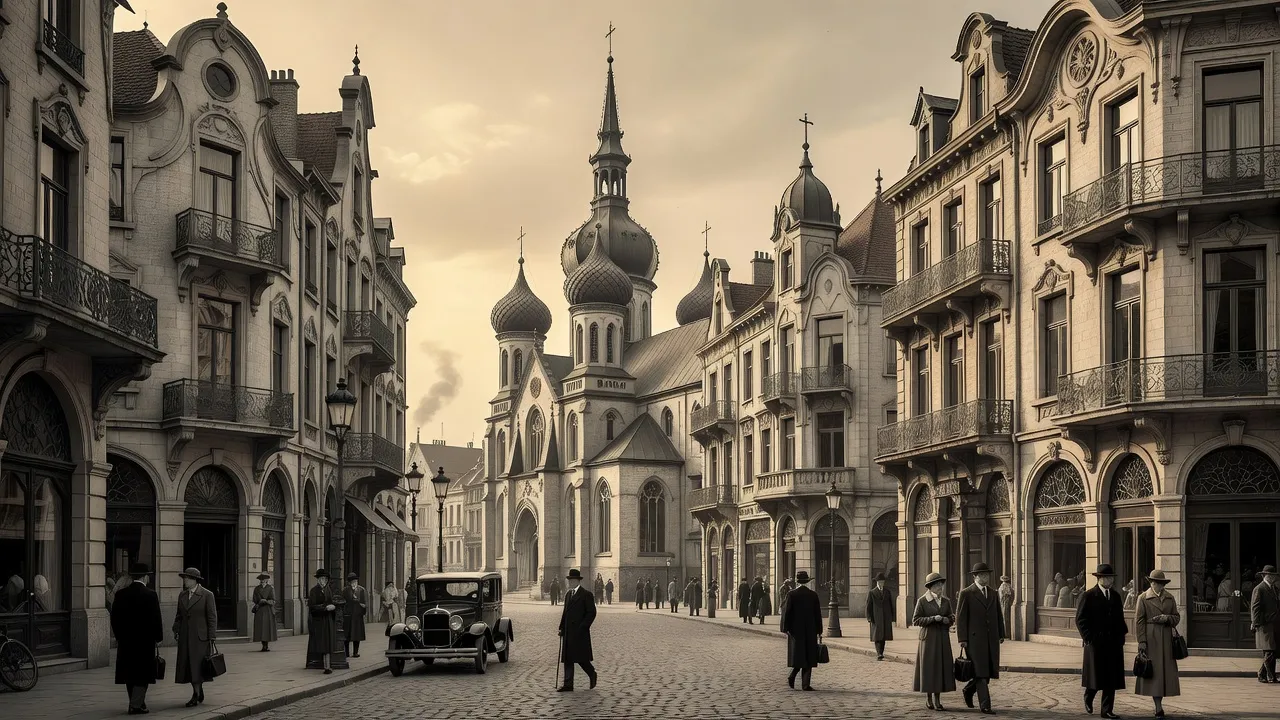
Introduction: Twenty Years in the Archives
Viktor Makarov is a historian at the Université Libre de Bruxelles (ULB), where he has spent twenty years working in Belgian, French, and Russian archives to reconstruct the history of Russian emigration to Belgium. His research spans the White emigration of the 1920s, the complex wartime period, the post-Soviet arrivals, and the contemporary diaspora. We met him at his office in Brussels to discuss this century of Russian presence in Belgium.
The Waves of Russian Immigration to Belgium: A Chronology
- 1920-1921 — The White emigration: officers, aristocrats, professionals, and intellectuals fleeing the Bolshevik victory in the Civil War, arriving via the Balkans and Constantinople
- 1940-1945 — The wartime generation: a community divided between collaboration with German forces and participation in the Belgian resistance
- 1945 — Forced repatriations: enforced by the Yalta Agreement, affecting emigrants classified broadly as “Soviet citizens”
- 1990s-2000s — Post-Soviet economic migration: younger, technically educated arrivals seeking professional opportunity in Western Europe
- Late 1990s-2000s — Political migrants: journalists, human rights activists, and business people fleeing the consolidating Putin system
- Since 2022 — The identity fracture wave: political emigrants alongside Russian-speaking Ukrainians, creating fractures across generations and within families
Interviewer (Marc Lecomte): Professor Makarov, what brought you to study the Russian diaspora in Belgium specifically?
Viktor Makarov: A combination of personal history and archival accident. I came to Brussels from Saint Petersburg in the early 2000s, initially to work in international cultural relations. I started using the archives at ULB for another project and stumbled across a collection of documents — letters, photographs, membership lists — from a Russian student association that had been active at the university in the 1920s. That was it. Twenty years of research.
Belgium is a particularly interesting case for studying Russian emigration because it’s often overlooked in favor of France, which received the most famous émigrés — the writers, composers, philosophers. Belgium received more ordinary people: engineers, military officers, craftsmen, nurses. And Cardinal Mercier’s personal involvement gave the Belgian case a distinctive humanitarian character that I find genuinely moving, having spent so long in the documents.
Interviewer: Let’s start at the beginning. When did Russians first arrive in significant numbers in Belgium, and who were they?
Viktor Makarov: The first significant wave came in 1920 and 1921, immediately following the Bolshevik victory in the Russian Civil War. The evacuation of the White armies — first from Novorossiysk, then from Crimea in November 1920 — set hundreds of thousands of people in motion across Europe. Most went first to the Balkans or Constantinople, and then redistributed across Western Europe over the following years.
Those who came to Belgium were a cross-section of imperial Russian society: military officers, often with technical backgrounds; aristocrats and land-owning families who had lost everything in the revolution; professionals — doctors, engineers, lawyers; and intellectuals, including students and academics. What they shared was the experience of total rupture. These were not people who had chosen to emigrate — they were people who had been expelled from their country by the force of history, often with nothing more than the clothes on their back and whatever documents they’d managed to carry.
The reception in Belgium was mixed, as it was everywhere. There was genuine humanitarian concern, particularly among Catholic institutions, but also economic anxiety about competition for employment and housing. The Russian engineers, in particular, found work relatively quickly in the mining and metallurgical industries of Liège and Wallonia. Others had much more difficult experiences.
Cardinal Mercier and the Humanitarian Reception
Interviewer: You mentioned Cardinal Mercier. What role did he play specifically?
Viktor Makarov: Cardinal Désiré-Joseph Mercier was one of the most significant figures in Belgian public life of that era — renowned for his moral leadership during the German occupation of World War I, deeply respected across religious and political lines. His advocacy for Russian emigrants came from a combination of Christian duty, genuine personal sympathy, and political intelligence.
He was, first of all, a man of considerable personal generosity. I found documentation in the archdiocesan archives that he contributed 20,000 Belgian francs from his personal funds — a substantial sum in 1921 — to a relief fund for Russian emigrants. But more importantly, he used his institutional influence to facilitate the integration of Russian students at the Catholic University of Leuven. He corresponded personally with Russian professors, some of whom found academic positions in Belgium.
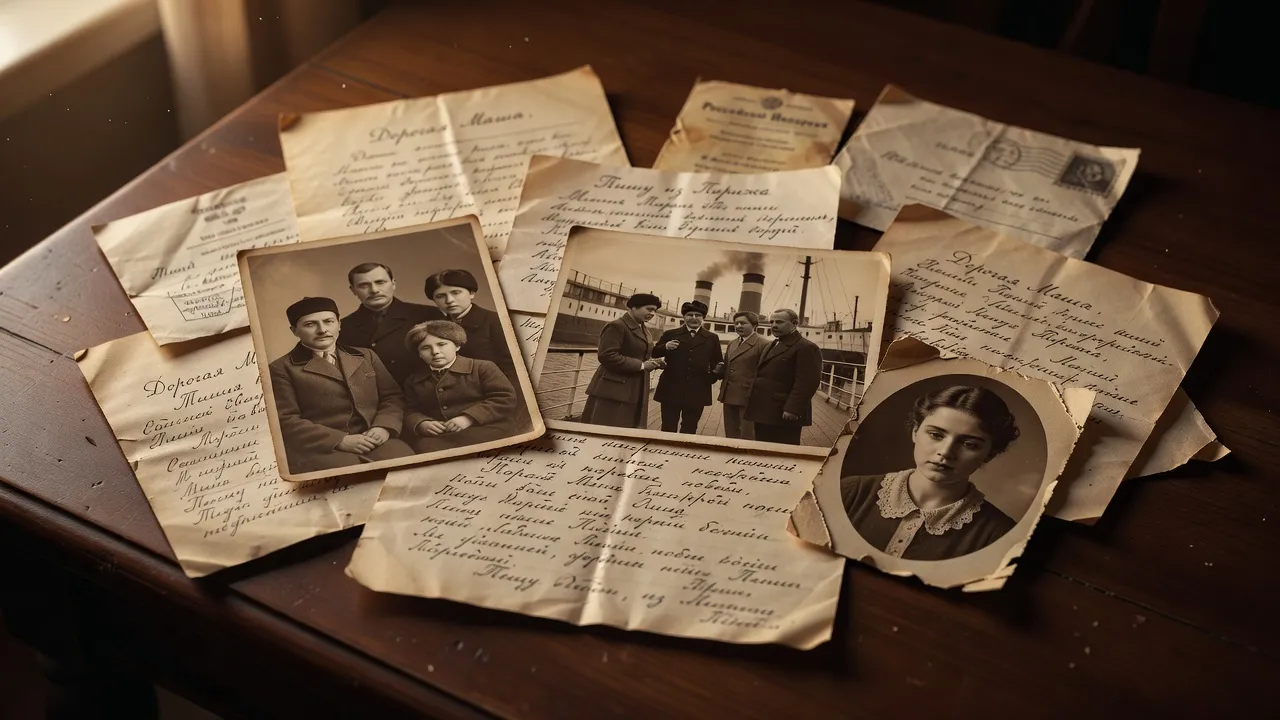
One of the most touching documents in my research is a letter from a young Russian engineering student, written to his mother in 1922, describing his arrival at Leuven. He writes that he expected hostility — “we are nothing, we have nothing, we know no one” — and instead found the university administration had arranged for him to be met, housed temporarily in a seminary guesthouse, and enrolled in his chosen faculty. He attributes this directly to “the intervention of the Cardinal.” The archival record confirms it.
Mercier saw the Russian emigrants not as an administrative problem but as human beings in extremis who carried with them the inheritance of a great civilization. He was not naive about the political situation — he had no sympathy for Bolshevism — but he was able to separate his political views from his humanitarian response. That distinction is not always easy to maintain, and I find his approach admirable.
Did you know? Cardinal Mercier contributed 20,000 Belgian francs of his own money — a substantial sum in 1921 — to a relief fund for Russian emigrants, and personally facilitated the enrollment of Russian students at the Catholic University of Leuven.
For more context on the history of this Russian Diaspora in Europe, Belgium’s experience fits within a broader pattern of reception that varied enormously by country, by the specific wave of emigration, and by the economic conditions of the receiving country.
Interviewer: What happened to this first wave of emigrants in the years after their arrival?
Viktor Makarov: Several things happened simultaneously. Institutionally, the diaspora organized itself with remarkable speed. Within a few years of their arrival, Russian emigrants in Belgium had established churches — including the beautiful Russian Orthodox church in Brussels that still stands today — schools for their children, cultural associations, and mutual aid societies. The sobraniya (assemblies) where emigrants gathered served simultaneously as practical support networks and as spaces for maintaining cultural identity.
Economically, adaptation was uneven but often successful. The engineering and technical professionals integrated most easily; Belgium’s industrial economy had genuine need for their skills. Those with artistic or humanistic backgrounds had harder paths — a former judge from Moscow might find himself working as a taxi driver in Liège. The social demotion was painful, but the diaries and memoirs of this period consistently show a remarkable resilience: people who had lost everything materially managed to preserve an extraordinary richness of interior life.
The question of identity was the most complex. These were people who were certain they would return — most believed the Bolshevik regime would collapse within a few years. When it didn’t, the community had to grapple with the possibility that exile might be permanent. This produced a particular psychological stance that defined the first-wave emigration: living in Belgium physically while remaining Russian in every other dimension. Many families spoke only Russian at home, educated their children in Russian schools, maintained the Orthodox calendar, and oriented their cultural life entirely toward the preservation of what they called “real Russia” — the Russia of before 1917.
World War II: A Community Divided
Interviewer: How did the Russian community in Belgium experience World War II?
Viktor Makarov: This is the most morally complex chapter of the history, and the one that requires the most careful handling. The German occupation of Belgium from 1940 to 1944 put the Russian diaspora in an impossible position. On one side: the German state was at war with the Soviet Union, which had destroyed the world these people came from and continued to imprison or kill their relatives. On the other: the German state was engaged in crimes against humanity on a massive scale.
The response of the Russian emigrant community was deeply divided. A significant number — particularly former military officers who had spent twenty years dreaming of reconquest — saw the German invasion of the Soviet Union as an opportunity. Some volunteered for Russian units fighting under German command, believing they were fighting Bolshevism, not Russia. This is a painful history, and I am committed to presenting it honestly: there were collaborators among Russian emigrants, and the political and moral complexity of their choices does not excuse the choices themselves.
At the same time, and in roughly equal numbers, Russian emigrants in Belgium joined the resistance, hid Jewish neighbors, helped downed Allied pilots, and died in Nazi camps. Father Dimitri Klepinine at the Russian Orthodox mission in Paris — not Belgium, but representative of the broader diaspora — was arrested and died in Dora concentration camp for sheltering Jews. He has since been recognized as a saint by the Russian Orthodox Church.
The community was not a monolith. It was a collection of individuals who made individual choices under extreme pressure, and the range of those choices reflects the full moral spectrum of human behavior under occupation.
The aftermath was also complex. The Yalta Agreement of 1945 required Allied forces to repatriate Soviet citizens — and the definition of “Soviet citizen” was applied broadly enough to affect some people who had left Russia before the Soviet period but were classified as Soviet by the formula applied. Forced repatriations occurred; some people who had lived in Belgium for twenty years were sent back to a country they had left as adults and in which many were immediately arrested. This trauma added another layer to the diaspora’s complicated relationship with the idea of return.
Post-Soviet Waves: 1990s and 2000s
Interviewer: Fast-forward to the post-Soviet period. What changed with the arrivals of the 1990s and 2000s?
Viktor Makarov: Everything changed, and yet something essential remained continuous. The post-Soviet arrivals were demographically very different from the White emigration: younger, often highly educated in technical fields, motivated by economic opportunity rather than political exile — at least in the early period. They came from a Russia that was simultaneously transforming and chaotic, seeking stability and professional advancement in Western Europe.
In Russian History, this period represents one of the most dramatic transformations the country has undergone: the simultaneous collapse of the Soviet system, the reorientation of an entire economy, and the emergence of a new social order in which the old rules no longer applied and the new ones were not yet clear.
For the diaspora in Belgium, this created a fascinating and sometimes difficult encounter. The first-wave emigrants and their descendants had maintained an idealized image of Russia — the Russia of before 1917, which they had preserved in cultural amber for seventy years. The post-Soviet arrivals brought a completely different Russia with them: irreverent, market-oriented, secular, and often startlingly indifferent to the cultural preservation that the older community regarded as sacred.
I have a very clear memory of attending a reception at the Russian Orthodox church in Brussels — I think it was around 2003 — where an elderly woman of the first-wave diaspora was trying to explain to a young Russian professional why he should learn the Church Slavonic liturgy. He looked at her with polite incomprehension: he had grown up in the Soviet period, had never been baptized, and associated Orthodox Christianity with the specific cultural performance of the “old emigration” rather than anything personally meaningful. Two Russias, in the same room, incomprehensible to each other.
Interviewer: Were there also political migrants in this period?
Viktor Makarov: Yes, particularly in the late 1990s and 2000s, as certain features of the Putin system became clearer. Journalists, human rights activists, business people who had crossed the wrong person — these individuals arrived with a very specific relationship to Russia that was neither the nostalgic idealization of the old emigration nor the pragmatic economic migration of the mainstream post-Soviet arrivals. They often had a clearer political consciousness and a stronger motivation to be active in civil society.
The Russian-speaking cultural organizations in Belgium during this period — cultural festivals, Russian-language media, educational initiatives — reflect this diversity. An organization like festival-russe.com that works to maintain Russian cultural presence in the diaspora context is navigating this complexity continuously: how do you create shared cultural space for people who share a language and cultural heritage but have very different political experiences and identities?
The Russian Diaspora in Belgium in 2026
Interviewer: What does the Russian community in Belgium look like today, after the events of recent years?
Viktor Makarov: The community today is estimated at 80,000 to 100,000 Russian-speaking people, though the boundaries are inevitably approximate — they include ethnic Russians, Russian-speaking Ukrainians (whose numbers have increased dramatically since 2022), Russian-speaking people from other post-Soviet states, and people of Russian descent who may or may not speak Russian at home.
What’s new since 2022 is an identity fracture of a type the community has not experienced in its century of Belgian history. The fractures are multiple and run in different directions. There is a fracture between those who have left Russia recently for political reasons and those who are here for economic reasons and maintain stronger ties to Russia. There is a fracture between generations — young people who grew up here or who arrived young, and who identify as Belgian or European far more than as Russian, and older people for whom Russian identity remains central. There is, most painfully, a fracture within families: parents and adult children who have ended up on different sides of political questions and for whom the political has become deeply personal.
Three Generations of the Belgian Russian Diaspora
| Generation | Arrival period | Primary motivation | Relationship to Russia |
|---|---|---|---|
| First wave (White emigration) | 1920-1921 | Political exile after the Civil War | Idealized “real Russia” of before 1917, preserved culturally |
| Post-Soviet wave | 1990s-2000s | Economic opportunity, professional advancement | Pragmatic, market-oriented, often secular |
| Contemporary wave | Since 2022 | Political exile, war, and economic reasons combined | Fractured — grief, renegotiation, and generational divergence |
For the historian, this is not entirely unprecedented. The White emigration also experienced deep political divisions — monarchists versus constitutional democrats versus socialists, Orthodox nationalists versus secular westernizers. The diaspora has always been more politically diverse than either Russians inside Russia or outsiders tended to assume.
What I observe that is different now is the intensity and the personal cost. In the 1920s, the political divisions within the emigration were about the future of a country you’d already lost. Today, the divisions are about events happening in real time to people you may still have family with, in a country you may have left only months ago. The psychological stakes are much higher.
Interviewer: Is there anything that maintains cohesion across these divisions?
Viktor Makarov: The Russian language remains the single most powerful cohesive force. Whatever their political views, whatever their generation, whatever their relationship to the Russian state, people gather around the language. Russian-language cultural events, theater performances, readings, book clubs — these continue to draw mixed audiences.
The cultural heritage more broadly — the literature, the music, the visual arts — also serves as common ground. I have attended events where people with completely incompatible political views found themselves moved by the same poem, the same folk song, the same image of a Russian winter landscape. The culture precedes and outlasts the politics, and most diaspora members understand this intuitively even when the politics are most acutely painful.
Key takeaway: Despite fractures along generational and political lines, three forces continue to hold the Belgian Russian diaspora together: the Russian language itself, shared cultural heritage in literature and the arts, and the continuity of the Orthodox liturgical calendar.
The Orthodox Church, for those who participate in it, provides another structure of continuity. The liturgical calendar — the same calendar followed since the Kievan Rus, as explored in our discussion of Russian Orthodox Holidays — maintains a rhythm of life that connects the contemporary diaspora to a tradition stretching back ten centuries. For many people, this continuity is not primarily theological but cultural: it is how they locate themselves in time, how they mark the seasons, how they observe the memory of the dead.
Interviewer: What has twenty years of studying this community taught you personally?
Viktor Makarov: That history is not a single story but a collection of individual stories that only sometimes cohere into a narrative. That people are more complicated and more resilient than categories — “emigrant,” “diaspora,” “Russian” — can capture. That documents in archives are the traces of human beings who were once fully alive, and that the obligation of the historian is to restore some of that fullness.
And that Belgium, this small country between its larger neighbors, has been a remarkable crossroads for people displaced by the largest catastrophes of the twentieth century. The Russian emigrants who came here in 1920 built lives, raised children, and left traces that I am still finding in the archives a century later. The people arriving today will do the same. That continuity, even through rupture, is what history is.
Interviewer: Professor Makarov, thank you.
Viktor Makarov: Thank you. These conversations matter — not just for scholarship, but for the people whose lives the scholarship is about.
Frequently Asked Questions
The first significant wave of Russian emigration to Belgium arrived in 1920-1921, following the Bolshevik victory in the Russian Civil War. These were predominantly officers, aristocrats, intellectuals, and professionals of the former Imperial Russia — the 'White emigration.' Cardinal Mercier of Belgium played a crucial humanitarian role, personally contributing 20,000 Belgian francs and welcoming Russian students at Belgian universities.
During WWII, the Russian diaspora in Belgium was deeply divided. Some members of the first-wave emigration supported German forces as a means to overthrow the Soviet regime, while others joined the Belgian resistance or sheltered Jewish neighbors. The Yalta Agreement of 1945 required the forced repatriation of Soviet citizens, which affected some members of the second-wave diaspora who had arrived after the war began.
Estimates suggest between 80,000 and 100,000 Russian-speaking people in Belgium today, representing three distinct generations: descendants of the White emigration, post-Soviet arrivals of the 1990s and 2000s, and more recent migrants. These groups are not homogeneous — they differ significantly in language, identity, religion, and political views.
Cardinal Désiré-Joseph Mercier, Archbishop of Mechelen and one of the most prominent Catholic leaders in Europe, personally advocated for Russian emigrants arriving in Belgium after 1920. He contributed 20,000 Belgian francs from his personal funds to assist them and used his institutional influence to facilitate the enrollment of Russian students at the Catholic University of Leuven.
The post-2022 period has created a significant identity fracture within the Russian diaspora. Long-established communities find themselves navigating between their cultural heritage and the political situation in Russia, while more recent arrivals include both those who fled the political situation and those who left for economic or personal reasons. The diaspora is more diverse and more divided than at any point in the past century.