The Two Calendars: Julian vs. Gregorian
To understand Russian Orthodox holidays, you must first understand the calendar question — the source of considerable confusion for Western visitors to Russia or observers of Russian cultural life.
The Russian Orthodox Church uses the Julian calendar, established by Julius Caesar in 46 BCE and used throughout the Christian world until the Gregorian calendar reform of 1582. Pope Gregory XIII’s reform corrected an accumulated drift in the solar calendar by eliminating 10 days and adjusting the leap-year rules. Catholic and Protestant countries gradually adopted the Gregorian calendar over the following centuries. Russia officially adopted the Gregorian calendar for civil purposes after the 1917 revolution.
The Russian Orthodox Church, however, has retained the Julian calendar for its liturgical year. As of the twenty-first century, the Julian calendar runs 13 days behind the Gregorian. This means that what is December 25 in the calendar system that most of the world uses corresponds to January 7 in the Julian calendar. Hence, Russian Orthodox Christmas is on January 7 (Gregorian).
The calendar difference creates an interesting phenomenon: Russia’s major religious holidays fall on dates that do not align with Western Christian equivalents. Christmas on January 7, when the Western holiday season has concluded. New Year (January 1) and Old New Year (January 14) — the new year as observed on the Julian calendar. And Orthodox Easter, calculated by a formula that combines the Julian calendar with the requirement that it fall after Jewish Passover, typically landing 1-5 weeks later than Western Easter.
This calendar situation interacts with Russian History in fascinating ways. The 1917 revolution — which the Bolsheviks called the “October Revolution” — actually occurred in November by the Gregorian calendar, which Russia adopted for civil purposes immediately after coming to power.
For foreign visitors, the practical consequence is simple: Russia celebrates holidays on what appear to be the “wrong” dates, and the Christmas-to-New Year period that defines the Western holiday season begins in Russia only with the Orthodox Christmas on January 7 — creating an extended festive season from December 31 through January 14 that Russians call the “New Year’s holidays.”
Key takeaway: Two calendars, two Christmases, two New Years. The Julian/Gregorian 13-day gap is the single fact that explains nearly every apparent date “anomaly” in the Russian Orthodox calendar — memorize it, and the rest of the calendar becomes logical rather than confusing.
The table below summarizes the main date shifts caused by the Julian calendar:
| Western Gregorian date | Corresponding Julian-calendar Russian observance | Gregorian date of the observance |
|---|---|---|
| December 25 | Catholic/Protestant Christmas | December 25 |
| January 1 | Civil New Year (secular) | January 1 |
| December 25 (Julian) | Russian Orthodox Christmas | January 7 |
| January 1 (Julian) | Old New Year | January 14 |
| June 24 (Julian) | Ivan Kupala | July 7 |
| October 1 (Julian) | Pokrov | October 14 |
Rozhdеstvo — Russian Orthodox Christmas
Rozhdеstvo Khristovo (Рождество Христово) — the Nativity of Christ — falls on January 7 by the Gregorian calendar and is celebrated with a mixture of ancient liturgical solemnity and folk customs that predate Christianity in Russia.
The Eve: Sochelnik
The evening before Christmas (January 6) is called Sochelnik (Сочельник), derived from sochivo — a porridge of grain and honey that is the traditional food of the vigil. Orthodox tradition prescribes a strict fast throughout Sochelnik, with the fast broken only after the first star appears in the evening sky — a reference to the Star of Bethlehem.
The traditional Sochelnik meal, once the fast is broken, consists of twelve Lenten dishes (twelve for the twelve apostles, Lenten because the Christmas fast officially continues until the star appears). The number twelve is consistent even if the specific dishes vary by region, and typically includes:
- Sochivo itself — grain with honey and nuts, the dish that gives the evening its name.
- Borscht without meat.
- Stuffed cabbage with buckwheat.
- Fish dishes.
- Mushroom pierogies.
- Assorted vegetable dishes rounding out the twelve-dish tradition.
The Liturgy
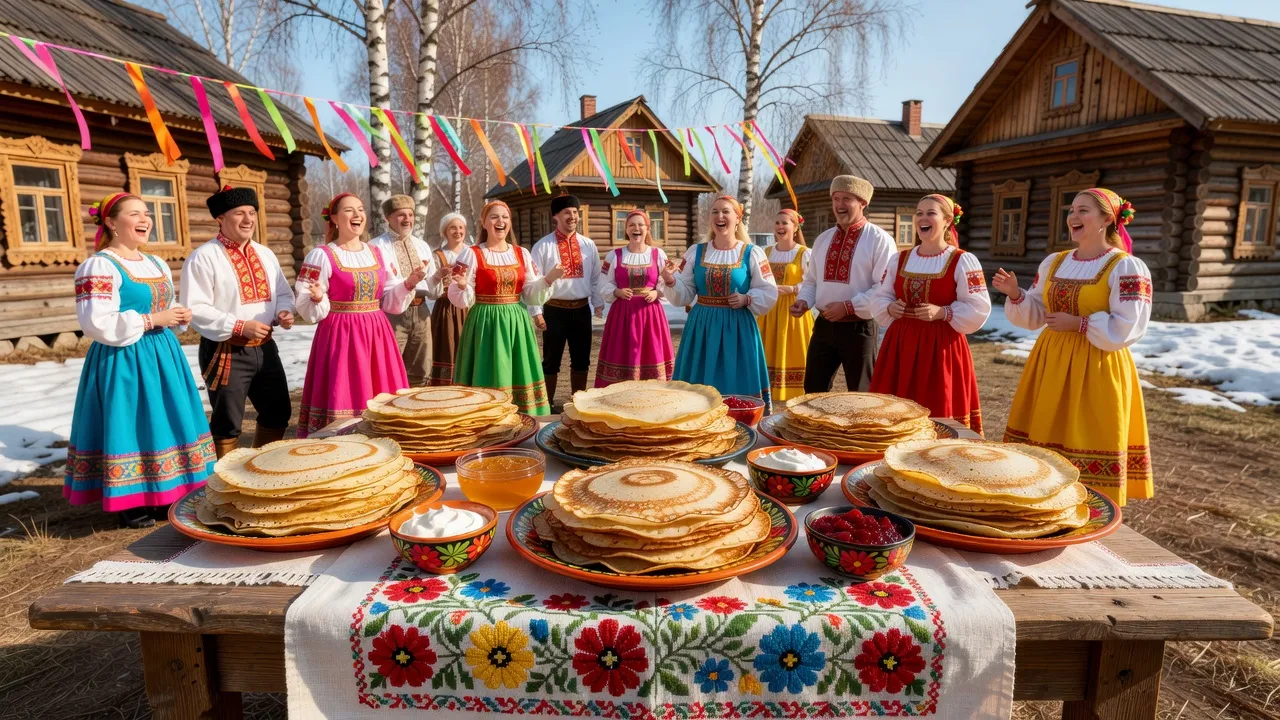
The Christmas Eve liturgy (Vsyenoshchnoe Bdeniye — the All-Night Vigil) begins at midnight or in the late evening of January 6. Russian Orthodox Christmas services are among the most visually and musically extraordinary experiences available in Russian religious culture: the darkened church, the hundreds of candles, the complex multi-voice choral liturgy of the Orthodox tradition, the procession of the clergy in gold vestments. For Orthodox Spirituality, this is one of the liturgical year’s peak moments.
Folk Customs: Kolyada and the Carolers
The twelve days between Christmas and Epiphany (Theophany, January 19) are called Svyatki (Святки) — holy days — and marked by folk customs that predate Christianity in Russia. The most famous is kolyada: groups of young people dressed in costumes (including folk characters like bears, goats, old men, and witches) go from house to house singing traditional songs (kolyadki) and receiving treats in return. The kolyada tradition almost exactly parallels Western Halloween trick-or-treat or the English wassailing tradition, reflecting the common Indo-European winter solstice roots of these customs.
Svyatki are also associated with divination (gadalye), particularly for unmarried young women predicting their future marriages. Pouring melted wax or lead into water, reading the shadows it casts, or interpreting the barking direction of dogs are among the traditional methods — practices that the Orthodox Church officially frowns upon but has never fully suppressed.
Did you know? The kolyada custom of costumed carolers going house to house closely parallels Western Halloween trick-or-treating and English wassailing — a reminder that many winter customs across Europe share the same pre-Christian, Indo-European solstice roots, later layered over with Christian meaning.
Paskha — Russian Orthodox Easter
If Christmas is the most visually spectacular Russian Orthodox holiday, Paskha (Пасха, Easter) is unquestionably the most theologically and culturally significant. In the Orthodox tradition, Easter is called the “Feast of Feasts” (Prazdnik prazdnikov) — the celebration of Christ’s Resurrection that gives all other holidays their meaning. The entire liturgical year in Orthodox Christianity is organized around Paskha as its center.
Great Lent: The Road to Paskha
Paskha is preceded by Velikiy Post (Great Lent) — a forty-day period of fasting, prayer, and spiritual preparation. Orthodox fasting is more rigorous than Western Lenten observance: traditionally, it excludes not just meat but also dairy, eggs, fish (allowed on some days), and oil. Observance today ranges from the fully traditional (monasteries) to nominal (many secular Russians who simply eat fewer heavy foods). But even for non-religious Russians, Great Lent has cultural weight: the period is associated with a change in seasonal mood, a quiet before the explosive joy of Easter.
The week immediately preceding Easter is Holy Week (Strastnaya Nedelya — Passion Week), the most intense period of the liturgical year. The services of Holy Thursday, Holy Friday, and Holy Saturday are among the longest and most complex in the Orthodox calendar, with readings, prostrations, and music that have remained essentially unchanged for over a millennium.
The Midnight Liturgy
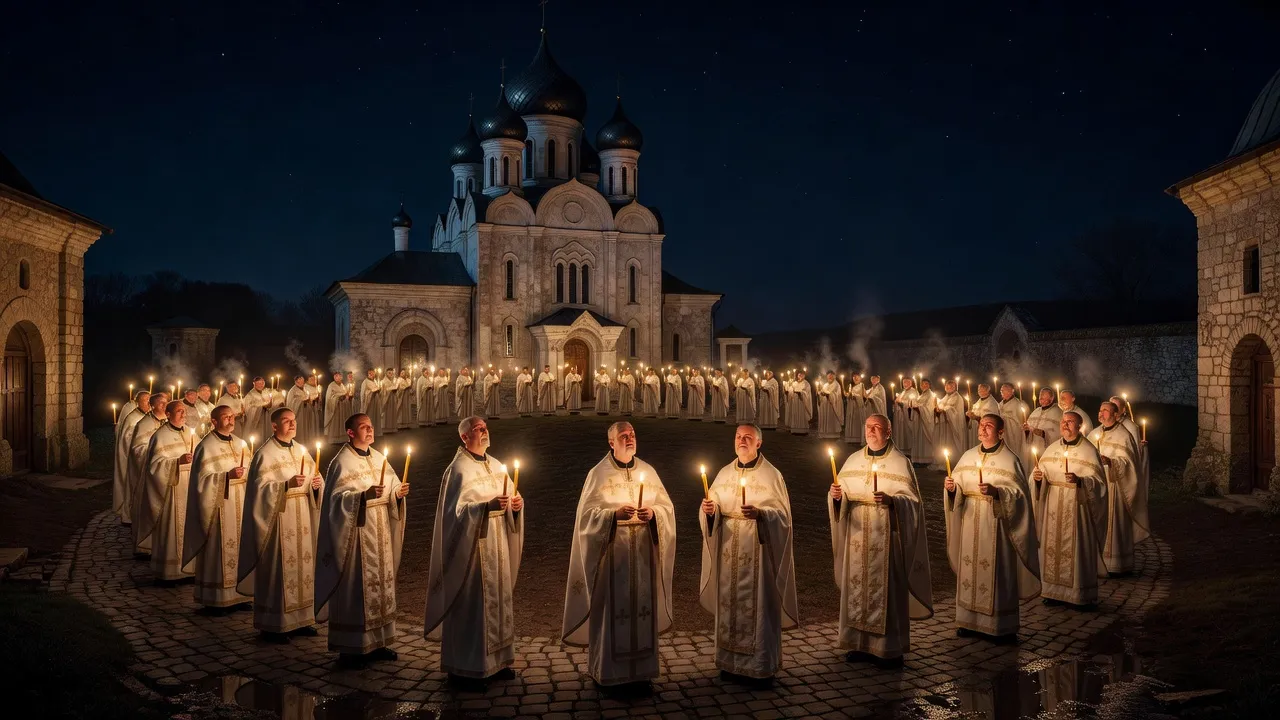
The Easter liturgy begins at midnight — or as close to midnight as the local church can manage — with one of the most dramatic moments in religious practice anywhere in the world. The church is completely darkened. The priest lights a candle at the altar and passes the light to those nearest, who pass it to their neighbors, until the entire darkened interior blazes with hundreds of individual flames. This ceremony, called the Krestokhod (procession around the church) or simply the Easter procession, then moves outside the church — the congregation circling the building three times while singing the Easter hymn Khristos Voskrese (Christ is Risen).
At the completion of the procession, the doors of the church open and the priest proclaims: “Khristos Voskrese!” (Христос Воскресе! — Christ is Risen!). The congregation responds: “Voistinu Voskrese!” (Воистину Воскресе! — Truly He is Risen!). This exchange is repeated throughout the Easter season — Russians greet each other with it throughout Bright Week (the week after Easter) and for forty days until Ascension.
Easter Foods
The blessing of Easter foods on Holy Saturday is another central custom. The traditional Easter basket (paskhalny korzinochka) contains:
| Easter food | Composition | Symbolism |
|---|---|---|
| Kulich (кулич) | Tall, cylindrical yeasted sweet bread with white icing and sprinkles | Dome shape represents Orthodox church rooftops |
| Paskha (пасха) | Molded dessert of tvorog, butter, eggs, sugar, dried fruits | Truncated pyramid shape represents the Holy Sepulchre; sensory celebration of Lent’s end |
| Krashenye yaitsa (painted eggs) | Hard-boiled eggs, traditionally dyed red | Red represents the blood of Christ and the joy of the Resurrection |
Kulich (кулич) — a tall, cylindrical yeasted sweet bread decorated with white icing and colorful sprinkles. Kulich is the Easter bread par excellence in Russian tradition; bakeries and home cooks alike produce it in the days before Easter, and the competition for the best kulich is taken seriously. The tall dome shape is said to represent the domed rooftops of Orthodox churches.
Paskha (пасха, same word as Easter) — a molded dessert made from fresh cottage cheese (tvorog), butter, eggs, sugar, and dried fruits. Traditionally pressed into a wooden mold in a truncated pyramid shape representing the Holy Sepulchre, with XB (Khristos Voskrese) impressed on the sides. The richness of paskha is deliberate: after forty days of Lenten fasting, a concentrated, sweet, fatty cheese dessert is a sensory celebration of the fast’s end.
Krashenye yaitsa (painted eggs) — hard-boiled eggs dyed red (traditionally) or in various colors. Red eggs represent the blood of Christ and the joy of the Resurrection. The custom of painting Easter eggs long predates Christianity in Russia and was incorporated into Christian symbolism. The egg-tapping game (bitkis) — two players tap their eggs together, and the one whose egg remains uncracked wins — is played throughout Bright Week.
Maslenitsa — Pancake Week
Maslenitsa (Масленица — Butter Week or Pancake Week) is the week immediately before Great Lent — a week of festivity, feasting, and farewell to the richness of the pre-Lenten world. In 2026, Maslenitsa falls in the first week of March (the exact date varies by year).
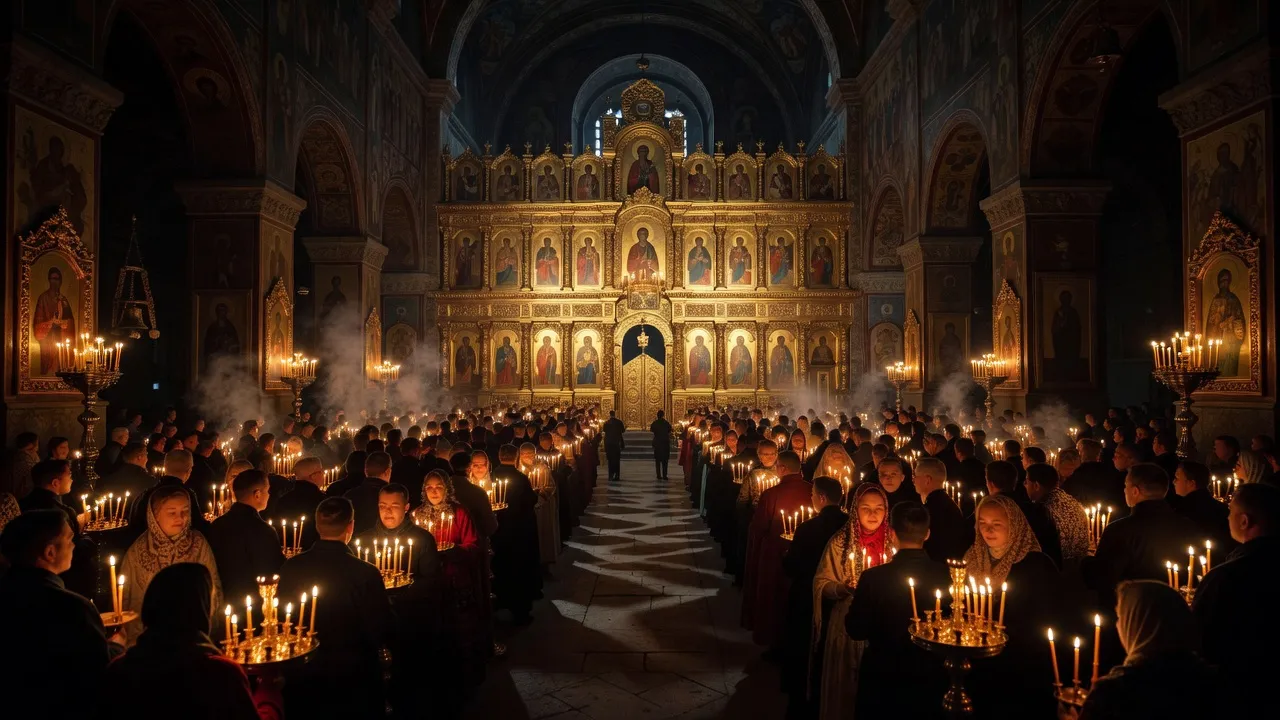
The central food of Maslenitsa is the blin (plural: blini) — the thin Russian pancake, the equivalent of the French crêpe. During Maslenitsa, blini are eaten in quantities that boggle non-Russian minds, with toppings ranging from sour cream and butter to salmon, caviar, jam, and honey. The traditional saying is that a proper Russian should “eat blini until you can’t stand up.” The round, golden blin itself is a solar symbol — a representation of the spring sun returning after the long winter.
Each day of Maslenitsa week has its traditional name and program:
- Monday (Vstrecha — Meeting): The effigy of Maslenitsa (a straw woman representing winter) is built and set up in the town square or village common.
- Tuesday (Zaigrysh — Revelry): The festivities begin in earnest: sledding, snowball fights, troika rides.
- Wednesday (Lakomka — Indulgence): Mothers-in-law traditionally invite sons-in-law for a meal — a day for in-law diplomacy and blini.
- Thursday (Razgulyay — Wide Thursday): The main day of celebration, with the most intense public festivities, fistfights between village teams (kulachny boy), and communal feasting.
- Friday (Tioshchiny Vecherini — Mother-in-Law Evenings): Sons-in-law now host their mothers-in-law.
- Saturday (Zolovsky Posidelki — Sister-in-Law Gatherings): Young women visit their husband’s sisters.
- Sunday (Proshcheny Voskresenye — Forgiveness Sunday): The final day of Maslenitsa, on which Russians ask forgiveness from each other for any wrongs done during the year. The effigy of Maslenitsa is burned — winter is symbolically destroyed, and spring is welcomed.
The thermal baths (banya) tradition is particularly associated with Maslenitsa: the intense heat of the banya represents a purification before Lent. For an understanding of how the banya fits within Russian cultural life, bainsrusses.fr provides a detailed cultural exploration of this central Russian institution.
Ivan Kupala, Troitsa, and Other Seasonal Feasts
The Russian Orthodox liturgical calendar contains twelve Great Feasts (Dvenadtsat Prazdnikov) plus Easter, which stands above all others. Several deserve special attention for their cultural significance.
Troitsa / Pentecost (Троица) falls fifty days after Easter and commemorates the descent of the Holy Spirit on the Apostles. In Russian folk tradition, Troitsa is closely associated with the arrival of summer and is celebrated with birch branches: churches and homes are decorated with fresh birch, symbolizing new life. The week of Troitsa (Semik) was traditionally associated with forest spirits called rusalki — the spirits of young women who died before marriage — who were believed to emerge from rivers and lakes during this period. Protective rituals involving birch and flowers were performed to ward off their mischief.
Ivan Kupala (Иван Купала, John the Baptist’s Day) falls on July 7 by the Gregorian calendar (June 24 Julian) and represents the most vivid fusion of Christian and pre-Christian Slavic tradition in the annual calendar. The night of Ivan Kupala is the Russian equivalent of Midsummer: bonfires are lit, young people jump over the flames (those who jump highest or together as couples will have the best fortune), girls weave flower crowns and send them downstream to predict their marriages, and the folk belief holds that on this one night, the fern flowers bloom — and whoever finds the flower will discover hidden treasure.
The legend of the fern flower — a plant that botanically does not flower — is a particularly beautiful example of how Russian folk tradition inhabits the boundary between the natural and supernatural. The night of Ivan Kupala is when that boundary is thinnest.
Pokrov (Покров — the Protection of the Theotokos, October 14 Gregorian) commemorates a vision of the Virgin Mary extending her veil over Constantinople in protection. In Russia, Pokrov marks the transition to autumn: folk wisdom says “after Pokrov, the fields rest.” It is one of the most popular feasts in Russian folk piety, associated with the protection of the home and family. The date also marked the beginning of the agricultural off-season — a time for weddings, fairs, and the preparation of stored goods for winter.
The connection between these seasonal celebrations and Russian Traditions more broadly is profound: the Orthodox calendar did not replace the pre-Christian seasonal cycle but absorbed and transformed it, creating the rich palimpsest of customs that characterizes Russian folk religious life. Understanding this layering — Christian theology inscribed over Slavic seasonal observance — is essential for anyone seeking to understand the deep structure of Russian culture.
For readers interested in how the Orthodox tradition expresses itself visually, the article on Russian Orthodox Icons and Byzantine Art explores the sacred art that forms the visual environment of all these celebrations. The interview on Russian character by Dr. Sokolova also touches on how these holidays function as identity anchors, particularly for diaspora communities that maintain them far from Russia’s geography.
Frequently Asked Questions
The Russian Orthodox Church uses the Julian calendar, which runs 13 days behind the Gregorian (Western) calendar. What is December 25 in the Gregorian calendar corresponds to January 7 in the Julian calendar. Most Western Christian churches celebrate Christmas on December 25 Gregorian; the Russian Orthodox Church celebrates it on December 25 Julian, which falls on January 7 Gregorian.
Yes. Orthodox Easter (Paskha) is calculated using the Julian calendar and additional rules that ensure it falls after Jewish Passover. As a result, Orthodox Easter usually falls 1-5 weeks later than Western Easter, though they occasionally coincide. In 2026, Orthodox Easter falls on April 19. Paskha is the most important feast of the Russian Orthodox year, far exceeding Christmas in liturgical significance.
Maslenitsa (Масленица) is Pancake Week — the week immediately preceding Great Lent. Russians eat blini (thin pancakes) abundantly throughout the week, and each day has its traditional program of activities: Monday for meeting, Tuesday for revelry, Wednesday for feasting, Thursday for the main celebration, Friday for mother-in-law visits, Saturday for sister-in-law visits, and Sunday for Forgiveness Sunday and the burning of the Maslenitsa effigy.
Paskha (Easter) is the pinnacle of the Russian Orthodox liturgical year. The midnight procession (krestny khod) around the church with candles, the triumphant proclamation 'Khristos Voskrese!' (Christ is Risen!) and response 'Voistinu Voskrese!' (Truly He is Risen!), the blessing of traditional Easter foods (kulich bread and paskha cheese dessert), and the exchange of Easter eggs (traditionally painted red) are the central customs.
Russia maintains two parallel holiday systems: Orthodox religious holidays (Rozhdеstvo, Paskha, Maslenitsa, Pokrov, etc.) and secular state holidays (New Year January 1, Victory Day May 9, Russia Day June 12, National Unity Day November 4). Some secular holidays were created to replace Orthodox ones during the Soviet period; since 1991, both systems coexist with some overlap and tension.