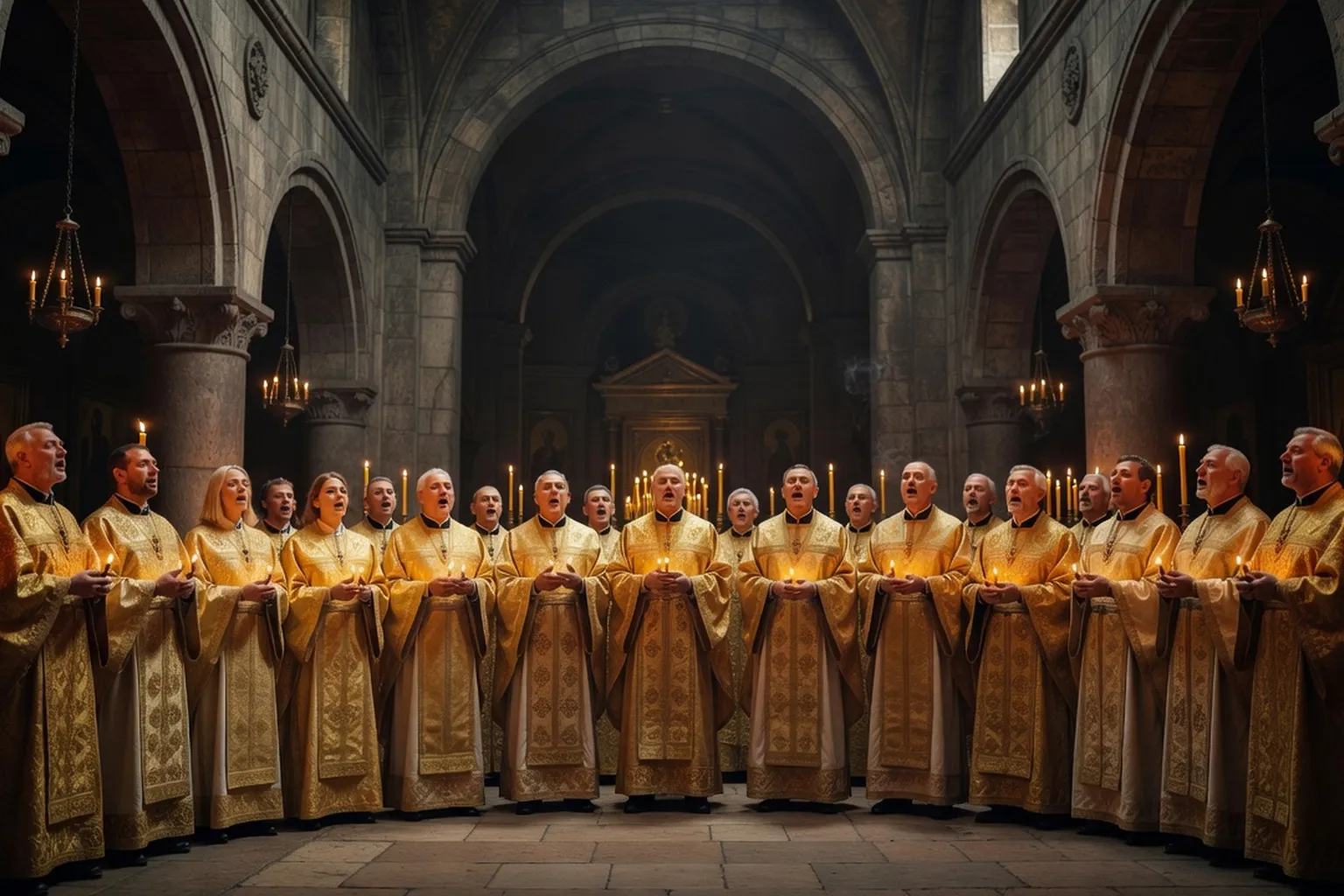
The Byzantine Roots: Znamenny Chant and Orthodox Polyphony
Russian music is inseparable from the sacred. When Prince Vladimir of Kiev baptised his people in the Dnieper River in 988, he also imported the Byzantine musical tradition — a monophonic, modal, profoundly spiritual form of chant that would shape all subsequent Russian musical development. This is Znamenny chant (znamenny raspev), named after the znamyona (signs or neumes) used to notate it. For nearly seven centuries, Znamenny chant was the sole musical voice of Russian Orthodoxy, its austere beauty filling stone churches from Novgorod to Pskov to Kiev.
Key takeaway: For nearly seven centuries, Znamenny chant was the sole musical voice of Russian Orthodoxy — monophonic, unaccompanied by any instrument, and built around the extraordinary basso profondo voice that remains a hallmark of Russian choral singing today.
Unlike Gregorian chant in the West, Znamenny chant remained monophonic for centuries, relying on the sheer depth and richness of massed male voices rather than harmonic complexity. The tradition cultivated the extraordinary bass voices for which Russian choral singing is still celebrated: the basso profondo, capable of descending to registers below the standard bass range, gives Russian liturgical music its characteristic subterranean resonance. Visitors to Russian Orthodox services are often overwhelmed by this sonic phenomenon — a sound seemingly rising from the very earth rather than from human lungs.
Polyphony arrived in Russia from Western and Ukrainian sources in the 17th century, initially controversial but ultimately embraced. The Ukrainian composer Dmitry Bortnyansky, trained in Italy, became director of the Imperial Court Chapel and composed polyphonic settings of Orthodox liturgical texts that blended Western technique with Russian spirituality. His influence on subsequent Russian sacred music was enormous and long-lasting.
Orthodox spirituality and music are inseparable in Russia: the Divine Liturgy is sung throughout, with no organ accompaniment — only human voices. This aesthetic choice, maintained from Byzantine origins, gives the Russian choral tradition its unique character. The greatest Russian choir conductors have always understood that they were not merely musicians but custodians of a spiritual practice.
The Russian National School: From Glinka to The Mighty Five
The founding act of Russian classical music is usually dated to 1836, when Mikhail Glinka’s opera A Life for the Tsar (Zhizn za Tsarya) premiered at the Imperial Bolshoi Theatre in Saint Petersburg. Glinka was the first composer to achieve an unmistakably Russian sound within the framework of European operatic form. He drew on folk melodies, incorporated modal harmonies from Orthodox chant, and depicted Russian historical subjects with unprecedented authenticity. His successor opera Ruslan and Lyudmila (1842), based on Pushkin, introduced the orientalist idiom that would become a recurring element of Russian musical exoticism.
The movement known as The Mighty Five (Moguchaya Kuchka), or sometimes The Five, carried Glinka’s nationalist project forward with greater radicalism, explicitly rejecting German academic training in favour of Russian and oriental folk sources.
| Composer | Signature work | Legacy |
|---|---|---|
| Mily Balakirev | Leader and mentor of the group | Founded the nationalist aesthetic |
| César Cui | Critical writings and operas | Group’s principal music critic |
| Alexander Borodin | Prince Igor, Polovtsian Dances | Fused folk melody with orchestral grandeur |
| Nikolai Rimsky-Korsakov | Orchestration treatise | Standard reference for generations of composers |
| Modest Mussorgsky | Boris Godunov | Psychological realism through unresolved harmony |
Russian traditions deeply permeated this music: folk songs collected by ethnomusicologists in the mid-19th century provided raw melodic material that Rimsky-Korsakov in particular transformed into sophisticated orchestral textures. His orchestration treatise became the standard reference for generations of composers worldwide.
Pyotr Ilyich Tchaikovsky occupies a complex position in this landscape. More cosmopolitan than The Five, trained in the German tradition at the Saint Petersburg Conservatory under Anton Rubinstein, he was nonetheless profoundly Russian in his emotional expressivity and melodic gifts. His ballets — Swan Lake, The Sleeping Beauty, The Nutcracker — are the most performed works in the classical repertoire worldwide, familiar even to those who have never attended a classical concert. His symphonies, particularly the Sixth (Pathétique, 1893), attain a tragic depth that transcends national boundaries.
Russian Choirs in Western Europe: The Don Cossack Tradition
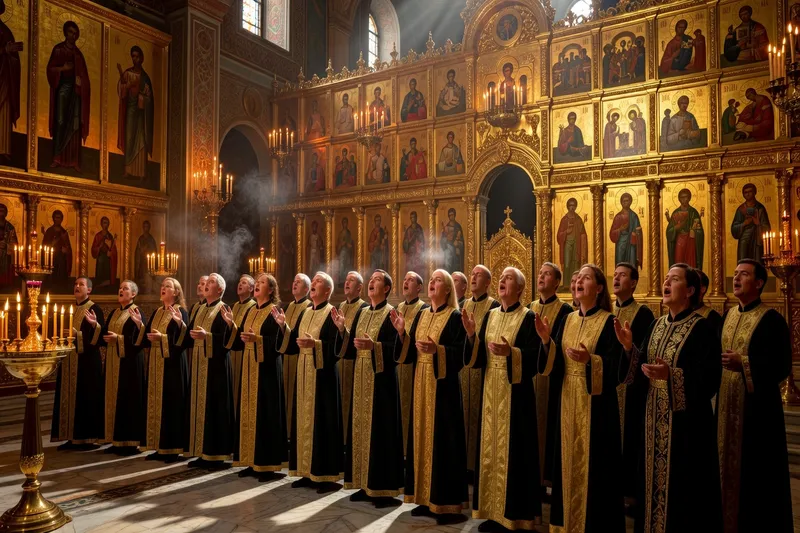
The great Russian choral tradition reached Western audiences primarily through the emigration that followed the 1917 Revolution. The Russian diaspora in Europe carried with them an extraordinary musical heritage, and choral singing became one of the most visible expressions of émigré cultural identity. The Don Cossack Choir (Donskie Kazaki), founded by Serge Jaroff in a prisoner-of-war camp in Bulgaria in 1921 with fifteen singers, became the most famous Russian ensemble in the world, touring Europe and America for decades and introducing Western audiences to the full spectrum of Russian choral music.
The Don Cossacks’ repertoire moved fluidly between Orthodox liturgical music, Cossack folk songs, military marches and popular romances. Their ability to modulate from shattering fortissimo to barely audible pianissimo, and the extraordinary depth of their bass voices, consistently astonished Western listeners. They performed for kings and presidents, sold out concert halls from Carnegie Hall to the Royal Albert Hall, and recorded extensively, leaving a sonic legacy that continues to inspire.
Paris became the capital of Russian musical exile. The Russian Musical Society, the Russian Conservatory, and dozens of smaller ensembles flourished in the 1920s and 1930s, supported by the large émigré community. Composers like Sergei Rachmaninoff, Alexander Scriabin (before his early death in 1915) and Sergei Prokofiev (who eventually returned to the USSR) all spent significant periods in Western Europe, contributing to the cultural exchange between Russian and French musical traditions.
Today, festival-russe.com documents and promotes events where Russian musical traditions are kept alive in the diaspora — concerts, festivals, recordings and educational programmes that ensure the continuity of this heritage.
The 20th Century: Shostakovich, Schnittke and Gubaidulina
The Soviet period produced two of the most important composers of the 20th century: Dmitri Shostakovich and Alfred Schnittke. Shostakovich’s fifteen symphonies constitute a musical chronicle of the Soviet era — by turns ironic, anguished, triumphant and mournful. His Fifth Symphony (1937), written after Stalin’s denunciation of his opera Lady Macbeth of the Mtsensk District, is a masterpiece of ambiguity: its apparently triumphant finale has been interpreted as both genuine Soviet optimism and bitter sarcasm. His Seventh Symphony (Leningrad, 1941), performed under siege conditions with relief musicians who could barely lift their instruments, became a symbol of Soviet resistance.
Alfred Schnittke’s polystylism — his deliberate juxtaposition of Baroque counterpoint, 12-tone serialism, jazz, Orthodox chant and popular music — expressed the fractured consciousness of the late Soviet intellectual. Born of German and Russian parents, Schnittke inhabited a cultural borderland that enriched his music with radical eclecticism. His Viola Concerto and his Requiem are among the most powerful works of the late 20th century, their spiritual searching rooted in the Russian Orthodox tradition even when the idiom is entirely contemporary.
Sofia Gubaidulina, born in 1931 in Tatarstan of Tatar and Russian heritage, is the third great figure of the Soviet-era avant-garde. Her music draws on Orthodox spirituality, Eastern mysticism and serialism in equal measure. Her collaboration with Gidon Kremer produced the violin concerto Offertorium (1980/86), one of the defining works of the era. Gubaidulina’s spiritual vision — music as a form of prayer — connects her directly to the Znamenny chant tradition with which Russian music began.
Russian visual arts and music have always been closely intertwined: the Ballets Russes united Diaghilev’s curatorial genius with Stravinsky’s revolutionary scores and Bakst’s incandescent set designs, creating a total artwork that transformed 20th-century aesthetics worldwide. The interdisciplinary nature of Russian cultural production remains one of its most distinctive characteristics.
Folk Music and the Romance Tradition
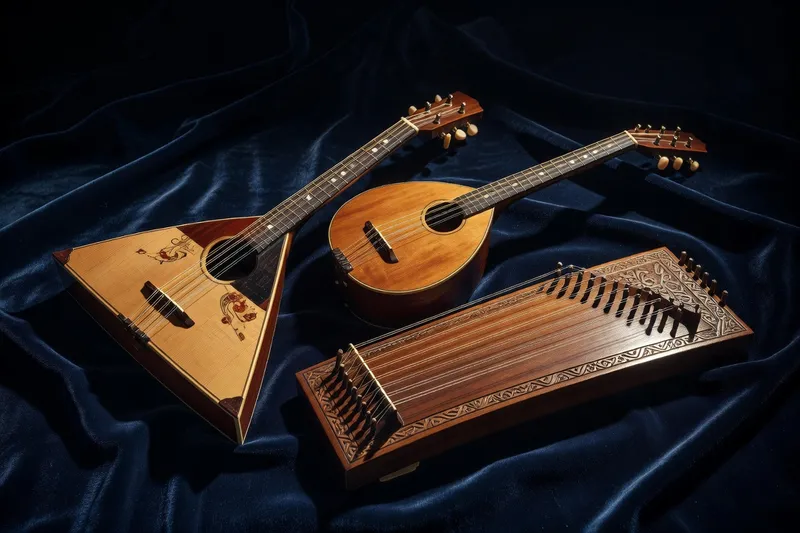
Alongside the classical tradition, Russian folk music has maintained its vitality across centuries. The byliny — epic narrative songs performed by itinerant singers called skaziteli — preserved the memory of heroic deeds from the era of Kievan Rus and the struggle against the Mongols. These songs, collected in the 19th century by ethnomusicologists like Alexander Hilferding, form a repository of pre-Christian and early Christian Russian identity.
The Russian romance (romans) — an intimate vocal genre combining a vocal line of great melodic beauty with simple piano accompaniment — became the domestic music of the 19th-century Russian intelligentsia. Composers like Mikhail Glinka, Alexander Dargomyzhsky and later Sergei Rachmaninoff and Nikolai Medtner contributed masterpieces to the genre. The great romance tradition lives on in the work of performers who combine classical training with the warmth and directness of folk expression.
Cossack music deserves special mention. The Don, Kuban and Terek Cossacks each developed distinctive musical traditions — polyphonic songs, instrumental dances, martial music — that blend Slavic, Turkic and Eastern European influences. Russian traditions cannot be fully understood without this Cossack musical contribution, which gave Russian folk music some of its most characteristic features: bold rhythms, modal harmonies and the interplay between solo voice and choral response.
Listening: A Guide for the Newcomer
For those approaching Russian music for the first time, a structured listening journey proves more rewarding than random exploration:
- Tchaikovsky’s Swan Lake — melodic accessibility and orchestral brilliance
- Mussorgsky’s Pictures at an Exhibition (Ravel orchestration) — the Russian fascination with visual and literary inspiration
- Shostakovich’s Fifth Symphony — the best introduction to Soviet-era complexity
- Rachmaninoff’s All-Night Vigil — the summit of unaccompanied choral writing
- Recordings of the Don Cossack Choir from the 1930s — irreplaceable folk vitality
For sacred music, seek out recordings of the complete Divine Liturgy by Rachmaninoff — his All-Night Vigil (Vespers, 1915) is considered one of the greatest choral works ever composed. The basso profondo solos in this work are truly extraordinary. For folk music, recordings of the Don Cossack Choir from the 1930s retain an irreplaceable vitality.
The Russian musical tradition is not merely a historical artifact but a living presence. Russian-speaking communities throughout Western Europe maintain choral ensembles, chamber music groups and folk dance ensembles that continue this heritage with obvious love and technical mastery. Attending a Russian Orthodox liturgy — even without understanding Church Slavonic — provides an experience of this living musical tradition that no recording can fully replicate.
Frequently Asked Questions
Znamenny chant is the ancient monophonic liturgical music of the Russian Orthodox Church, introduced from Byzantium in the 10th century. It forms the bedrock of all subsequent Russian choral tradition and influenced composers from Glinka to Rachmaninoff. Its modal character and syllabic precision give Russian sacred music its unique spiritual weight.
The Russian national school was founded by Mikhail Glinka (A Life for the Tsar, 1836) and developed by The Mighty Five: Balakirev, Cui, Borodin, Rimsky-Korsakov and Mussorgsky. Tchaikovsky, though more cosmopolitan, remains the most internationally celebrated. The 20th century brought Prokofiev, Shostakovich, Schnittke and Gubaidulina.
The Russian bass voice, known as basso profondo, reaches lower registers than Western basses, sometimes descending to contra-F or even contra-C. This vocal phenomenon, cultivated in Orthodox monasteries, gives Russian choral music its characteristic resonant, earthy depth. The Don Cossack choirs have made this voice famous worldwide.
Yes. Russian Orthodox choirs maintain an active presence in Paris, Brussels, Berlin, London and Geneva, serving liturgical functions while also giving public concerts. Groups like the Moscow Synodal Choir and various diaspora ensembles tour regularly. The Don Cossack Choir tradition has been revived by several European-based groups.
Sergei Diaghilev's Ballets Russes (1909–1929) commissioned works from Stravinsky, Prokofiev, Debussy and Ravel, directly shaping 20th-century Western music. Stravinsky's The Rite of Spring (1913) caused a famous riot at its Paris premiere and permanently altered musical aesthetics. The collaboration between Russian visual artists, choreographers and composers in the Ballets Russes was a watershed moment in cultural history.