
Pushkin and the Golden Age of Russian Poetry
It is impossible to overstate Alexander Pushkin’s importance to Russian culture. He is simultaneously Russia’s Shakespeare, its Dante and its Goethe — the writer who created the literary language, established the principal genres, and set the aesthetic standards by which all subsequent Russian writing has been measured. Born in Moscow in 1799 to a noble family with African ancestry (his great-grandfather was an Abyssinian general in Peter the Great’s army), Pushkin combined an aristocratic sensibility with a democratic sympathy for ordinary Russians. His life ended in a duel in 1837 at the age of 37 — a death that Russia has never entirely ceased mourning.
His masterpiece, Eugene Onegin (1823–1831), is a novel in verse — a form unique in world literature — that simultaneously embodies and subverts the Romantic conventions of its age. The eponymous hero, a bored St Petersburg dandy who carelessly destroys all possibility of happiness, became the archetype of the lishniy chelovek (superfluous man): a figure of unfulfilled potential, disconnected from social purpose, that would recur throughout Russian literature. Turgenev’s Rudin, Goncharov’s Oblomov, Chekhov’s intellectuals — all descend from Onegin.
Pushkin’s lyric poetry is even more central to Russian cultural identity. Russians learn his verses at school and recite them throughout life; his lines surface in conversation, speeches and letters with a naturalness that reflects genuine internalisation rather than literary performance. The Russian language reached a peak of expressive precision and beauty in Pushkin’s hands, and the connection between his poetry and the language itself is so intimate that to know Pushkin well is to know Russian in a fundamental sense.
Key takeaway: Pushkin’s Onegin created the archetype of the lishniy chelovek (superfluous man) — a figure of unfulfilled potential disconnected from social purpose — that recurs throughout Russian literature, from Turgenev’s Rudin to Goncharov’s Oblomov to Chekhov’s intellectuals.
His contemporaries were no less remarkable. Mikhail Lermontov, killed in a duel in 1841 at 26, left the psychological novel A Hero of Our Time — a proto-existentialist work of remarkable modernity. Nikolai Gogol, Ukrainian-born, wrote Dead Souls and The Government Inspector, introducing into Russian literature a grotesque absurdism that would surface again in Bulgakov, Kharms and Voinovich.
Tolstoy, Dostoevsky and the Great Novels
The second half of the 19th century produced the greatest concentration of literary genius Russia has ever seen. Leo Tolstoy and Fyodor Dostoevsky stand at the apex, but they are flanked by Ivan Turgenev (whose Fathers and Sons coined the term nihilist), Ivan Goncharov (whose Oblomov gave Russian a word for pathological inertia), and Anton Chekhov (whose plays and short stories revolutionised both theatrical form and prose fiction simultaneously).
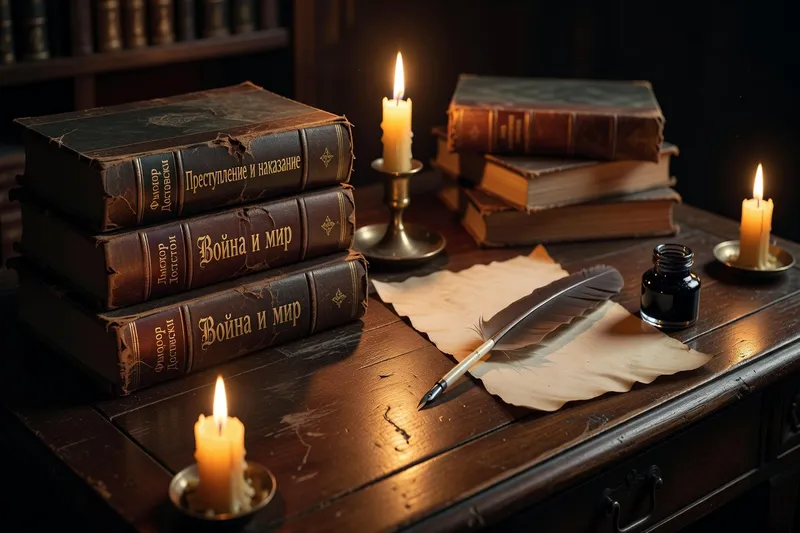
Leo Tolstoy (1828–1910) is the novelist of the real: his observation of human behaviour, social hierarchy, historical process and psychological motivation is so precise and comprehensive that War and Peace (1869) and Anna Karenina (1878) feel not like novels but like life itself, rendered in words. Napoleon’s invasion, the Moscow fire, the Natasha Rostova who dances at her first ball, the Anna who destroys herself for passion — these are among the most vivid and durable creations in world fiction. Tolstoy’s late conversion to a radical Christian anarchism added a dimension of moral urgency to his later writing (The Death of Ivan Ilyich, Resurrection) that makes him as much a religious thinker as a novelist.
Fyodor Dostoevsky (1821–1881) is the novelist of the underground: the psychological abyss, the split consciousness, the murderer and the saint sharing a single soul. His own life — poverty, epilepsy, political arrest, mock execution, four years in a Siberian prison camp — gave him access to human experience that Tolstoy, for all his genius, never possessed. Crime and Punishment (1866), The Idiot (1868), The Possessed (1872) and The Brothers Karamazov (1880) are works of metaphysical intensity unmatched in the novel form. The Grand Inquisitor chapter in The Brothers Karamazov is the greatest philosophical dialogue in fiction.
Key Russian cultural concepts such as toska (spiritual longing), doucha (soul) and avos’ (fatalistic hope) find their deepest literary expression in Dostoevsky. To read him is to encounter the Russian soul at its most exposed and most profound.
The Silver Age: Poetry Under Pressure
The decades surrounding the 1917 Revolution produced a flowering of Russian poetry known as the Silver Age — a period of extraordinary technical innovation and personal anguish.
| Movement | Key poets | Aesthetic aim |
|---|---|---|
| Symbolism | Blok, Bryusov, Bely | Capture transcendence through sound and image |
| Acmeism | Akhmatova, Mandelstam, Gumilev | Precision, clarity, the weight of the concrete word |
| Futurism | Mayakovsky, Khlebnikov | Destroy poetic convention in the name of revolutionary newness |
Anna Akhmatova (1889–1966) survived the entire Soviet period with her integrity intact, though at enormous personal cost. Her husband Nikolai Gumilev was executed in 1921; her son spent years in the Gulag; her long companion Nikolai Punin died in a camp. Her Requiem, a cycle of poems written between 1935 and 1940 and memorised by friends for safety because written copies were too dangerous to keep, is both a personal lament and an indictment of Stalinist terror. She continued to write until her death, producing the masterpiece Poem Without a Hero (1940–1965) — a labyrinthine meditation on memory, guilt and the weight of the Russian past.
Marina Tsvetaeva (1892–1941) is Akhmatova’s opposite in almost every way: where Akhmatova is classical, restrained, St Petersburg elegant, Tsvetaeva is volcanic, formally experimental, Moscow baroque. Her cycles Verses to Blok and The Swans’ Encampment are among the most passionate poetry in any language. She spent years in Paris in poverty and creative isolation, returned to the USSR in 1939 following her husband and daughter (both of whom were arrested), and hanged herself in Yelabuga in 1941 after her husband was shot. No other biography in Russian literary history so completely embodies the tragedy of 20th-century Russia.
Literature in Exile: Bunin, Nabokov, Brodsky
The Russian émigré literary tradition is one of the richest in the world. From the first wave of exiles after 1917 to the dissidents of the Soviet era and the writers of today, Russian literature has been written simultaneously inside and outside Russia, and sometimes the most important voices have come from outside. Its major figures include:
- Ivan Bunin — first Russian Nobel laureate in Literature (1933), writing from France
- Vladimir Nabokov — switched from Russian to English while remaining a Russian writer at heart
- Joseph Brodsky — expelled from the USSR in 1972, Nobel Prize 1987
- Mikhail Shishkin, Lyudmila Ulitskaya, Vladimir Sorokin — the post-2022 generation in exile
Ivan Bunin (1870–1953), who emigrated to France after the Revolution and never returned, became in 1933 the first Russian to win the Nobel Prize in Literature. His prose, of a lyrical precision reminiscent of poetry, mourned the vanished Russia of country estates and Orthodox piety with an intensity that never softened into sentimentality. His short stories and the novel The Life of Arseniev are among the masterpieces of 20th-century prose, though they remain less known in the West than they deserve.
Vladimir Nabokov (1899–1977) is the supreme example of a Russian writer who became an American one. Born in St Petersburg to an aristocratic family, he spent his early career writing in Russian for the émigré community (The Gift, The Defense, Invitation to a Beheading) before switching to English and creating an entirely new literary identity. Lolita (1955), Pale Fire (1962) and Ada (1969) demonstrate a mastery of English prose that his native colleagues never quite equalled. Yet he always insisted on the primacy of his Russian self.
Joseph Brodsky (1940–1996), expelled from the USSR in 1972 after a famous trial in which he was accused of “social parasitism” (the judge asked what gave him the right to call himself a poet; he replied “I think it comes from God”), became America’s Poet Laureate and won the Nobel Prize in 1987. His essays in Less Than One are among the finest prose writings of the 20th century. Brodsky’s career embodies the paradox of Russian literature in exile: the distance from Russia intensifies rather than diminishes the Russianness of the writing.
The Russian diaspora in Europe has maintained literary culture in exile through publishing houses (YMCA Press in Paris, Ardis in the United States), literary journals and reading circles that have kept Russian literature alive across generations of emigration.
Translating Russian: Losses and Gains
The challenge of translating Russian literature into English is real and unavoidable. The two languages are structurally very different: Russian’s six grammatical cases allow word-order freedom impossible in English, enabling poetic effects that resist translation. Tolstoy’s hypotactic sentences — long chains of subordinate clauses tracking the movements of consciousness — can be rendered in English, but something is always lost. Dostoevsky’s colloquial energy, his characters who gabble and interrupt and contradict themselves, survives better, but the specific flavour of 19th-century Petersburg argot disappears entirely.
Poetry is even more resistant. Every translation of Pushkin’s Eugene Onegin has had to choose between fidelity to the Onegin stanza (fourteen lines of iambic tetrameter with a specific rhyme scheme) and fidelity to the meaning. Nabokov’s famously literal translation preserves the meaning at the cost of all poetry; Charles Johnston’s rhyming version is genuinely poetic but frequently paraphrastic. Neither approach is wrong; they simply illuminate different aspects of the original.
For serious readers, Cerclepouchkine.com provides a rich resource: articles, analyses, event listings and educational material dedicated to Pushkin and the Russian literary tradition in France. The site exemplifies the effort of the Russian diaspora to maintain and transmit literary culture across linguistic and national boundaries.
The lesson is clear: the best way to appreciate Russian literature is to learn the language, or at least enough of it to feel the music of the words. Even a basic reading knowledge of Cyrillic transforms the experience of reading Pushkin, Akhmatova or Mandelstam in ways that no translation can replicate.
Frequently Asked Questions
Alexander Pushkin (1799–1837) created the modern Russian literary language, fusing colloquial speech with Church Slavonic and French influences into a flexible, precise and beautiful instrument. His novel in verse Eugene Onegin established the templates for Russian psychological fiction, while his poetry set standards of lyrical beauty that all subsequent Russian poets have had to engage with.
Tolstoy (1828–1910) is the supreme novelist of social panorama, historical sweep and moral clarity — War and Peace and Anna Karenina are unrivalled in their breadth of vision. Dostoevsky (1821–1881) explores the underground of consciousness, the psychology of crime, suffering and spiritual redemption — The Brothers Karamazov and Crime and Punishment remain the deepest psychological novels ever written.
The Silver Age (roughly 1890–1925) produced Anna Akhmatova, Marina Tsvetaeva, Osip Mandelstam, Boris Pasternak and Alexander Blok — poets who combined technical brilliance with metaphysical depth. Many suffered persecution under Stalin: Mandelstam died in a transit camp, Tsvetaeva took her own life in 1941, and Akhmatova spent decades writing her Requiem in secret.
Russian poetry relies fundamentally on rhyme, metre and the phonetic beauty of Cyrillic sounds. The six grammatical cases allow extraordinary word-order freedom, enabling rhymes and rhythms impossible in English. Most English translations sacrifice either the formal structure or the literal meaning, and sometimes both. Learning even basic Russian opens up a dimension of these poems entirely inaccessible in translation.
Since 2022, a new wave of Russian writers has left the country, joining an already active diaspora that includes figures like Mikhail Shishkin (Switzerland), Lyudmila Ulitskaya (Germany) and Vladimir Sorokin. The tradition of writing in exile goes back through Brodsky, Solzhenitsyn, Nabokov and Bunin — exile and Russian literature have been intertwined for over a century.