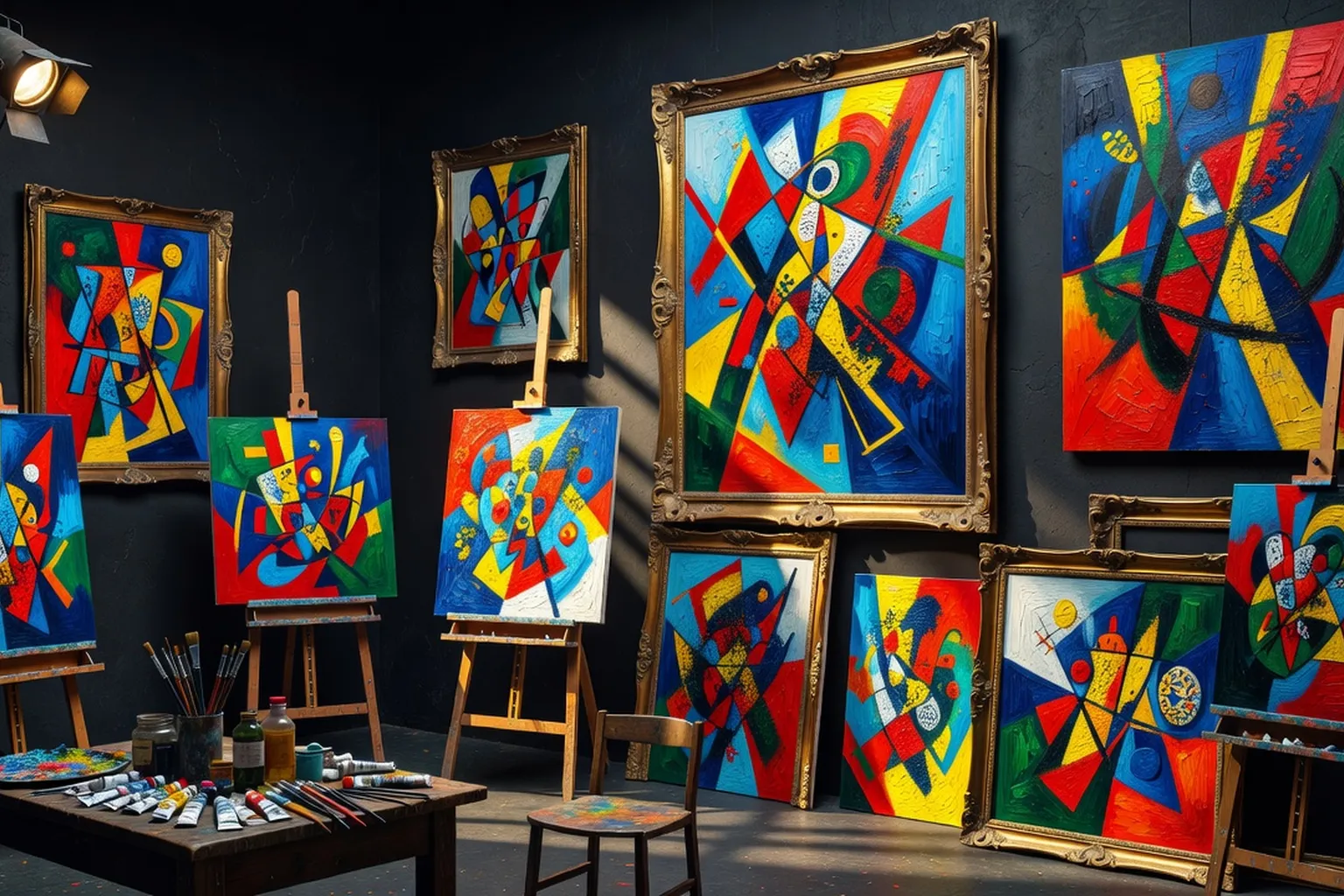
From Byzantine Icons to Imperial Splendour
The history of Russian visual art is a millennial odyssey that begins with the Byzantine icons introduced during the Christianisation of Kievan Rus in 988. These sacred images, painted on wood according to strict theological canons, are not mere objects of devotion: they constitute a genuine window onto the divine, a theology expressed in colour. Master iconographers such as Andrei Rublev, whose celebrated Trinity (c. 1411) is housed in the Tretyakov Gallery in Moscow, achieved heights of spiritual expression rarely equalled in medieval Western art. The technique, transmitted from master to apprentice within monastic workshops, combines ochre, gold and deep blues to create a light that seems to emanate from the surface itself.
Icons served simultaneously as objects of worship, instructional tools for an illiterate population, and repositories of theological meaning. Their conventions — inverse perspective, hierarchical scale, gold backgrounds representing divine light — were not limitations but a deliberate visual language. The great icon-painting schools of Novgorod, Pskov and Moscow each developed distinctive styles, recognisable to trained eyes: the Novgorodian palette tends toward warm reds, while the Moscow school under Rublev’s influence favoured cooler, more harmonious tones of blue and green.
Key takeaway: Russian visual art moved from sacred icon painting to secular European academicism under Peter the Great, then found its own voice again in the 1870s when the Wanderers rejected academic convention to depict the real lives of ordinary Russians.
The rupture came with Peter the Great, who dispatched Russian artists to study in Amsterdam, Paris and Rome. The Imperial Academy of Fine Arts, founded in Saint Petersburg in 1757, trained generations of painters according to European neoclassical canons. Dmitry Levitsky and Vladimir Borovikovsky excelled in official portraiture, while Karl Bryullov astonished all of Europe with his colossal Last Day of Pompeii (1833). But it was the Wanderers (Peredvizhniki) who, from the 1870s onwards, liberated Russian art from academic conventions by taking their easels to the heart of villages, forests and steppes. Ilya Repin, Ivan Shishkin and Isaac Levitan thus gave birth to Russian landscape painting and social realism, reflections of a nation seeking to understand itself.
The Wanderers organised travelling exhibitions precisely to bring art to people who had never visited the grand galleries of St Petersburg. Their subjects — peasant life, the Russian landscape in all its seasons, scenes of social injustice — constituted a form of cultural democracy unprecedented in Russian art history. Repin’s monumental canvases such as Barge Haulers on the Volga (1873) became icons of a different kind: secular, humanist, profoundly Russian.
The Revolutionary Avant-Garde
The turn of the 20th century saw the flowering of one of the most revolutionary avant-gardes in the history of world art. The influence of this period permeates all contemporary Russian culture, including the way diaspora artists define themselves today.
| Movement | Key figure | Defining work or idea |
|---|---|---|
| Abstraction | Wassily Kandinsky | Concerning the Spiritual in Art (1911) |
| Suprematism | Kazimir Malevich | Black Square on White Background (1915) |
| Constructivism | Alexander Rodchenko, Varvara Stepanova | Art as a tool of social transformation |
| Rayonism | Natalia Goncharova, Mikhail Larionov | Fusion of Cubism, Futurism and folk art |
These movements, born in Russia, went on to irrigate the German Bauhaus, Dutch De Stijl and all of Western modernity. The irony of history is profound: Russian artists who sought to destroy bourgeois culture ended up becoming the foundations upon which Western commercial design, architecture and visual communication were built. The photomontages of Rodchenko, the typographic experiments of El Lissitzky, and the theatrical sets of Lyubov Popova all found their way into advertising, book design and industrial aesthetics across Europe and America.
The suppression of the avant-garde under Stalin — who imposed Socialist Realism as the sole acceptable aesthetic in 1934 — drove many of these artists into silence, exile or, in some cases, death. Yet their work survived, often preserved in Western collections or in the archives of fellow artists who understood its historical significance. The rehabilitation of the avant-garde after Stalin’s death in 1953 was a gradual process, complete only after the fall of the USSR.
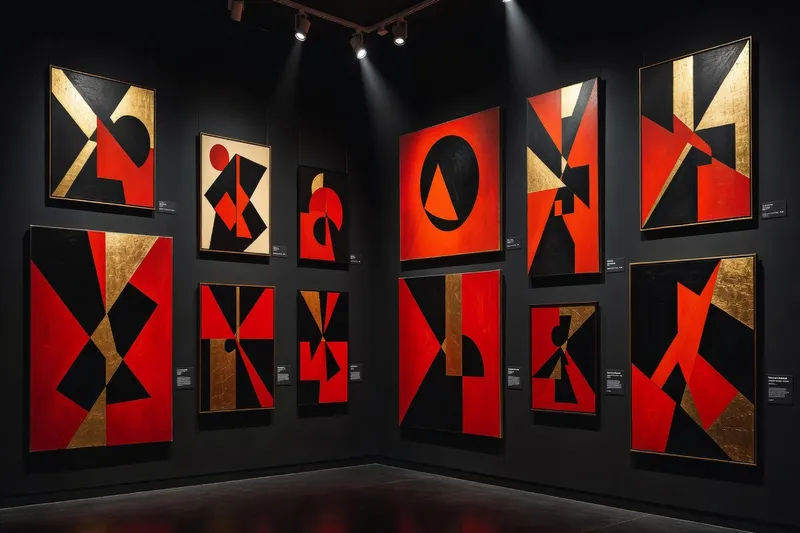
The Perestroïk’art Collection: A Window on Soviet Creativity
For the history of the late twentieth century, the opening of the Berlin Wall and the fall of communist regimes represent an absolutely decisive turning point. The Perestroïk’art collection, presented at the Cultureel Centrum of Hasselt in Belgium, takes on its full historical significance within this context. As Jean-Pierre Grootaers, then Director of the Cultureel Centrum, wrote: “Thanks to the efforts of the Colas family of Paris and the ardent research of Monsieur Hugo Donné, a collection of visual artworks dating from the Perestroika era has been assembled.”
The years 1985–1991 saw Soviet artists emerge from clandestinity. Unofficial exhibitions, long forbidden or confined to private apartments, invaded State galleries. The sots-art movement (Soviet art) subverted the visual codes of Socialist Realism with biting irony. Ilya Kabakov, Erik Bulatov and Komar & Melamid transformed the icons of Soviet power into artistic material. The Russian literary tradition nourishes this visual creativity: Russian culture has always maintained a close relationship between word and image.
The Perestroïk’art collection also documents the mutual fascination between Eastern artists and Western collectors. For the first time in decades, works produced in Leningrad, Kiev or Tbilisi could legally cross borders and find an audience in Belgium, France or the Netherlands. This artistic circulation preceded and prepared the great political changes of 1989–1991.
Andrey Redlich and the Germano-Russian Painters
Among the essential figures of Russian art in the West, Germano-Russian painters occupy a particular place. This community, born of the successive migrations of the 20th century, blends Slavic heritage and German academic training to create a singular visual language. Andrey Redlich, born in Moscow and trained in Berlin, is one of its most accomplished representatives.
Redlich works within a figurative tradition that does not abandon the real but transcends it through an intense palette and dramatic composition. His large canvases evoke both Orthodox icons and German Expressionism — two traditions that his biographical trajectory allowed him to integrate organically. His portraits of Russian women, often presented against golden backgrounds reminiscent of Byzantine gold grounds, question identity, memory and cultural transmission in an uprooted world.
The galleries of Berlin, Hamburg and Munich have played a crucial role in disseminating this Germano-Russian art. The Galerie Gmurzynska in Cologne, specialising in historical Russian avant-garde, has contributed to revaluing the forgotten masters of Constructivism while presenting contemporary creators. This continuity between historical modernity and contemporary creation is one of the strengths of the Germano-Russian scene: it fully assumes its dual cultural belonging without attempting to artificially resolve this creative tension.
The Russian diaspora in Europe thus constitutes a unique cultural laboratory, at the crossroads of Slavic traditions and Western modernities. The Berlin scene today houses several thousand Russian-speaking artists. After 2022, this community was further strengthened by the arrival of new exiles, often young, who bring a different perspective on Russian identity.
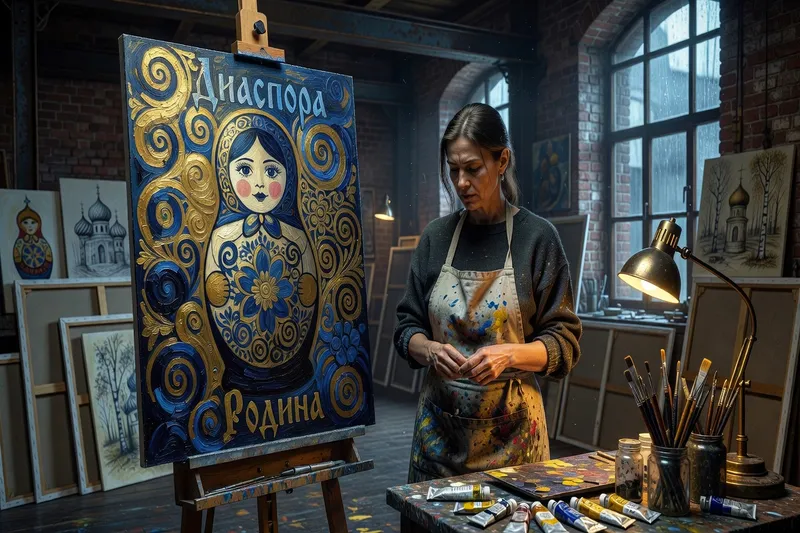
Contemporary Russian Art in Exile: Belgium and Europe
Belgium occupies a singular place in the geography of Russian art in exile. Since the first migration waves of the 1920s, the country has welcomed Russian artists, intellectuals and ecclesiastics who have maintained a remarkably vibrant cultural presence. The association Art-Russe.com is today one of the essential portals for discovering this artistic scene: online gallery, classified advertisements for artworks, exhibition calendar.
Brussels houses several galleries specialising in Russian and Eastern European art. The Russian Orthodox community, organised around the Cathedral of Saints Constantine and Helena, has always been a centre of artistic creation: icon restoration, liturgical embroidery, illuminated manuscripts. These traditional arts are still practised today in parochial workshops that transmit century-old skills.
Contemporary Russian art in exile is, however, quite distinct from this tradition. The Parisian gallery Iragui, the London gallery Triumph, and several Brussels spaces regularly present artists who question Russian identity from the outside. This critical distance permits a perspective that conditions inside the country sometimes make difficult. The work of Pavel Pepperstein, Recycle Group, or the video installations of Alexandra Sukhareva interrogate Soviet memory, the imperial heritage and the contradictions of contemporary Russian nationalism.
The Artivisme Russe collection documents for its part engaged artists — those who use their art as a tool of political resistance. This tradition, which goes back to the Wanderers of the 19th century and the artists persecuted by Stalin, continues to manifest itself vigorously in the post-2022 diaspora.
How to Collect Russian Art
Collecting Russian art is both an intellectual and emotional adventure. The market is vast, diverse and sometimes complex to navigate for the newcomer. A few reference points allow one to approach this passion with method.
The first distinction to make is between historical and contemporary art, and each category carries its own considerations for a new collector:
- Ancient icons (14th–17th centuries) — belong to the sacred art market, subject to strict export regulations from Russia
- Avant-garde works (1905–1935) — actively traded at Christie’s, Sotheby’s and Bonhams, but also frequently forged; expert appraisal is indispensable
- Soviet and post-Soviet art — more accessible prices, found at fairs such as Art Basel, FIAC and Artissima
- Regional auction houses — particularly in Germany, Belgium and France, offer reasonably priced entry points
For Soviet and post-Soviet art, prices remain more accessible. Art fairs such as Art Basel, FIAC or Artissima regularly present specialist galleries. Regional auction houses — particularly in Germany, Belgium and France — offer works at reasonable prices. It is advisable to build a sustained relationship with two or three specialist galleries, which will help refine your eye and understand market trends.
Russian history provides the indispensable keys for understanding what Russian artists seek to express. Even a partial knowledge of the Russian language is a considerable asset: the titles of works, literary references and wordplay constitute a layer of meaning accessible only to those who understand Cyrillic. The Russian language is a key to the entirety of Russian culture — and exploring it opens unexpected depths in the visual arts as well.
Finally, the cultural associations of the diaspora — literary circles, Franco-Russian friendship associations, Orthodox parishes — constitute places of exchange where private collections are sometimes shown, where artists exhibit their work in progress, and where lasting friendships form around the love of Russian art.
Frequently Asked Questions
Russian visual art spans several key eras: Byzantine icon painting (10th–17th century), Imperial baroque and neoclassicism (18th–19th century), the Wanderers movement and critical realism (19th century), the revolutionary avant-garde (1905–1935), Soviet Socialist Realism, and the contemporary renaissance since Perestroika.
The major figures of the Russian avant-garde include Wassily Kandinsky (pioneer of abstraction), Kazimir Malevich (founder of Suprematism), El Lissitzky, Natalia Goncharova and Mikhail Larionov (Rayonism), and Alexander Rodchenko for Constructivism. These artists revolutionised world art at the beginning of the 20th century.
The Perestroïk'art collection, assembled by the Colas family of Paris and researcher Hugo Donné, gathers visual artworks by Soviet artists from the Gorbachev era (1985–1991). Exhibited at the Cultureel Centrum of Hasselt in Belgium, it documents the creative explosion that followed the relaxation of artistic censorship.
After 1991, Russian art diversified radically: a return to expressionism and abstraction, the emergence of a private market, the development of conceptual art (AES+F group, Olga Chernysheva), and above all a very active creative diaspora in Germany, France and Belgium.
Numerous galleries and institutions present Russian art in Europe: the Art Russe gallery online, the Berlin State Museums (icon collections), the Musée des Confluences in Lyon, and exhibitions organised by Russian diaspora cultural associations, particularly in Belgium and the Netherlands.