The First Wave: White Russian Exile (1919–1922)
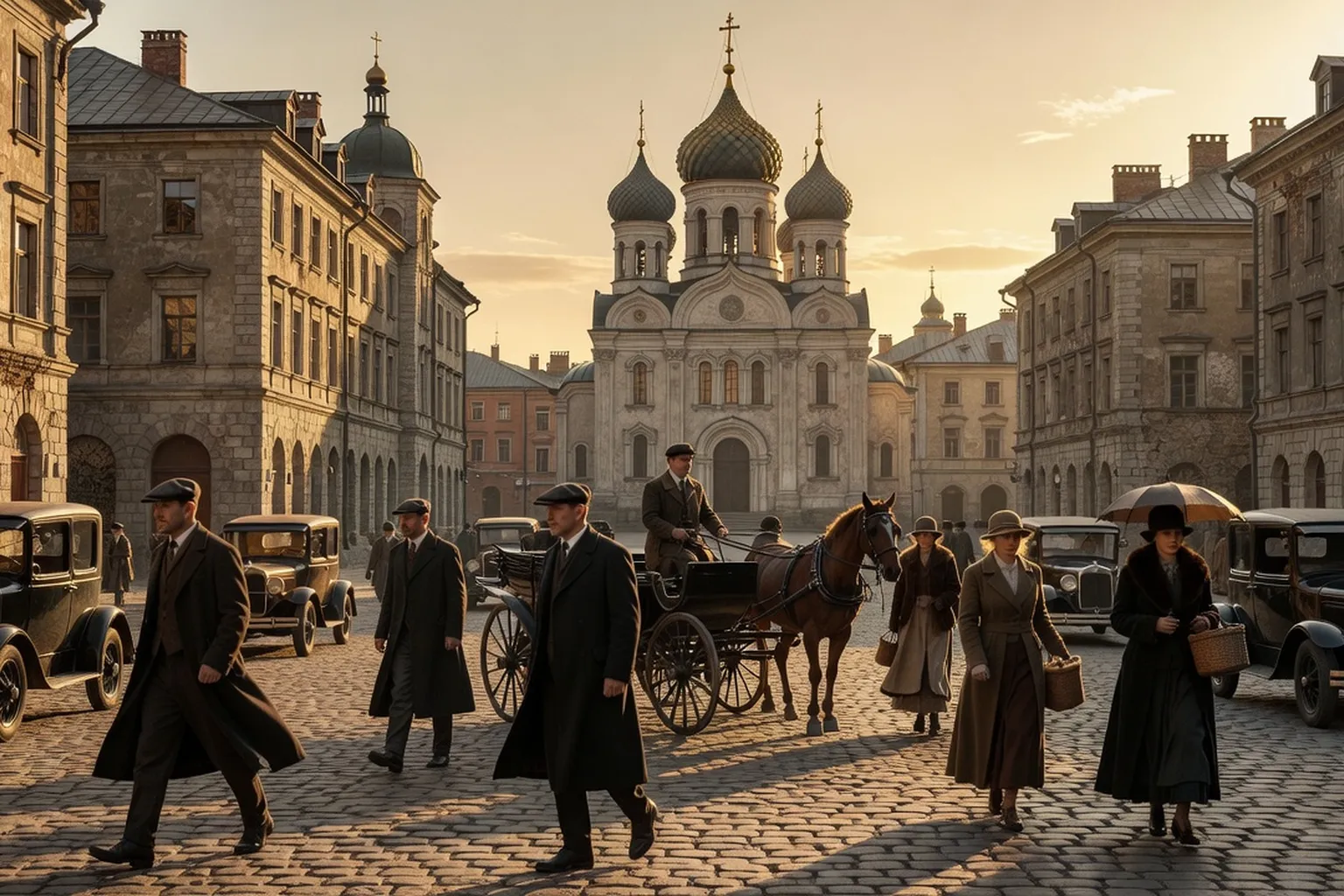
The catastrophe of 1917 set in motion the largest forced migration in modern European history until the Second World War. As the Bolshevik Revolution consolidated its hold and the White Army crumbled in the Civil War, approximately two million Russians left their country — never, as most believed, for long. Officers and aristocrats, intellectuals and artists, priests and merchants, teachers and engineers: a cross-section of old Russia poured westward and southward, through Constantinople, through the Bosphorus, into the ports of Greece, Yugoslavia, Bulgaria, and onward to France, Germany and beyond.
Key takeaway: The first wave of Russian emigration (1919–1922) was the largest forced migration in modern European history until World War II, scattering roughly two million Russians across Europe and beyond within a few years.
The departure was often chaotic. Ships crowded with White Army soldiers and their families left Crimea and Odessa in November 1920 under fire. General Pyotr Wrangel’s evacuation of the White Army from Crimea brought 145,000 people to Constantinople in a matter of days. From there, the stream dispersed across Europe and beyond, following existing cultural and diplomatic connections. France, Russia’s traditional ally and the home of a pre-existing Russian cultural presence, became the most important destination. By 1924, Paris housed approximately 400,000 Russians, a community large enough to sustain its own newspapers, publishing houses, cabarets, restaurants, churches and schools.
Berlin briefly rivalled Paris in the early 1920s, when the relative weakness of the German mark made life economically viable for émigrés subsisting on foreign currency. Russian publishing houses flourished: Nabokov’s early Russian novels were first published in Berlin, and the city hosted an extraordinary concentration of Russian literary and artistic talent before hyperinflation and the rise of Nazism dispersed it westward.
Russian visual arts found an important home in the diaspora: émigré galleries in Paris, Berlin and Prague kept the avant-garde tradition alive long after it had been suppressed in the Soviet Union, and Kandinsky’s work was better known in Western Europe than in his homeland for decades.
Cardinal Mercier and Belgium: An Ecumenical Act of Generosity
Belgium deserves special attention in the history of the Russian diaspora, not least because of the remarkable role played by Cardinal Désiré-Joseph Mercier, Archbishop of Mechelen. Mercier, already celebrated for his courageous resistance to the German occupation during the First World War, turned his pastoral energy to the Russian refugees flooding into Belgium in 1921. In an era when Catholic–Orthodox relations were tense and ecumenism largely theoretical, Mercier made a concrete, personal gesture of solidarity.
He contributed 20,000 Belgian francs — a substantial sum — from his personal resources to support the establishment of Russian Orthodox refugees in Belgium. He mobilised the diocesan charitable networks to assist families who arrived destitute, without papers, without knowledge of French or Flemish, and often traumatised by the violence of the Civil War. Mikhail Troïepolsky, a prominent member of the Russian community, received direct support through Mercier’s network.
This gesture had lasting consequences. The Russian community in Belgium developed a sense of belonging and security that distinguished it from Russian communities in countries where official hostility or indifference made integration harder. The Orthodox parish network in Belgium, centred on the Patriarchate of Constantinople’s Archdiocese of Belgium, grew steadily and maintained close relations with the wider Belgian Catholic society — a relationship shaped in part by the memory of Mercier’s generosity.
Orthodox spirituality was the cement binding these communities together. The parish was not merely a place of worship but the social, cultural and administrative centre of émigré life. Records of births, marriages and deaths were maintained by the parish; Russian-language schools were often run by the parish; cultural events took place in parish halls.
The Four Waves of Russian Emigration
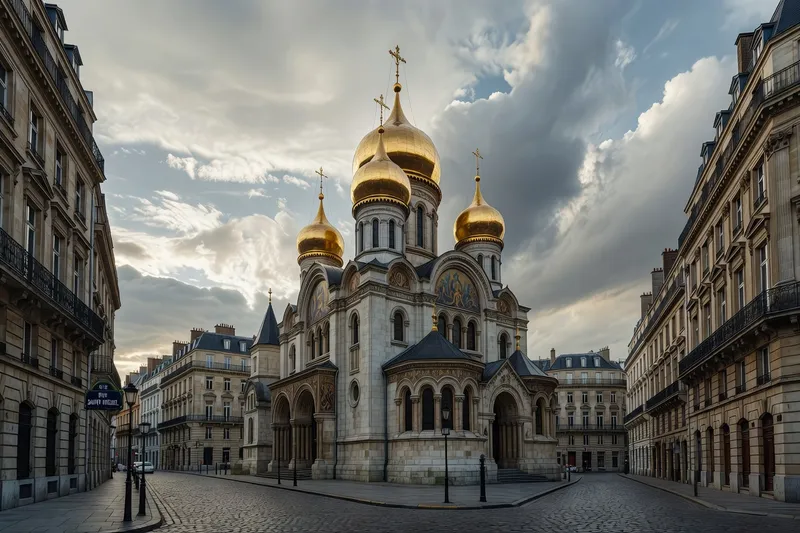
The Russian emigration to Europe has not been a single event but a process extending over more than a century, organised by historians into four distinct waves.
| Wave | Period | Primary cause | Main destinations |
|---|---|---|---|
| First | 1919–1922 | Revolution and Civil War (White exile) | Paris, Berlin, Belgrade, Prague |
| Second | 1941–1945 | Refusal of Soviet repatriation (Displaced Persons) | France, Germany, USA, Australia |
| Third | 1970s–1980s | Dissidence, Jewish emigration, détente | Israel, USA (via Austria) |
| Fourth | Post-1991, surges 2014 & 2022 | Economic migration, then political exile | Berlin, Riga, Tbilisi, Yerevan |
The first wave (1919–1922) has been described above: the White Russian exile, largely involuntary, of Russia’s educated and professional classes. This wave produced the richest cultural legacy: the literary journals of Paris, the philosophical circles of Prague and Belgrade, the theological renewal at the Institut Saint-Serge, the musical emigration that brought Russian choral and orchestral music to Western concert halls.
The second wave (1941–1945) consisted of Soviet citizens who found themselves in German-occupied territory and, when liberated, refused repatriation to the USSR — with good reason, since Stalin treated returnees as suspected traitors. These Displaced Persons, or DPs, spent years in camps before emigrating to France, Germany, the United States and Australia. Their experience differed sharply from the first wave: they were often of lower social class, less educated, and had lived under Soviet power; the first wave still remembered pre-Revolutionary Russia directly.
The third wave (1970s–1980s) came under the specific conditions of Soviet dissidence and the pressure of détente: Jewish emigration (often to Israel or the United States via Austria), expelled dissidents like Solzhenitsyn and Brodsky, and a smaller number of artists and intellectuals who managed to leave. This wave produced important cultural figures and reinforced existing diaspora institutions while also creating new ones.
The fourth wave (post-1991, with surges in 2014 and particularly 2022) is primarily economic in origin but increasingly includes political exiles. The post-2022 arrivals, fleeing the war in Ukraine and the repression of dissent inside Russia, have settled primarily in Berlin, Riga, Tbilisi and Yerevan, creating new centres of Russian cultural life outside Russia.
Orthodox Communities in Europe Today
The Russian Orthodox Church in Western Europe presents a complex ecclesiastical landscape. Three main jurisdictions coexist, each reflecting a different historical trajectory. The Russian Orthodox Church Outside Russia (ROCOR), founded in 1921 by émigré bishops who refused recognition of the Moscow Patriarchate under Soviet control, long maintained a position of strict separation from Moscow; it reunited with the Moscow Patriarchate in 2007, though some communities refused to follow. The Archdiocese of Russian Orthodox Churches in Western Europe (formerly under Constantinople) has maintained greater independence. The Moscow Patriarchate itself has parishes throughout Europe.
The Institut de Théologie Orthodoxe Saint-Serge (Institut Saint-Serge), founded in Paris in 1925, has been the intellectual centre of Russian Orthodoxy in the West for a century. Theologians trained there — Georges Florovsky, Alexander Schmemann, John Meyendorff — shaped Orthodox theology worldwide and influenced ecumenical dialogue profoundly. The Institut continues to train priests and theologians from across the Orthodox world.
Russian cultural associations throughout Europe — from the Russian Cultural Centre in Paris to dozens of smaller groups in Belgium, Germany, the Netherlands and the United Kingdom — sustain the diaspora’s identity through several parallel channels:
- Orthodox parishes functioning as spiritual and social centres
- Russian-language schools attached to parish life
- Literary and theatrical clubs, and publishing houses
- Concerts, exhibitions and literary evenings
- Digital media and Russian-language cultural festivals
Festival-russe.com provides an invaluable calendar of events where the diaspora’s cultural vitality is on public display.
Cultural Legacy: Publishing, Theatre, Education
The cultural legacy of the Russian diaspora in Europe is immense and largely underappreciated. The YMCA Press in Paris, founded in 1921, published Russian literature and theology in exile for decades when these works could not appear inside the USSR. It published Berdyaev, Ilyin, Solzhenitsyn (the Paris edition of The Gulag Archipelago in 1974) and dozens of other writers and thinkers whose works were banned at home.
Russian-language theatre flourished in the émigré communities of the 1920s and 1930s. Actors trained in the Stanislavski method found work in Paris cabarets and theatres; some, like Michael Chekhov (the playwright’s nephew), travelled on to London and eventually Hollywood, where their influence on acting technique was profound.
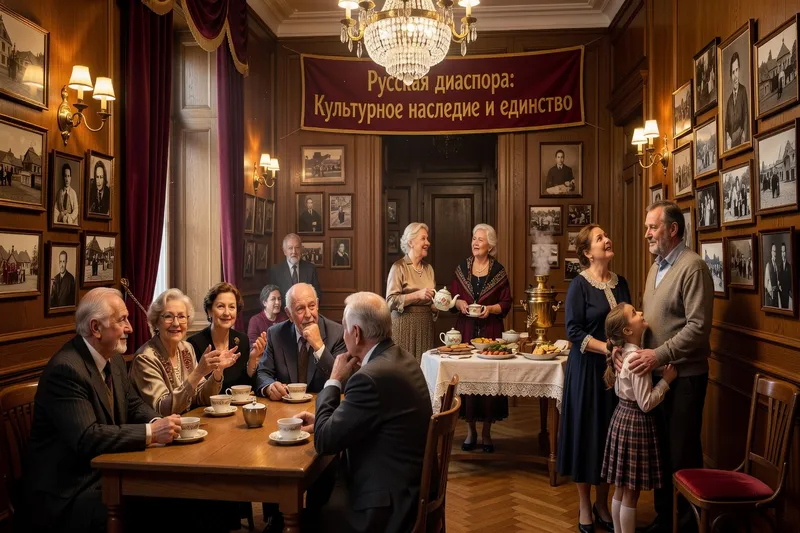
Russian-language schools, often attached to Orthodox parishes, maintained the language and cultural identity of the diaspora across generations. Children born in France or Belgium to Russian parents learned to read and write Cyrillic, to celebrate Orthodox feast days, to dance folk dances and sing folk songs. The persistence of Russian cultural identity across three and four generations of emigration is one of the most remarkable phenomena in the history of diaspora communities.
Russian literature provided the thread connecting generations: Pushkin read in the original, Chekhov performed in Russian-language theatre, Akhmatova’s poems copied and exchanged — these were the cultural practices that maintained Russian identity in exile, and they continue to do so today.
Frequently Asked Questions
The first and largest wave occurred in 1919–1922 following the Bolshevik Revolution and the defeat of the White Army in the Russian Civil War. Approximately two million Russians left the country, settling primarily in France, Germany, Yugoslavia, Bulgaria, Czechoslovakia and China. Paris and Berlin became the main capitals of Russian émigré culture.
Cardinal Désiré-Joseph Mercier, Archbishop of Mechelen and Primate of Belgium, personally organised the reception of Russian refugees in 1921. He contributed 20,000 Belgian francs from his own funds and mobilised Catholic charitable networks to support the exiled Orthodox community, demonstrating an ecumenical generosity remarkable for its era. Mikhail Troïepolsky was among the Russian figures who received direct support.
The four waves are: (1) 1919–1922 — White Russian exiles fleeing the Revolution and Civil War; (2) 1941–1945 — Soviet citizens displaced by WWII who refused repatriation; (3) 1970s–1980s — dissidents and Jewish emigration during the Soviet era; (4) 1990s–present — economic migration after the Soviet collapse, with a significant new wave after 2022.
Germany hosts the largest Russian-speaking community in Europe (approximately 3–4 million), largely descended from the Soviet German (Volga German) repatriation programme of the 1990s. France, the United Kingdom, Spain, Cyprus and the Baltic states also have significant communities. After 2022, Berlin, Tbilisi, Riga and Yerevan received large numbers of new Russian arrivals.
Through Orthodox parishes (which function as cultural as well as spiritual centres), Russian-language schools, literary and theatrical clubs, publishing houses, cultural associations and digital media. The Institut de Théologie Orthodoxe Saint-Serge in Paris, founded in 1925, has been a particularly important intellectual centre. Folk music ensembles, ballet schools and Russian cultural festivals also play a vital role.