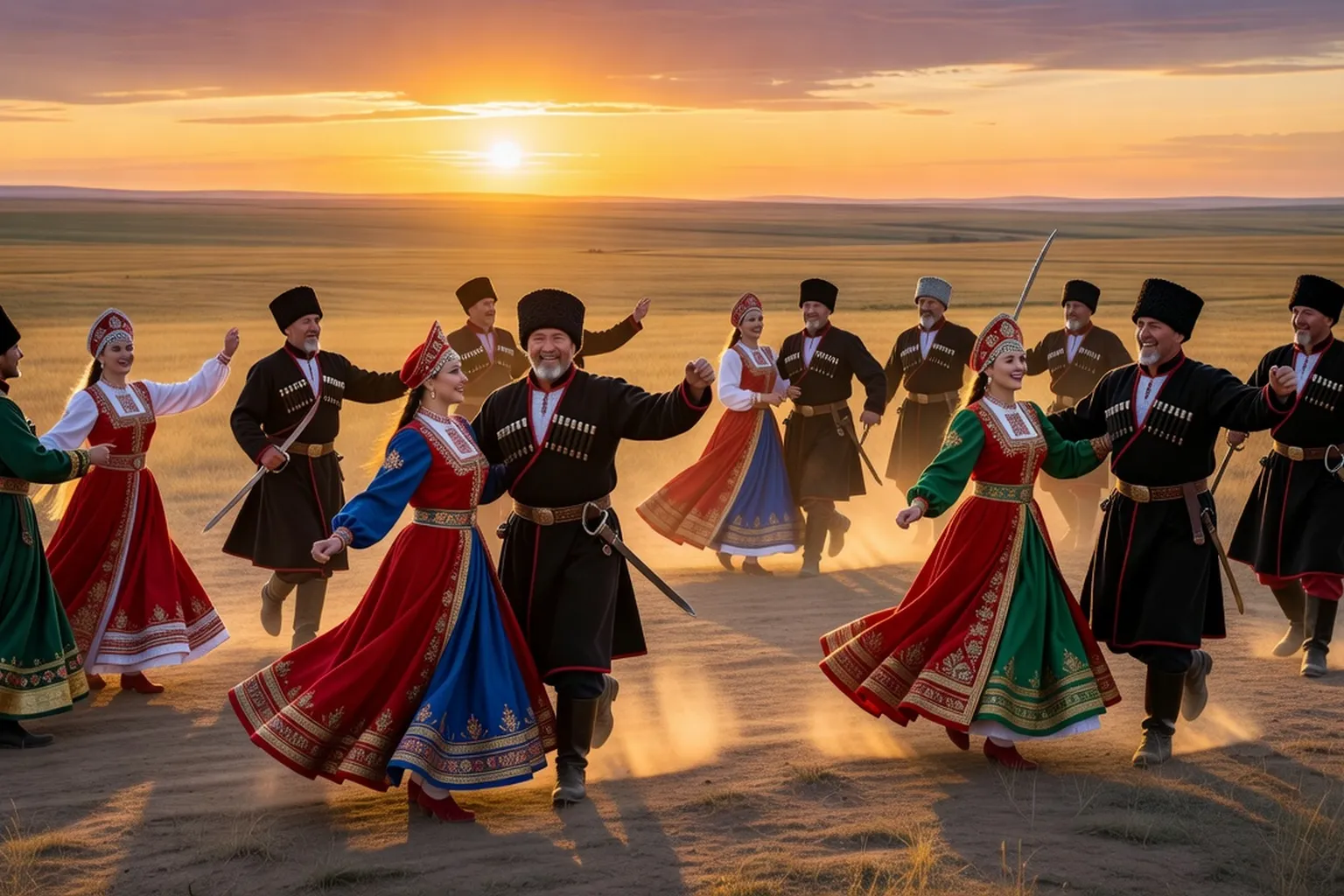
The Cossacks: Warriors, Farmers and Cultural Custodians
No people embody the wild freedom and martial spirit of the Russian steppe more completely than the Cossacks. The word kazak appears in Turkic languages meaning “free man” or “wanderer,” and it captured something essential about these communities of the frontier: their refusal of serfdom, their love of horses and open land, their cultivation of a warrior ethic that was simultaneously brutal and deeply humane. The Cossack hosts — the Don, the Kuban, the Yayik (later renamed Ural after the Pugachev Rebellion to erase the memory of Cossack insurrection), the Zaporozhian beyond the Dnieper — each developed distinct cultures while sharing fundamental characteristics.
The major Cossack hosts, though sharing a common warrior ethic, each developed their own distinct regional identity:
- The Don Cossacks — the largest host, celebrated in Sholokhov’s And Quiet Flows the Don
- The Kuban Cossacks — settled in the north Caucasus, blending Ukrainian and Russian traditions
- The Yayik (Ural) Cossacks — renamed after the Pugachev Rebellion to erase its memory
- The Zaporozhian Cossacks — the Dnieper host immortalised in Repin’s famous painting
Cossack society organised itself around the krug (circle) — a democratic assembly in which all free Cossacks had an equal voice. The elected ataman (hetman) commanded in war but answered to the krug in peacetime. This combination of military hierarchy and democratic practice gave Cossack communities a social model sharply different from the hierarchical serfdom of central Russia, and it explains their recurring role as leaders of peasant uprisings: Stenka Razin in 1670, Yemelyan Pugachev in 1773–1775, and countless smaller revolts.
Russian literature has always been fascinated by Cossack life. Leo Tolstoy spent time in the Caucasus as a young officer and drew on his observations for The Cossacks (1863) — a novella of extraordinary beauty that contrasts the vital freedom of Cossack existence with the self-conscious paralysis of the Russian educated class. Mikhail Sholokhov devoted his life’s work to the Don Cossacks: his And Quiet Flows the Don (1928–1940), winner of the Nobel Prize, is one of the great historical novels of the 20th century, tracking the fate of a Cossack community through the First World War, Revolution and Civil War with epic sweep and intense psychological depth.
Ilya Repin painted the Reply of the Zaporozhian Cossacks to Sultan Mehmed IV (1880–1891) — a panoramic canvas of bearded, laughing warriors composing an obscene letter to the Ottoman Sultan — which became one of the most celebrated paintings in Russian art history. The painting captures the Cossack spirit perfectly: defiant, exuberant, contemptuous of authority, supremely self-confident.
The kozatchok (also spelled gopak in its Ukrainian form) is the most famous Cossack dance: a spectacular display of acrobatic leaping, squatting and spinning that requires years of practice and extraordinary physical condition. It embodies the Cossack ideal of masculine vitality and is performed at festivals throughout southern Russia and Ukraine. Russian music and choral traditions are deeply intertwined with Cossack musical culture: the polyphonic songs of the Don Cossacks, blending Slavic, Turkic and Eastern European influences, are among the most distinctive sounds in the Russian musical universe.
The Samovar: Russia’s Tea Ceremony
Key takeaway: The samovar is not a passive appliance but a social instrument — it requires the drinker’s active participation in blending concentrate and hot water, turning the simple act of making tea into a shared ritual of hospitality.
Tea arrived in Russia from China in the 17th century, carried along the great caravan routes through Mongolia and Siberia — the Great Siberian Tea Road — and it found a people perfectly suited to its comforting warmth. Russia’s severe winters, the vast distances between settlements, and the cultural value placed on hospitality and conversation created ideal conditions for the development of a tea culture more elaborate than anything in Western Europe.
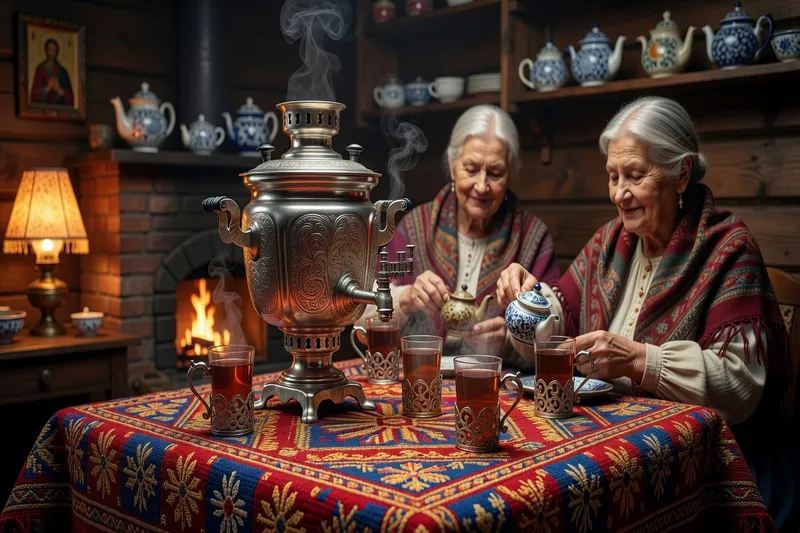
The samovar — samovar in Russian, literally “self-boiler” — is the centrepiece of this culture. Introduced from the Ural mining regions in the late 18th century, the samovar is a heated metal urn that maintains boiling water at the perfect temperature for extended periods. A strong concentrate (zavarka) is brewed in a small teapot placed on top; individual cups are poured by combining a splash of concentrate with hot water from the samovar’s tap, allowing each person to adjust the strength of their tea. The samovar thus requires active participation from the drinker — it is not a passive machine but a social instrument.
The Russian tea ceremony is a ritual of hospitality whose rules, though unwritten, are well understood. A guest who arrives at a Russian home will be offered tea almost immediately; to refuse is mildly impolite. The tea is drunk with sugar (sometimes held between the teeth in the old-fashioned manner, s prikusom), with jam (varenie) dissolved directly in the cup, or with slices of lemon. Accompanying the tea will be baked goods — pirozhki, pryaniki (spiced honey cakes), cookies, or black bread with butter. The samovar remains at the table throughout the gathering; refills are expected and offered.
The unwritten rules of the Russian tea ceremony are well understood by anyone raised in the culture:
- A guest is offered tea almost immediately upon arrival; refusal is mildly impolite
- Sugar may be held between the teeth in the old-fashioned manner (s prikusom)
- Jam (varenie) is often dissolved directly in the cup rather than spread on bread
- The samovar remains on the table throughout the gathering, with refills expected
The social significance of the samovar is embedded in Russian literature, art and everyday speech. Chekhov’s characters conduct their most intimate conversations over tea; Tolstoy’s characters reveal their souls at the tea table; Dostoevsky’s Underground Man both despises and desires the warmth of the tea ceremony he cannot quite accept. The samovar appears in paintings by Repin, Kustodiev and dozens of other artists as a symbol of domestic warmth and human connection.
Today, traditional charcoal-burning samovars are collector’s items, but electric versions maintain the social function. In Russian homes throughout the diaspora in Europe, the samovar remains a symbol of Russian identity and belonging, its presence on the table saying: you are welcome here, we have time for each other, this is a Russian home.
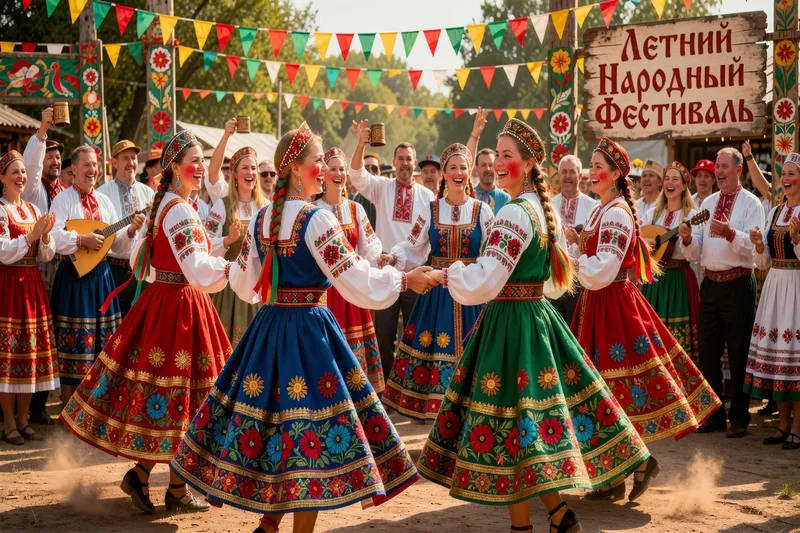
Orthodox Festivals: The Sacred Calendar
Orthodox spirituality gives the Russian year its sacred structure, and the great festivals of the Orthodox calendar remain culturally central even for Russians who are not practising believers. The Orthodox liturgical year follows the Julian calendar, which runs 13 days behind the Gregorian calendar used in the West.
| Festival | Date / period | Key custom |
|---|---|---|
| Rozhdestvo (Christmas) | January 7 | Advent fast, sochivo wheat porridge, breaking fast at first star |
| Maslenitsa (Butter Week) | Week before Great Lent | Blini, sleigh rides, burning a straw effigy of winter |
| Paskha (Easter) | Variable, rarely coincides with Western Easter | Midnight liturgy, candlelit procession, Christos Voskrese |
| Epiphany | January 19 | Blessing of waters, tradition of ice bathing |
Rozhdestvo (Christmas) is a more solemn occasion than in Western tradition, emphasised less as a family gift-giving celebration and more as a sacred birth narrative. The preparations involve a strict Advent fast; Christmas Eve is called sochelnik, when the fast is broken only after the first star appears in the sky. The traditional Christmas food is sochivo — a wheat porridge with honey and dried fruits. The Christmas tree (yolka) and the figure of Ded Moroz (Grandfather Frost, the Russian equivalent of Father Christmas) are associated not with Christmas itself but with New Year, a historical legacy of the Soviet period when Christmas was suppressed but New Year celebrations were promoted as a secular equivalent.
Maslenitsa (Butter Week) is the Orthodox carnival, the week immediately preceding Great Lent. Its name derives from maslo (butter), which may be consumed along with all dairy products before the Lenten fast begins. Maslenitsa is a boisterous, outdoor celebration: the central food is blini (thin pancakes), eaten with sour cream, butter, caviar or jam, their round golden form symbolising the sun and the approaching warmth of spring. Outdoor festivities include sleigh rides, snowball fights, fist-fights (in the old tradition), and the burning of a straw effigy called Maslenitsa-Zimushka, symbolising the death of winter.
Paskha (Easter) is the supreme celebration of the Orthodox year — indeed, the feast of feasts. The midnight liturgy, when the lights go out and the priest emerges from behind the iconostasis carrying a lighted candle, chanting Christos Voskrese (Christ is Risen) to the response Voistinu Voskrese (Truly He is Risen), is one of the most moving moments in the Christian liturgical year. The procession around the church by candlelight, the explosion of bells at midnight, the joyful chaos of the greeting — all combine into an experience of collective spiritual intensity that is distinctly Russian in its emotional register.
The Bania: Russia’s Sacred Steam Bath
The Russian bania (banya) is far more than a place to get clean. It is a site of physical therapy, social bonding, spiritual renewal and intimate conversation that has occupied a central place in Russian culture for over a thousand years. The earliest Russian chronicles mention the bania; medieval travellers reported with astonishment on the Russian habit of subjecting themselves to extreme heat, birch-branch beatings and then plunging into cold water or rolling in snow.
Tip: A Russian bania differs from a Finnish sauna in one crucial respect — it uses wet steam produced by throwing water on hot stones, rather than dry heat, and adds the venik (birch branch bundle) ritual that a Finnish sauna does not have.
The traditional bania consists of at least two rooms: the predbannik (outer room for changing and resting) and the parilka (steam room), where temperatures reach 80–110°C with high humidity. The steam is produced not by electricity or pipes but by throwing water (often infused with birch or eucalyptus oil) onto stones heated by a wood-burning stove. This produces a moist, intensely hot steam called par, which penetrates the skin more effectively than the dry heat of a Finnish sauna.
The defining element of the Russian bania experience is the venik — a bundle of young birch branches (or oak, eucalyptus, or linden) with their leaves still attached, soaked in warm water before use. A practised parshchik (steam attendant) uses the venik to beat the bather rhythmically, creating a whipping motion that both massages the skin and wafts the hot steam across the body. The birch leaves release volatile oils and tannins that are antibacterial and anti-inflammatory; the effect is both stimulating and deeply relaxing.
The social dimension of the bania is as important as the physical. Russian men have conducted business negotiations, resolved disputes, celebrated victories and processed grief in the bania. The nakedness and vulnerability of the bania environment creates a particular form of equality and intimacy — in the steam room, a tsar and a peasant are equally exposed. Russian history records that Peter the Great was a devoted bania enthusiast, and diplomatic relationships were sometimes cemented in the bania as much as at the formal table.
Matryoshka and Russian Folk Crafts
The matryoshka (nesting doll) is the most recognisable symbol of Russian craftsmanship worldwide, but its origins are surprisingly recent and modestly eclectic. The first Russian matryoshka was created in 1890 by woodworker Vasily Zvezdochkin in the workshop of the Abramtsevo artistic colony, painted by Sergei Malyutin to depict a round-faced peasant girl in a kokoshnik headscarf. The design was inspired by Japanese nesting figures brought back from Japan by the philanthropist Savva Mamontov.
The name matryoshka derives from the popular Russian female name Matryona — a name associated with peasant women, motherhood and abundance. The nesting structure, with smaller figures hidden inside larger ones, was interpreted as symbolising fertility and generational continuity: grandmothers containing mothers containing children. Deeper interpretations connect the matryoshka to the Russian philosophical fascination with hidden inner realities — the doucha (soul) concealed within the outer person.
The Abramtsevo Colony where the matryoshka was born was itself a remarkable enterprise: the wealthy industrialist Savva Mamontov established it as a centre for the revival of Russian folk arts and crafts, bringing together painters, sculptors, architects and craftsmen to study and reinvent traditional forms. This movement — analogous to the Arts and Crafts movement in Britain — produced the distinctive Russian Style (Russkiy stil) in architecture, decorative arts and graphic design that marked the late 19th and early 20th centuries.
Traditional Russian folk crafts extend far beyond the matryoshka, each associated with a specific region and technique:
| Craft | Region | Description |
|---|---|---|
| Palekh lacquer miniatures | Palekh | Papier-mâché boxes, fairy-tale scenes, style derived from icon painting |
| Khokhloma ware | Volga region | Wooden bowls and spoons in red, black and gold, since the 17th century |
| Zhostovo trays | Near Moscow | Floral bouquets painted on a black background |
| Matryoshka | Abramtsevo colony | Nesting dolls symbolising fertility and generational continuity |
These crafts, maintained by specialist villages and workshops, represent a living connection to pre-industrial Russia. Art-Russe.com provides a gateway for those wishing to discover and acquire authentic Russian folk arts and crafts today.
Frequently Asked Questions
The Cossacks are a distinct people of the Eurasian steppe who developed a semi-autonomous military culture from the 15th century, serving as frontier guards for the Russian and Polish-Lithuanian empires. They include several host groups — Don, Kuban, Yayik (Ural), Zaporozhian — each with distinctive customs, songs and dances. Cossack culture is celebrated in the works of Tolstoy, Sholokhov and Repin, and remains a living presence in southern Russia.
The samovar (literally 'self-boiler') is a heated metal urn used to heat and serve water for tea. Introduced to Russia in the 18th century, it became the centrepiece of the Russian tea ceremony — a social ritual of hospitality and conversation that transformed the simple act of sharing tea into a cultural institution. A traditional samovar burns charcoal or pine cones; modern versions are electric, but the social ritual remains the same.
The major Orthodox festivals include Rozhdestvo (Christmas, celebrated on January 7 in Russia due to the Julian calendar), Maslenitsa (Butter Week, the Orthodox carnival preceding Lent, featuring blini and outdoor festivities), and Paskha (Easter), which climaxes in a midnight liturgy when the congregation processes around the church by candlelight singing Christ is Risen. Epiphany (January 19), with its tradition of ice bathing, is also widely celebrated.
The bania (Russian steam bath) differs from a Finnish sauna in using wet steam (steam is produced by throwing water on hot stones) and in the use of the venik — a bundle of birch, oak or eucalyptus branches with which bathers beat each other to improve circulation. The bania is deeply embedded in Russian culture as a ritual of physical and spiritual purification, social bonding and therapeutic relaxation.
The matryoshka (nesting doll) was created in 1890 by woodworker Vasily Zvezdochkin and painter Sergei Malyutin, inspired by Japanese nesting figures. The name comes from the Russian female name Matryona, associated with peasant women and motherhood. The nesting structure symbolises fertility, generational continuity and the idea of a hidden interior life — themes central to Russian culture and philosophy.