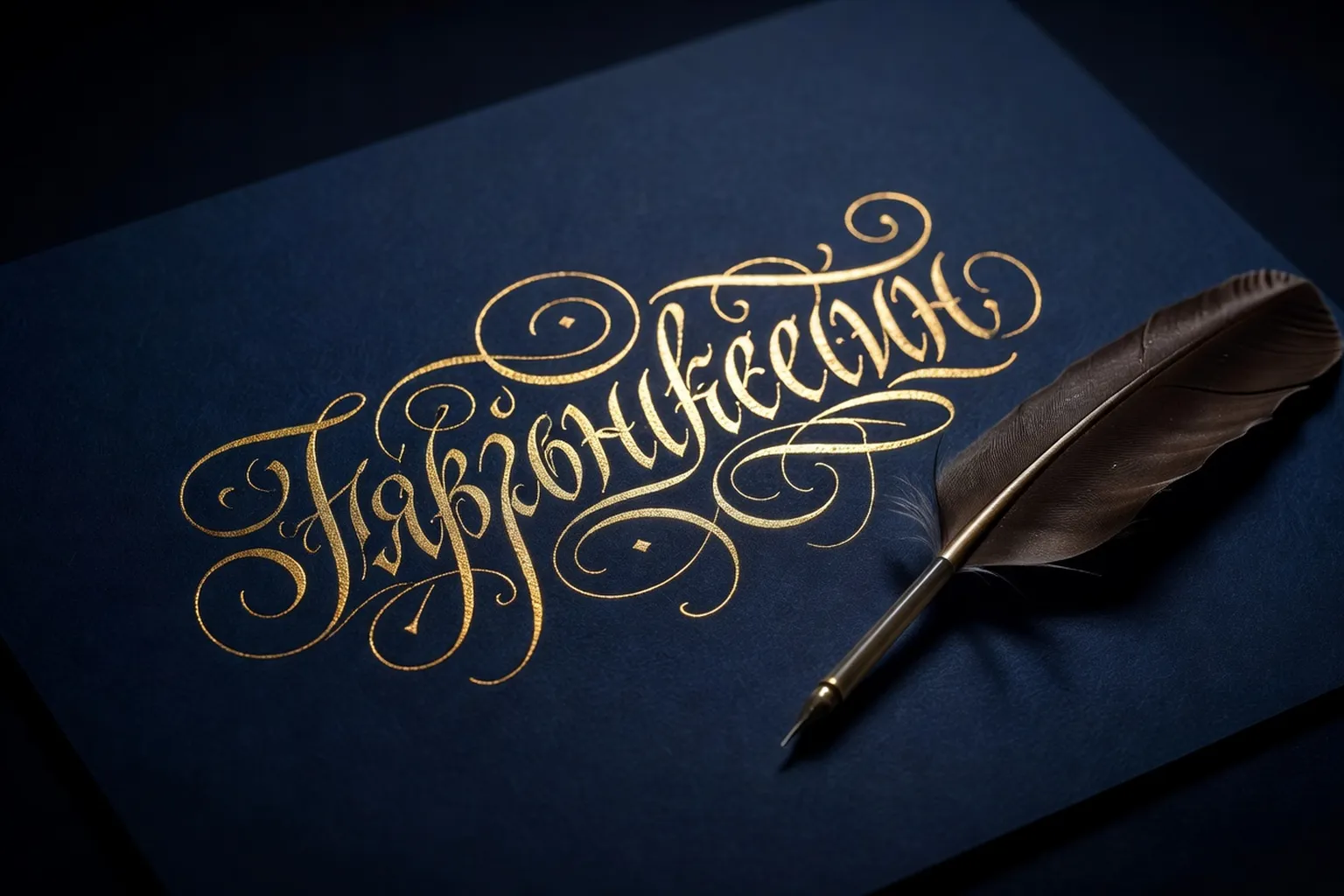
The Birth of the Cyrillic Alphabet
The story of the Russian language begins not in Russia but in Macedonia, in the middle of the 9th century, with two brothers from Thessalonica: Constantine (who took the monastic name Cyril) and Methodius. Sent by the Byzantine Emperor Michael III to evangelise the Slavic peoples of Moravia, they confronted a fundamental problem: there was no written form of the Slavic languages. The liturgy, the Bible and theological texts could not be translated into Slavic without a script to write them in.
Constantine’s response was one of the most remarkable intellectual achievements of the medieval world. He created the Glagolitic alphabet — 40 letters designed from scratch to represent the sounds of Old Slavic — in 862 or 863, completing the translation of the Gospels and other liturgical texts in time for the mission to Moravia. The Cyrillic script, named after him by his disciples, was developed later (probably by his student Clement of Ohrid in Bulgaria, c. 893) and adapted the Glagolitic system to incorporate Greek letter forms where they corresponded to Slavic sounds.
Key takeaway: The Cyrillic alphabet was not inherited passively but deliberately created in the 860s by Constantine (Cyril) and Methodius as a theological and political act — the assertion that Slavic peoples had the right to worship, and to write, in their own language.
This act of linguistic creation was simultaneously a theological statement and a political challenge. Rome had long insisted that the liturgy be conducted only in Latin, Hebrew or Greek — the three “sacred” languages supposedly inscribed on the titulus above the Cross. Constantine and Methodius argued, with remarkable sophistication, that all languages were equally capable of expressing divine truth, and that the Slavic peoples had the right to worship in their own tongue. Pope Adrian II ultimately approved the Slavic liturgy in 868 — a decision with enormous consequences for European cultural history.
The Cyrillic script that arrived in Kievan Rus with Christianity in 988 was subsequently adapted and simplified over the centuries. Peter the Great’s reform of 1708 introduced the civil script (grazhdansky shrift), a simplified form for secular use; the final major reform came in 1918, when the Bolsheviks eliminated several obsolete letters and standardised the modern 33-letter alphabet.
The Beauty and Logic of Cyrillic
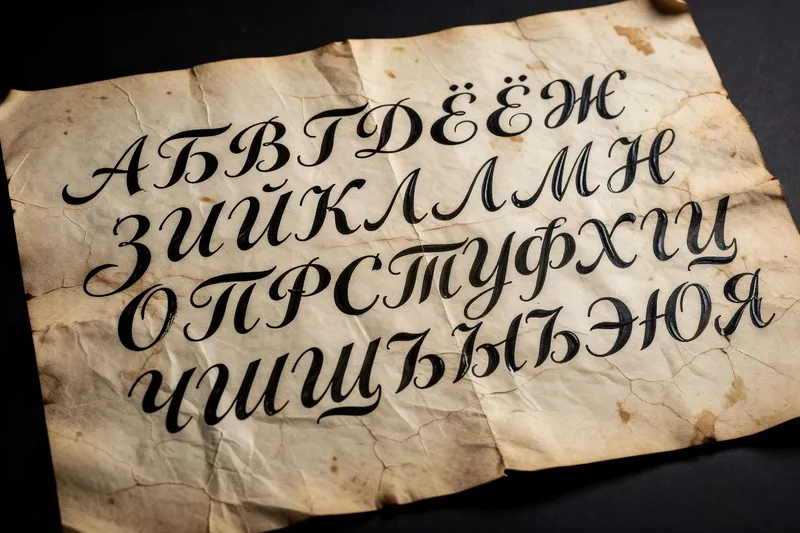
Many learners are intimidated by the Cyrillic script, but this fear is largely unfounded. The 33 letters of the Russian alphabet can be mastered in one to two weeks of consistent practice. The logic of the system is actually superior to that of English spelling: Russian Cyrillic is largely phonetic, meaning that words are pronounced as they are written (with some predictable exceptions involving vowel reduction in unstressed syllables).
The visual distinction between Cyrillic and Latin is smaller than it appears, and letters fall into three clear groups for the beginner:
| Group | Examples | Behaviour |
|---|---|---|
| Identical or near-identical | А, Е (YE), К, М, О, Т | Look and sound familiar |
| False friends (look Latin, sound different) | В (V), Р (R), С (S), Н (N), Х (CH as in “Bach”), У (OO) | Require deliberate relearning |
| Entirely new shapes | Ж (ZH), Ч (CH), Ш (SH), Щ (soft SH), Ю (YU), Я (YA) | No Latin equivalent, learned fresh |
The two signs that have no pronunciation of their own — the soft sign ь and the hard sign ъ — modify the pronunciation of the consonant they follow. The soft sign palatalises the preceding consonant (making it “softer,” produced further forward in the mouth); the hard sign, now quite rare, indicates the absence of palatalisation after certain prefixes. Once learners understand these modifying signs, the logic of Russian pronunciation becomes clear.
Russian literature rewards the effort of learning Cyrillic many times over. Pushkin’s original text of Eugene Onegin, Akhmatova’s Requiem, Pasternak’s lyrics — these works gain an entirely new dimension when read in the original. The musicality of Russian poetry, its rhymes and rhythms, its phonetic beauty, are simply not accessible through translation.
Russian Grammar: Cases, Aspects and the Freedom of Word Order
Russian grammar has a reputation for difficulty that is, in part, deserved but also partly misleading. The challenges are real but finite; mastering them opens a language of extraordinary expressive flexibility.
The six grammatical cases are the central structural feature. Russian nouns, pronouns and adjectives change their endings depending on their grammatical function in the sentence.
| Case | Function | Example |
|---|---|---|
| Nominative | Subject of the verb | Ivan reads a book |
| Accusative | Direct object | Ivan reads a knigu (book) |
| Genitive | Possession, negation | Ivan’s book; there is no book |
| Dative | Indirect object | Give a book to Ivan |
| Instrumental | Means, company | Writing with a pen; travelling with Ivan |
| Prepositional | Location, after certain prepositions | Thinking about a book |
This system sounds complicated, and mastering all the endings for all noun classes, adjective agreement patterns and pronoun forms takes considerable time. But the case system provides something English lacks: complete freedom of word order. In Russian, Ivan loves Maria and Maria, Ivan loves express the same basic meaning but with different emphases; the case endings make the grammatical relationships unambiguous regardless of position. This is why Russian poetry can achieve rhyme schemes and metrical patterns impossible in English — the case endings move where the poet needs them.
Verbal aspect — the distinction between perfective and imperfective verbs — is the other major grammatical challenge. Russian verbs exist in pairs: one form indicates completed actions (I wrote the letter — done, finished), the other indicates ongoing or habitual actions (I was writing the letter, I write letters regularly). English approximates this distinction with auxiliary verbs (I wrote / I was writing), but in Russian it is built into the verb itself. Mastering aspect takes time but dramatically improves both comprehension and expressive nuance.
Russian in the World: 258 Million Speakers
Russian is the most widely spoken Slavic language and the sixth most spoken language in the world by total number of speakers. Approximately 154 million people speak it as their native language, primarily in Russia, Belarus, Kazakhstan and Kyrgyzstan. A further 104 million use it as a second language, particularly throughout the former Soviet space: Ukraine, Moldova, the Baltic states, the Caucasus, Central Asia.
During the Soviet era, Russian served as the lingua franca of an empire spanning twelve time zones. Scientists, engineers, military officers, politicians and cultural figures from Tallinn to Tashkent communicated in Russian; Russian was the language of advanced education, upward mobility and access to metropolitan culture throughout the USSR. This linguistic legacy persists: Russian remains the common language of post-Soviet technical and scientific communities, and Russian-language media, publishing and internet content continue to serve a vast audience stretching from the Baltic to the Pacific.
Russian is one of the six official languages of the United Nations, and one of the two working languages of the UN Secretariat (with English). It is the fourth most used language on the internet by number of websites. Russian-language culture — literature, cinema, music, journalism — maintains global reach through a diaspora extending from Berlin to New York to Tel Aviv to Melbourne.
Russian history has shaped the language in ways visible to any careful reader. Words borrowed from Church Slavonic carry a formal, elevated register (the Slavic word for “city,” grad, sounds more solemn than the vernacular gorod). Petrine-era borrowings from Dutch, German and French filled the vocabulary of technology, navigation, military affairs and social life. Soviet ideological vocabulary — tovarishch (comrade), kolkhoz (collective farm), glasnost, perestroïka — entered international usage and remains part of Russian cultural memory.
Learning Russian: A Practical Guide
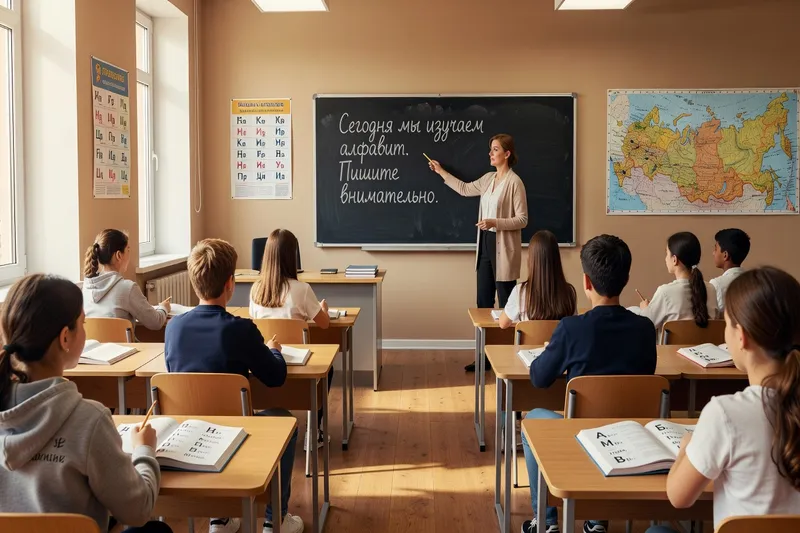
Learning Russian is one of the most rewarding language projects an English speaker can undertake, and the resources available today are far better than those of even twenty years ago. A structured approach works better than ad hoc vocabulary accumulation, and generally follows this progression:
- Master the Cyrillic alphabet through daily practice with pronunciation guides and audio
- Build core vocabulary through spaced repetition (Anki with Russian frequency lists)
- Learn grammar through pattern recognition rather than paradigm memorisation
- Begin conversation practice early, even before grammar feels secure
- Immerse through Russian films, music and media to accelerate progress
Begin with the alphabet: two weeks of daily practice, using a pronunciation guide and audio resources, will enable you to read any Russian word phonetically. This is the essential first step; attempting to learn vocabulary in transliteration creates habits that are very difficult to correct later. The website langue-russe.fr provides structured lessons for French speakers, while offering resources also useful for the Anglophone learner interested in the linguistic parallels.
Once the alphabet is secure, vocabulary acquisition through spaced repetition (Anki software with Russian frequency lists) provides the fastest route to reading comprehension. Russian has absorbed many international words — especially in science, technology, medicine, music and gastronomy — that are immediately recognisable: telefon, restoran, teatr, muzey, kompyuter. Building on this recognition, a learner can acquire a working vocabulary of 1,000 common words within three months of consistent daily study.
Grammar should be approached through pattern recognition rather than memorisation of paradigm tables. Choose one or two good grammars (David Barras’s Russian Grammar for English speakers, or the Assimil method which integrates grammar into dialogues naturally) and work through them systematically. The cases become less frightening once you understand that each one has a core semantic logic that covers most uses.
Conversation practice is essential and should begin earlier than most learners think. Platforms like italki and Preply connect learners with Russian native speakers for conversational practice at all levels. Russian tutors are generally excellent, patient and affordable. Even thirty minutes of conversation practice per week produces measurable improvements in comprehension and confidence.
Traducteur-russe.com offers professional translation services for those needing to engage with Russian texts in professional or personal contexts — and browsing the site’s resources gives a useful sense of the complexity and richness of professional Russian-to-French and French-to-Russian translation.
Russian as a Cultural Key
The deepest reason to learn Russian is not practical but cultural. Russian literature, music, philosophy and spiritual tradition constitute one of the great cultural inheritances of humanity. To read Pushkin in the original, to understand the wordplay and cultural allusions in Chekhov, to follow the theological arguments of Dostoevsky’s Father Zosima in The Brothers Karamazov, to hear the liturgy of the Orthodox Church in Church Slavonic — these experiences are simply not available in translation, or available only in attenuated form.
Key Russian cultural concepts like toska (spiritual longing), doucha (soul), mir (world/peace/commune) and avos’ (fatalistic hope) require knowledge of Russian not just to pronounce but to feel. These words resonate in the Russian imagination with associations accumulated across centuries of literary, spiritual and everyday use. A translator can provide a definition; only the language itself provides the experience.
Important: No translation can substitute for the language itself when it comes to Russian culture’s untranslatable concepts. Toska, doucha, mir and avos’ can be defined in English, but they can only be fully felt by a reader who encounters them in Russian, with the accumulated weight of centuries of literary and everyday use behind them.
The Russian language is ultimately a key to a way of seeing the world: its grammar encodes assumptions about time, action, completion and ongoing process that differ from English assumptions; its vocabulary carries the weight of specific historical and cultural experiences. Learning it is an act of imaginative hospitality — an opening of oneself to a radically different yet extraordinarily rich way of being human.
Frequently Asked Questions
The US Foreign Service Institute classifies Russian as a Category III language requiring approximately 1,100 hours of study for professional proficiency — about twice the time needed for French or Spanish, but significantly less than Arabic, Chinese or Japanese. The main challenges are the Cyrillic alphabet (learnable in 1–2 weeks), the six grammatical cases, and verbal aspects. The phonology is actually not especially difficult for English speakers.
The modern Russian Cyrillic alphabet has 33 letters: 10 vowels, 21 consonants, and 2 signs (the soft sign ь and the hard sign ъ) that modify pronunciation without themselves being pronounced. Several letters look identical to Latin letters but represent different sounds (P = R, C = S, H = N, B = V), which is the main source of confusion for beginners.
Russian has six grammatical cases: Nominative (subject), Accusative (direct object), Dative (indirect object), Genitive (possession and negation), Instrumental (by means of, together with), and Prepositional (location, after certain prepositions). Each noun, adjective and pronoun changes its ending depending on its case. There are no articles (no 'the' or 'a') in Russian, which simplifies one area while complicating another.
Russian has approximately 258 million speakers worldwide: about 154 million native speakers and 104 million second-language speakers. It is the official or co-official language of Russia, Belarus, Kazakhstan and Kyrgyzstan, and is widely used across the former Soviet space from the Baltic states to Central Asia. Russian is one of the six official languages of the United Nations.
Effective resources include: Assimil Russian (for structured grammar learning), Anki (for vocabulary memorisation with spaced repetition), Duolingo (for daily practice and habit formation), italki or Preply (for conversation practice with native speakers), and the website Russian Pod 101 for audio learning. Immersion through Russian films (with subtitles), Russian music and Russian-language media accelerates progress significantly.