The Baptism of Rus: A Civilisational Choice
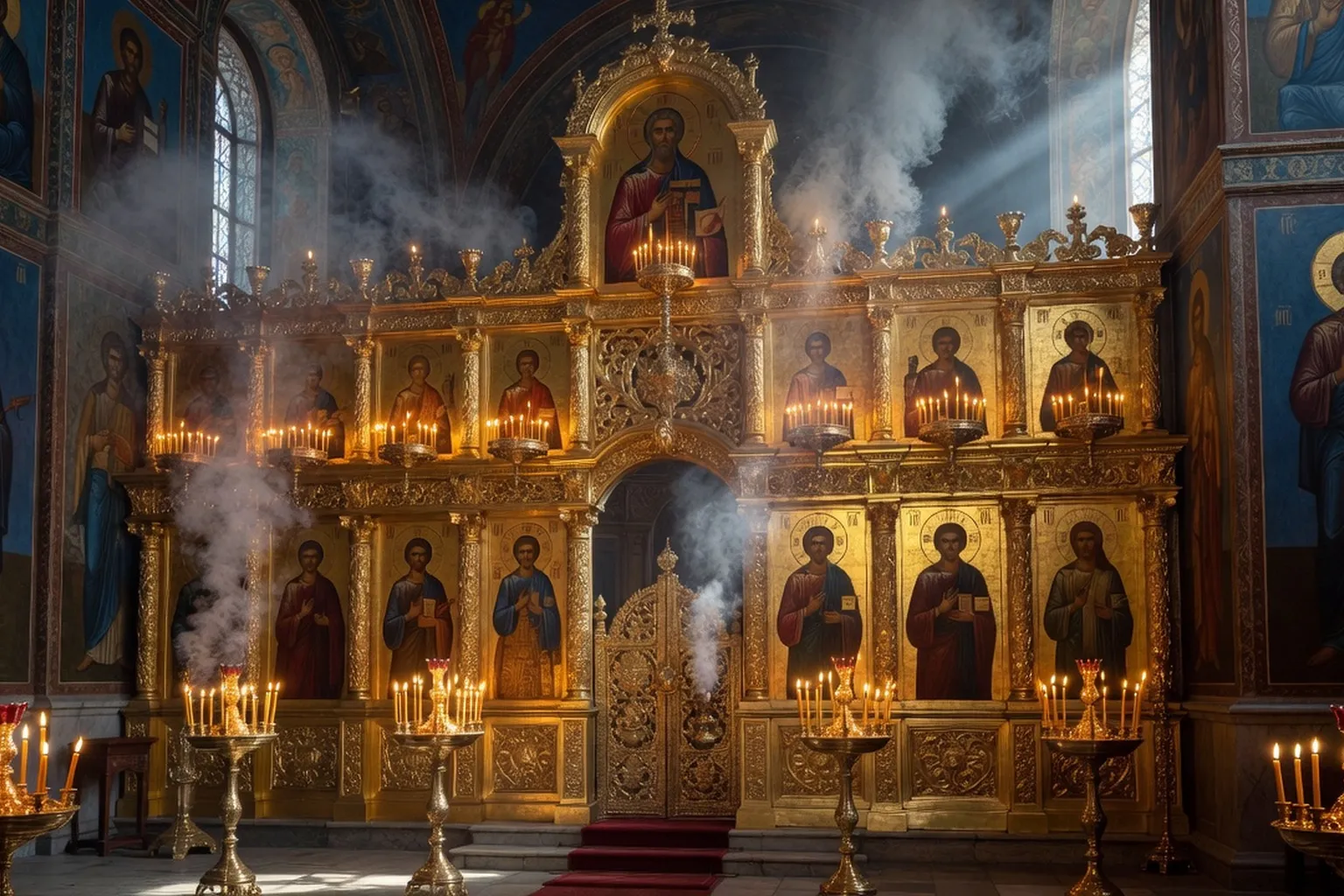
The year 988 is the most important date in Russian cultural history. When Prince Vladimir I of Kiev ordered the mass baptism of his people in the Dnieper River, he made a civilisational choice whose consequences continue to unfold more than a thousand years later. The famous account of how Vladimir decided — reportedly sending envoys to observe the major religions, with the Orthodox emissaries returning overwhelmed by the liturgy they witnessed in Constantinople’s Hagia Sophia (“We knew not whether we were in heaven or on earth”) — may be a literary construction, but it captures something true about the Russian religious sensibility: its emphasis on beauty, transcendence and experiential encounter with the divine.
Key takeaway: The Baptism of Rus in 988 was not merely a religious conversion but a civilisational choice — Vladimir’s adoption of Byzantine Christianity brought Russia the icon, liturgical chant, mosaic art and domed architecture as a single cultural package that still shapes Russian identity today.
Vladimir’s choice of Byzantine Christianity over Latin Christianity, Islam and Judaism was not arbitrary. Kievan Rus had longstanding commercial and diplomatic ties with Constantinople; Byzantine culture — its art, its law, its theological tradition — was the most sophisticated the medieval world offered. The Orthodox Church brought to Russia not only Christian theology but the Byzantine aesthetic tradition: the icon, the liturgical chant, the mosaic, the architectural forms of the domed church. These arrived as a complete cultural package that shaped Russian civilisation at its most fundamental level.
The process of Christianisation was long and uneven. Pagan practices survived for centuries alongside Christian ones in a phenomenon the church called dvoeverie (dual faith): the old gods were not so much defeated as assimilated, reappearing in the guise of Christian saints. Saint Blaise became the protector of cattle (replacing the Slavic god Veles); fertility rites were absorbed into the spring festivals of Orthodox Easter; the midsummer festival of Ivan Kupala retained pre-Christian elements that the Church could never quite expunge.
The relationship between Church and state in Russia was always intimate and sometimes dangerously confused. Russian history is partly a story of this entanglement: the Church providing ideological legitimacy to rulers, rulers protecting (and sometimes dominating) the Church. The phrase Moscow is the Third Rome — articulated by the monk Filofei of Pskov in the early 16th century — expressed the idea that after the fall of Constantinople (1453), Moscow had inherited the role of centre of true Christianity.
The Divine Liturgy: A Theology in Sound and Movement
To attend a Russian Orthodox Divine Liturgy is to encounter a form of worship that has changed very little since the 9th century, and in its essential structure has remained stable since the 4th. The Liturgy of Saint John Chrysostom, the most commonly celebrated form, is a richly layered ceremony in which every movement, gesture, vestment, vessel and word carries theological significance. For the unprepared Western visitor, it can appear bewildering; for those who have spent time understanding its structure, it reveals extraordinary depth.
The Divine Liturgy unfolds in a fixed sequence, each stage carrying its own theological weight:
| Stage | What happens | Theological significance |
|---|---|---|
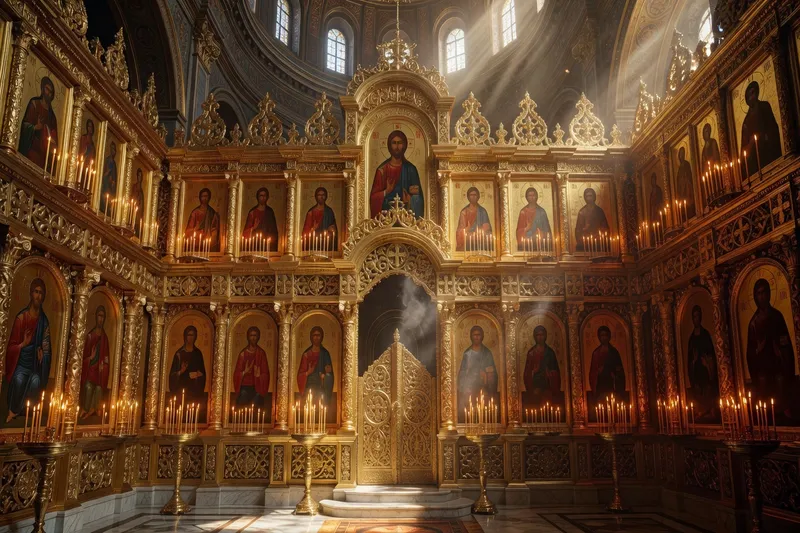
| Proskomedia | Preparation of bread and wine, in private | Behind the iconostasis, unseen by the faithful |
| Great Litany | Choir responds Gospodi pomiluy to each petition | Opens the public portion of the liturgy |
| Liturgy of the Word | Old Testament, Epistle, Gospel readings, homily | Instruction of the faithful |
| Great Entrance | Bread and wine carried in solemn procession | Beginning of the Liturgy of the Faithful |
| Anaphora | Prayer of consecration, sung softly by the priest | The central mystery of the Eucharist |
| Communion | Distributed on a golden spoon | Union of the faithful with Christ |
Russian choral music finds its deepest roots here. The choir is not an embellishment but an essential participant in the liturgy, representing the voices of angels. Orthodox regulations forbid any instrument in the service: the human voice alone is acceptable, a rule that shaped the extraordinary development of Russian choral polyphony from the 17th century onward. Rachmaninoff’s All-Night Vigil (1915) and his Divine Liturgy of St John Chrysostom are the greatest achievements of this tradition in its concert form.
Russian Monasteries: Centres of Prayer and Learning
The monastery has been the laboratory of Russian Orthodoxy from its earliest days. Saint Theodosius of the Caves (died 1074) established the Kyiv Pechersk Lavra (Monastery of the Caves) as the prototype of Russian cenobitic monasticism, adapting the Byzantine rule of Theodore the Studite to Russian conditions. This tradition of rigorous communal asceticism, combined with manuscript copying, icon painting, medical care and hospitality to pilgrims, made Russian monasteries the cultural and charitable centres of medieval society.
The Trinity-Saint Sergius Lavra (Troitse-Sergieva Lavra) in Sergiev Posad, 70 kilometres north of Moscow, is the spiritual capital of Russian Orthodoxy. Founded around 1345 by Saint Sergius of Radonezh — Russia’s most beloved saint, whose spiritual authority united the warring Russian princes against the Mongols — the monastery became the site of a decisive Russian victory at the Battle of Kulikovo (1380), blessed by Sergius himself. It survived a Polish siege during the Time of Troubles (1608–1610), was secularised and restored several times, and today functions both as an active monastery of some 300 monks and as a major museum complex attracting hundreds of thousands of visitors annually.
The Solovetsky Monastery, founded in 1436 on islands in the White Sea above the Arctic Circle, represents both the heights and the depths of Russian monastic history. Its remote location made it both a spiritual stronghold and, under Stalin, the site of one of the first Soviet labour camps — the SLON (Solovetsky Special Purpose Camp, 1923–1939), prototype of the entire Gulag system. The monastery was restored to the Orthodox Church in 1990; today its whitewashed walls and golden domes rising from the windswept islands carry the weight of this complex history.
Russian traditions were preserved and transmitted through monasteries, which functioned as workshops for a whole range of practical arts:
- Icon painting techniques passed from master to apprentice
- Liturgical embroidery and manuscript illumination
- Herbal medicine and hospitality to pilgrims
- Brewing of kvas and other monastic crafts
The Icon as Theology: Writing the Sacred Image
The Orthodox icon (ikona, from the Greek eikôn, image) is not a painting in the Western sense. It is a sacred object, a window onto divine reality, produced according to canonical forms that have been refined over fifteen centuries. To understand the icon is to understand the difference between the Orthodox and Western approaches to sacred art.
The icon painter does not create freely: he or she follows patterns (podlinniki) that govern the proportions, colours and compositional arrangements of each sacred figure. Faces are elongated, eyes enlarged, noses small — not because the painter cannot draw naturalistically, but because the goal is not naturalistic representation but spiritual transparency. The figure depicted in an icon is not the physical body of the saint but his or her transformed, glorified body as it exists in the Kingdom of God. The gold background represents the uncreated light of divine reality; the inverse perspective (in which lines converge not at a vanishing point behind the picture plane but toward the viewer) expresses the idea that the icon looks out at the viewer rather than being viewed passively.
The Iconoclast Controversy (726–843) nearly destroyed the icon tradition. The Byzantine Emperor Leo III, influenced by Islamic and Jewish objections to religious images, ordered the destruction of icons throughout the empire. The Second Council of Nicaea (787) definitively rejected iconoclasm, establishing that icons are venerable (not worshipped) and that the honour given to an image passes to its prototype. This theological resolution shaped the entire subsequent tradition.
The greatest icon painter in Russian history is Andrei Rublev (c. 1360–1430), whose Old Testament Trinity (c. 1411) — depicting the three angels who visited Abraham at Mamre as a representation of the Holy Trinity — is considered the masterpiece of the genre. Rublev’s ability to convey theological depth through colour (his blues and greens are extraordinary), compositional balance and psychological stillness has never been surpassed. The original is housed at the Tretyakov Gallery in Moscow; Russian visual arts cannot be understood without this icon at their centre.
Orthodoxy in Western Europe: The Institut Saint-Serge
The Russian Revolution scattered the Orthodox clergy along with the rest of the educated emigration. Bishops, priests, theologians and lay intellectuals found themselves in Paris, Belgrade, Prague and Berlin, faced with the task of maintaining the Church in conditions of poverty, uncertainty and complete discontinuity with their Russian homeland.
The response to this challenge was remarkable. The Institut de Théologie Orthodoxe Saint-Serge (Institut Saint-Serge), founded in Paris in 1925 on a former Lutheran property in the 19th arrondissement, became the intellectual centre of Russian Orthodoxy in exile. Its faculty included some of the greatest Orthodox theologians of the 20th century: Sergei Bulgakov, Georges Florovsky, Alexander Schmemann and John Meyendorff. Their work — developed in dialogue with Catholic and Protestant theologians in Paris — shaped Orthodox theology worldwide and contributed decisively to the ecumenical movement.
Cerclepouchkine.com documents the cultural events through which the Orthodox and Russian communities in France maintain their heritage: concerts, exhibitions, literary evenings, and celebrations of the great feast days that structure the Orthodox year. This cultural presence is inseparable from the spiritual one: in Russian tradition, faith and culture are not two separate spheres but dimensions of a single way of inhabiting the world.
The Orthodox revival inside Russia since 1991 has been extraordinary in scale. Thousands of churches closed under Stalin have been restored; hundreds of new monasteries have been opened; religious education has returned to schools. The Cathedral of Christ the Saviour in Moscow, demolished by Stalin in 1931 to build a swimming pool, was rebuilt in the 1990s and consecrated in 2000. Whatever the political complications of the Church’s relationship with the state, the spiritual hunger that drives this revival is genuine and deep.
The Russian diaspora in Europe maintains its Orthodox parishes and institutions as centres not only of worship but of cultural transmission. The parish choir that sings the Liturgy of St John Chrysostom in Brussels or Berlin carries a tradition that stretches back through the monasteries of medieval Rus to the liturgical chant of Constantinople — a living thread connecting modern Russians to a civilisational inheritance that no political upheaval has been able to sever.
Frequently Asked Questions
The Baptism of Rus occurred in 988, when Prince Vladimir I of Kiev ordered the mass baptism of his subjects in the Dnieper River following his own conversion. Vladimir chose Christianity over Islam, Judaism and Latin Christianity after reportedly sending envoys to observe each religion; his emissaries were said to have been overwhelmed by the beauty of the Divine Liturgy in Constantinople's Hagia Sophia.
The Divine Liturgy is the central act of Orthodox worship, based primarily on the Liturgy of Saint John Chrysostom (4th century). Sung entirely in Church Slavonic (or in the national language of the celebrating community), it lasts approximately 90 minutes and involves an elaborate sequence of prayers, Scripture readings, processions and the Eucharist. There is no organ; all music is provided by the human voice, a cappella.
The Trinity-Saint Sergius Lavra in Sergiev Posad (founded c. 1345 by St Sergius of Radonezh) is the spiritual heart of Russian Orthodoxy. The Solovetsky Monastery in the White Sea (founded 1436) became infamous as the site of early Soviet political prison camps. The Novodevichy Convent in Moscow (1524) is a UNESCO World Heritage Site. The Pskov-Caves Monastery has maintained continuous monastic life since the 15th century.
Orthodox theology holds that an icon is not a mere picture or illustration but a window onto the divine — a visible representation of invisible spiritual reality. The Second Council of Nicaea (787) established that icons are venerable (not worshipped, which is reserved for God alone) and that the honour given to an image passes to its prototype. Icons are written (not painted) according to canonical forms that have theological meaning: inverse perspective, gold backgrounds, stylised figures that convey spiritual rather than physical reality.
Orthodoxy in Western Europe is divided between several jurisdictions: the Moscow Patriarchate (with parishes in most Western European countries), the Russian Orthodox Church Outside Russia (ROCOR, reunited with Moscow in 2007), and the Archdiocese of Russian Orthodox Churches in Western Europe (historically under Constantinople). The Institut de Théologie Orthodoxe Saint-Serge in Paris, founded in 1925, has been the intellectual centre of émigré Orthodoxy.