What Is an Orthodox Icon? The Theology of the Sacred Image
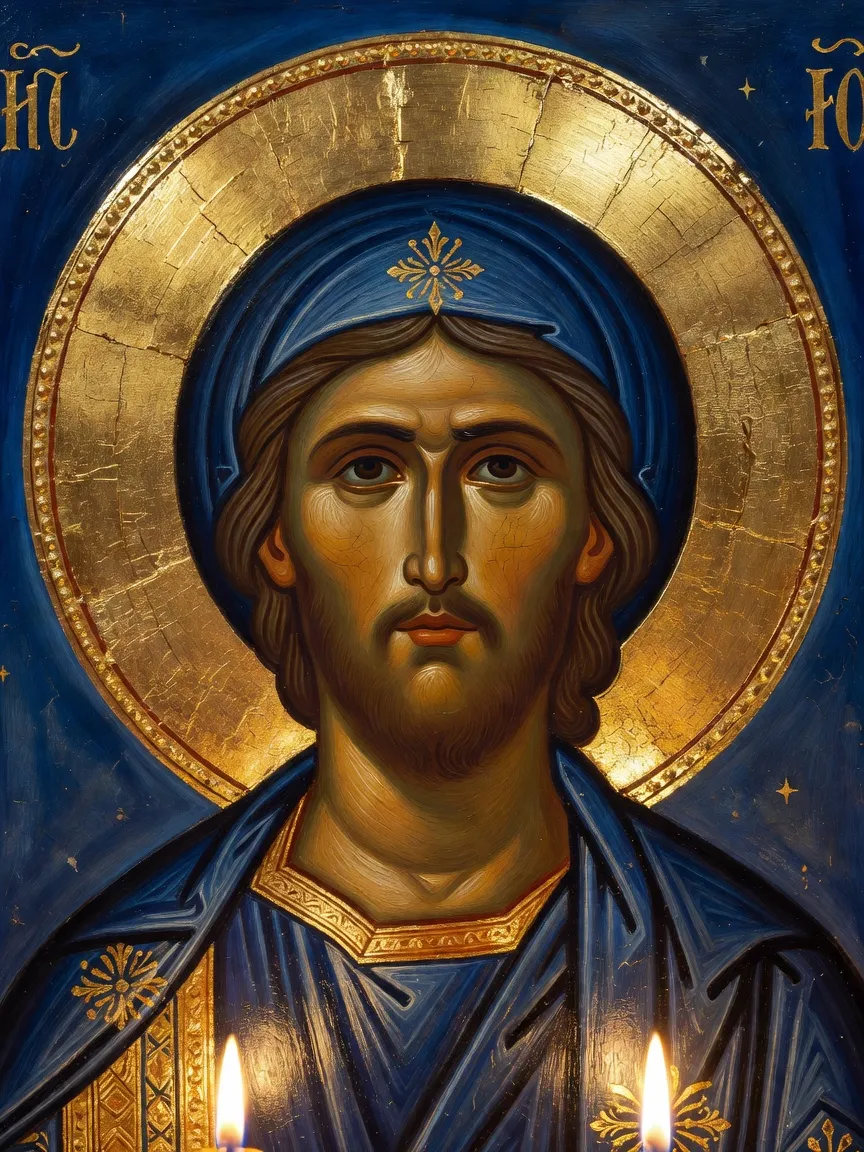
The Orthodox icon is one of the most theologically sophisticated art forms in human history — and one of the most commonly misunderstood by Western observers. An icon is not a religious painting in the Western sense. It is not created to decorate a church, celebrate an event, or express an artist’s vision. An icon is a liturgical object: a window onto the divine, an opening between the visible and invisible worlds, a means of sacred encounter. This distinction is fundamental to everything that follows.
The theological foundation of the icon was established at the Second Council of Nicaea in 787 CE, which resolved the Byzantine iconoclast controversy. The council distinguished between latria (worship due to God alone) and proskynesis (veneration appropriate for sacred images). The honor shown to an icon, the council declared, “passes to its prototype” — venerate the icon of Christ, and your veneration reaches Christ himself. This theological formulation legitimized icon veneration while protecting monotheism.
Three features distinguish icons from Western religious art and flow directly from this theology:
Reverse perspective: In Western art from the Renaissance onward, perspective creates an illusion of depth pulling the viewer’s eye into the depicted scene. In icons, perspective is reversed — the vanishing point lies in front of the image, in the viewer’s space. The figures expand slightly toward the viewer rather than receding away. Theologically, this expresses the idea that the holy persons depicted are present with the viewer, reaching outward from the divine realm into the human world.
Symbolic color: Icon colors carry fixed theological meanings, not naturalistic ones. Gold backgrounds represent divine light — eternity, the light of God’s presence. Red signifies divinity and martyrdom in different contexts. Blue indicates humanity or the earthly world. The Virgin Mary’s traditional blue and red garments simultaneously express her humanity (blue robe) and her divine maternity (red undergarment).
The kovtcheg: The distinctive slightly recessed central field of many icons (the kovtcheg or “ark”) frames the sacred image and distinguishes it visually from the world of the frame. Crossing the border of the kovtcheg is, theologically, crossing from the earthly to the divine plane.
| Feature | Western religious art | Orthodox icon |
|---|---|---|
| Perspective | Vanishing point within the scene, pulling the eye inward | Reverse perspective, vanishing point in the viewer’s space |
| Purpose | Decoration, narrative, artistic expression | Liturgical object, “window onto the divine” |
| Color | Naturalistic | Symbolic and theologically fixed (gold = divine light, red = divinity/martyrdom, blue = humanity) |
| Framing | Simple frame | Kovtcheg — recessed field marking the threshold to the divine plane |
Key takeaway: Every visual choice in an icon — perspective, color, framing — is a theological statement, not an aesthetic preference. The Council of Nicaea’s distinction between latria and proskynesis is what makes this entire visual language legitimate within Orthodox theology.
Exploring Visual Arts provides broader context for how the icon tradition fits within Russian artistic culture more broadly.
From Kievan Rus to Andrei Rublev: A History of Russian Icons
The icon tradition arrived in Russia with Christianity itself, brought from Byzantium when Prince Vladimir of Kiev accepted Orthodox Christianity in 988 CE. The earliest Russian icons were either imported from Constantinople or created by Byzantine masters working in Russia. This Greco-Byzantine inheritance established the canonical forms, color conventions, and theological programs that would define Russian icon painting for centuries.
The earliest major Russian icon schools developed in the city-states of Novgorod and Pskov, which maintained commercial and cultural connections with Byzantium while developing distinctly local characteristics. Novgorodian icons tend toward bold, simplified forms and vivid contrasts — often featuring a distinctive ochre-red background that gives them an immediate visual intensity. The Pskov school developed more expressive, emotionally charged figures with asymmetrical compositions that depart further from Byzantine norms. These regional schools reveal that from its earliest period, Russian icon painting was not mere imitation but active creative interpretation.
The fall of Constantinople to the Ottoman Turks in 1453 had a transformative effect on Russian icon culture. Moscow had already positioned itself as the “Third Rome” — the inheritor of Byzantine Christian civilization — and the fall of the Byzantine capital confirmed this self-understanding. Russian iconographers were now explicitly conscious of bearing the tradition of the Eastern Christian world. This consciousness produced both conservative fidelity to canonical forms and remarkable creative expansion.
The supreme achievement of this period — and arguably the greatest work of Russian religious art in any medium — is Andrei Rublev’s Trinity (c. 1411), commissioned for the Trinity-Sergius Monastery and now housed in the Tretyakov Gallery in Moscow. Rublev depicted the three angels who visited Abraham at the oaks of Mamre (Genesis 18) as an image of the Holy Trinity. The three figures are arranged in a perfect circle around a chalice on the table, creating a composition of absolute harmony and calm. The colors — celestial blue, soft green, muted gold — achieve an extraordinary luminous quality. The figures lean slightly toward each other in a gesture of mutual contemplation that the art historian Pavel Florensky called “the movement of love.”
Rublev’s Trinity synthesizes everything that makes Russian icon painting distinctive: the Byzantine theological structure, the Slavic capacity for spiritual interiority, and a painterly refinement that transcends both. It remains, seven centuries later, an image that stops visitors in the Tretyakov Gallery as completely as it must have stopped the monks who first received it. Rublev himself was canonized by the Russian Orthodox Church in 1988.
The early history of the Russian icon can be traced through several distinct regional schools, each with recognizable characteristics:
- Novgorod school: bold, simplified forms with vivid contrasts, often on a distinctive ochre-red background.
- Pskov school: more expressive, emotionally charged figures with asymmetrical compositions departing further from Byzantine norms.
- Moscow school (culminating in Rublev): synthesis of Byzantine structure, Slavic interiority, and refined painterly technique.
Did you know? The fall of Constantinople in 1453 did not weaken Russian icon painting — it intensified it. Moscow’s self-declared status as the “Third Rome” made Russian iconographers explicitly conscious of carrying forward the entire Eastern Christian artistic tradition.
Painting Technique: How an Orthodox Icon Is Made
Creating an Orthodox icon is understood in the tradition not as artistic production but as prayer made visible. The ikonopisets (iconographer) traditionally prepared through fasting, prayer, and spiritual counsel before undertaking a commission. The craft itself involves extraordinary technical mastery accumulated over years of apprenticeship.
The production of an icon follows a sequence of clearly defined stages, each requiring specific materials and mastery:
- Panel preparation: a wooden panel — typically linden, pine, or cypress — is dried and treated to prevent warping, with the back reinforced by wooden battens.
- Levkas application: a layer of linen cloth is sometimes glued to the front surface, then the levkas (chalk or alabaster mixed with animal glue) is applied in multiple layers and smoothed to a flat surface.
- Design transfer: the composition is transferred through pouncing or direct drawing, establishing the major forms.
- Gold leaf: applied before painting begins, then burnished with an agate stone until it achieves the characteristic luminous depth of icon gold.
- Egg tempera painting: dry pigments ground in water and bound with egg yolk, built in translucent layers from dark to light (sankir technique).
- Varnishing: the finished icon is covered with olifa, a drying oil varnish that protects the surface but darkens significantly over centuries.
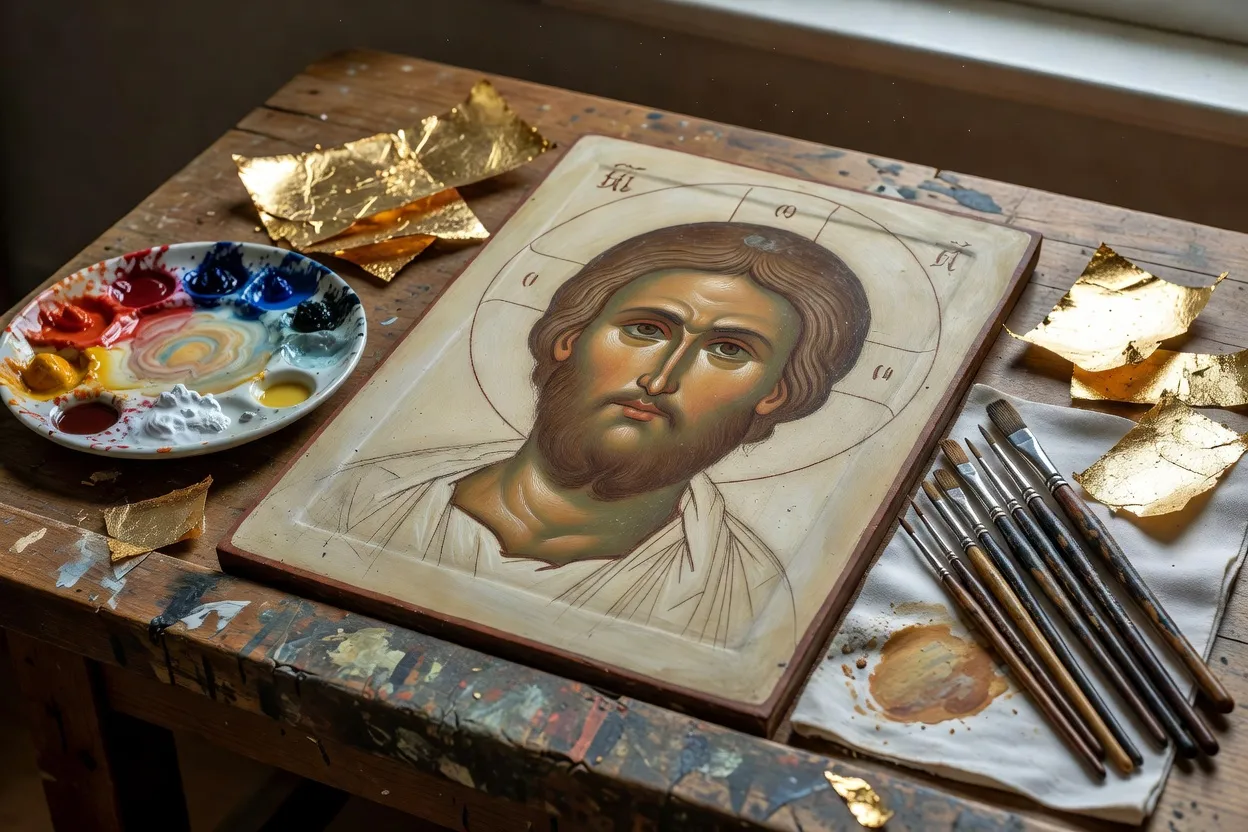
The support is a wooden panel, typically of linden, pine, or cypress, dried and treated to prevent warping. The back of the panel is often reinforced with wooden battens. A layer of linen cloth is sometimes glued to the front surface before the application of the levkas — a preparation of chalk (or alabaster) mixed with animal glue applied in multiple layers and smoothed to a perfectly flat, slightly warm surface.
The design is transferred to the prepared panel through a system of pouncing or direct drawing, establishing the major forms. Gold leaf — the representation of divine light — is applied at this stage, before painting begins. On levkas that has been brought to a specific moisture level, gold leaf is burnished with an agate stone until it achieves the characteristic luminous depth of icon gold.
The paint itself is egg tempera: dry pigments ground in water and bound with egg yolk, sometimes with a small addition of vinegar or white wine as preservative. The technique requires building color in multiple translucent layers, moving from dark to light in a process called sankir — the dark underpainting of flesh tones — followed by successive lighter flesh tones that create the luminous effect of skin in icons. The distinctive high point on foreheads, noses, and cheekbones (called probel) — often appearing as bright white strokes — represents divine light touching the holy face.
Pigments were traditionally mineral, as shown in the table below:
| Pigment | Color produced | Traditional source |
|---|---|---|
| Lapis lazuli | Blue | Semi-precious stone |
| Cinnabar | Red | Mercury sulfide mineral |
| Malachite | Green | Copper carbonate mineral |
| Lead white | Light/highlight tones | Processed lead |
Many historical pigments are now replaced by synthetic equivalents, but the technique remains the same. The finished icon was typically covered with olifa — a drying oil varnish — that protected the surface but darkened significantly over centuries, which is why many old icons appear very dark. The careful removal of this darkened varnish by conservators has revealed, in many cases, colors of extraordinary freshness and brilliance.
The Iconostasis: Where Heaven and Earth Meet
The iconostasis is one of the most distinctive features of Orthodox church architecture — a screen of icons that separates the nave from the sanctuary and makes the boundary between the earthly and divine worlds visually and spatially present.
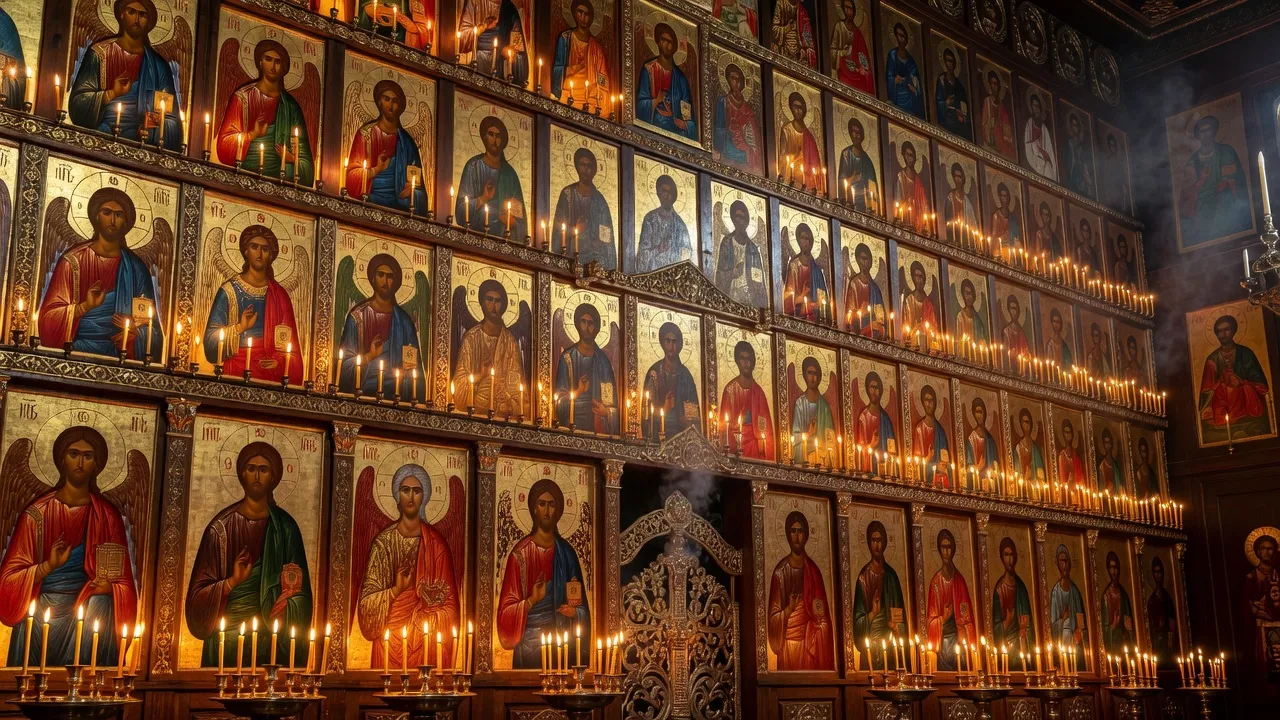
In its developed form, the Russian iconostasis typically consists of four horizontal rows (chin or tier) of icons. The lowest row (mestny or local tier) includes the largest icons, including those of the patron saint of the church. In the center are the Royal Doors (tsarskie vrata), which open into the sanctuary and typically depict the Annunciation and the four Evangelists. The iconostasis of the Assumption Cathedral in the Kremlin, dating from the fifteenth century, provides the classic model.
The second row (prazdnichny or festal tier) depicts the twelve major feasts of the Orthodox liturgical year: Nativity, Theophany, Entry into Jerusalem, Ascension, Pentecost, and others. The third row (deisis tier) is centered on Christ enthroned in majesty, flanked by the Virgin Mary and John the Baptist interceding for humanity, and accompanied by archangels, apostles, and saints. The uppermost row (prophets tier) depicts the Old Testament prophets who foretold the Incarnation.
The visual logic of the iconostasis is both pedagogical and liturgical. Looking at it, the viewer sees the entire economy of salvation simultaneously: the prophets who foretold it, the feasts that marked its unfolding, the interceding saints who accompany it, and Christ at its center. The iconostasis is not a wall that excludes the people from the sanctuary — it is a threshold where the divine and human worlds are made to face each other.
Collecting Russian Icons: Authenticity, Markets, and Resources
The market for Russian icons is active and complex, ranging from masterworks sold at major auction houses for six figures to modest devotional images available for a few hundred dollars. For those seriously interested in collecting, several principles apply.
The first step is education: understanding the different icon schools (Novgorod, Pskov, Moscow, Stroganov), periods (sixteenth through nineteenth century), and subject types is essential before making any significant purchase. Fakes are abundant in the market, and the ability to recognize authentic aging, traditional technique, and canonical composition is non-trivial.
For those interested in acquiring icons through specialist channels, the Russian art market offers multiple entry points. For smaller devotional icons and objects of Russian religious culture, the antique and art market in France and Belgium has historically been significant. The portal art-russe.com/petites-annonces/ offers classified listings for Russian art objects, including icons, where private sellers and small dealers list pieces across a wide range of price points.
Authentication of serious purchases should involve a specialist with expertise in Russian icons specifically — not just Eastern European art generally. Key markers of authenticity include:
- Panel construction consistent with the claimed period.
- Levkas composition and cracking consistent with age.
- Pigment analysis, increasingly available through non-invasive spectroscopy.
- Inscription style consistent with the claimed provenance.
- Provenance documentation — auction records, exhibition history, dealer receipts — which adds significant confidence.
Common mistake: Assuming that a dark, heavily varnished appearance automatically signals age and authenticity. Darkening comes from the olifa varnish oxidizing over time, but this effect can be artificially replicated by forgers — always pair visual impression with material and provenance analysis.
The Russian Orthodox Church itself maintains significant collections of icons in monastery settings. The Trinity-Sergius Lavra at Sergiev Posad, the Novodevichy Convent in Moscow, and the Cathedral of the Transfiguration in Saint Petersburg are among the most important accessible collections. For icons in museum settings, the Tretyakov Gallery in Moscow and the Russian Museum in Saint Petersburg hold the greatest concentrations of masterworks.
The connection between icon veneration and broader Orthodox Spirituality is inextricable: icons are not decorative objects but devotional ones, charged with the prayers of centuries and understood by the tradition as genuine presences. This understanding does not require the viewer to share the theological commitments — but knowing it transforms the experience of looking. The Russian soul that is explored in The Russian Soul: Understanding Dusha finds one of its deepest visual expressions in the icon: depth, interiority, the invisible made visible. The interview with Dr. Sokolova on Russian character also touches on how sacred art functions as a cultural anchor for diaspora communities navigating questions of identity. Both together help explain why the Russian icon, born in Byzantium and transformed on the Slavic plains, remains one of the world’s great art forms more than a thousand years after its arrival in Russia.
Frequently Asked Questions
An Orthodox icon is a sacred image depicting Christ, the Virgin Mary, saints, or scenes from sacred history, understood theologically as a 'window onto the divine.' Unlike Western religious art, icons are not decorative but liturgical objects with precise theological rules governing their composition, color, and perspective.
Reverse (or inverse) perspective places the vanishing point in front of the image, in the viewer's space, rather than within the depicted scene. This deliberate theological choice expresses the idea that the holy figures are present with the viewer, reaching outward from the divine realm into the human world — the opposite of the Western illusion of depth pulling the eye inward.
Andrei Rublev (c. 1360–1430) is considered the greatest Russian iconographer. His Trinity (c. 1411), housed in the Tretyakov Gallery in Moscow, depicts the three angels who visited Abraham and is universally regarded as the pinnacle of Russian icon painting — a perfect synthesis of Byzantine theology, Slavic spiritual sensitivity, and exceptional artistic refinement.
The iconostasis is a screen of icons that separates the nave (where the congregation stands) from the sanctuary (the altar area) in an Orthodox church. It typically has three doors and four horizontal rows of icons with specific theological programs. The iconostasis makes the boundary between the earthly and divine worlds visible and permeable.
Authentic antique icons typically show panel aging (wood contraction, visible in the back), natural cracking of the levkas (chalk ground), and paint layers consistent with traditional tempera technique. Authentication requires examining wood type, paint pigments, inscription style, and stylistic features. Always buy from reputable dealers or auction houses with provenance documentation.