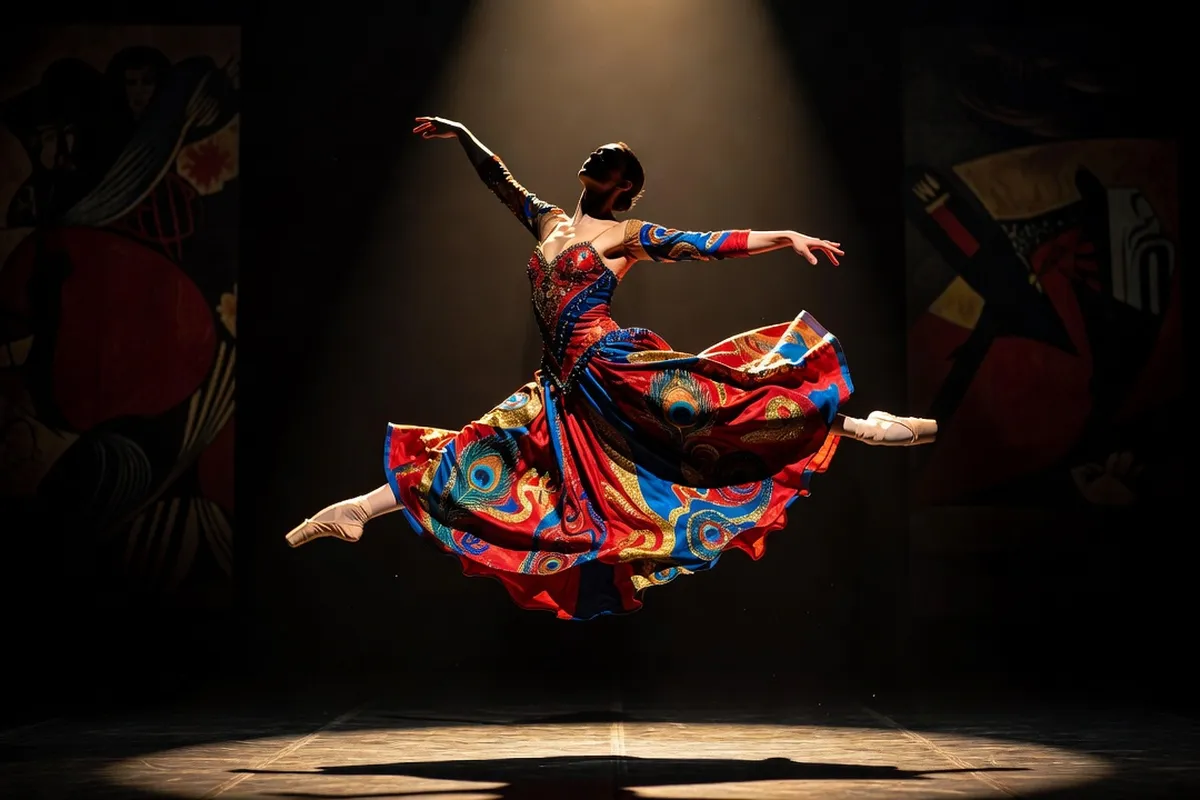
The Ballets Russes under Sergei Diaghilev transformed European cultural life between 1909 and 1929 by importing Russian theatrical energy into Western stages. Their productions fused music, design, and movement at a scale never previously attempted, drawing audiences from Paris to London and New York. The company operated without a permanent home yet maintained a roster of dancers, composers, and painters whose names still define twentieth-century modernism. Diaghilev’s approach drew on deep roots in Russian Visual Arts, where centuries-old icon painting traditions met the experimental impulses of the Mir Iskusstva circle.
Diaghilev, the Visionary Impresario
Sergei Diaghilev was born in 1872 in Perm province and arrived in Saint Petersburg as a law student before shifting to the arts. By 1898 he edited the journal Mir Iskusstva, which championed Russian painters against academic conservatism. Diaghilev organised exhibitions that toured to Paris in 1906 and concerts of Russian music the following year. His method relied on personal networks rather than institutional funding; he secured private patrons and negotiated directly with theatres. When the Imperial Theatres dismissed him in 1908, he turned the setback into an opportunity to create an independent touring ensemble. Diaghilev demanded exacting standards from every collaborator and kept detailed notebooks recording rehearsal times and costume measurements. His financial records show that the 1909 season cost 300,000 francs yet generated ticket sales exceeding 450,000 francs in the first month alone. This combination of curatorial eye and administrative discipline allowed the Ballets Russes to survive repeated crises until his death in Venice in 1929.
The table below summarizes the milestones of Diaghilev’s transition from journal editor to touring impresario:
| Year | Milestone | Detail |
|---|---|---|
| 1898 | Editor of Mir Iskusstva | Championed Russian painters against academic conservatism |
| 1905 | Tauride Palace exhibition | 50,000 visitors in six weeks; established his reputation for large-scale logistics |
| 1906 | Paris touring exhibition | First major export of Russian visual arts to Western Europe |
| 1907 | Concerts of Russian music | Introduced Russian composers to Paris audiences |
| 1908 | Dismissed from Imperial Theatres | Turned the setback into the founding of an independent touring ensemble |
| 1909 | First Ballets Russes season | Season cost 300,000 francs; ticket sales exceeded 450,000 francs in the first month |
Diaghilev’s early career included a decisive 1905 exhibition of historical Russian portraits at the Tauride Palace that attracted 50,000 visitors in six weeks and established his reputation for large-scale logistics. He cultivated relationships with figures such as Grand Duke Vladimir Alexandrovich, whose annual subsidy of 10,000 roubles helped underwrite the 1908 Boris Godunov performances at the Paris Opéra. When the subsidy ended abruptly, Diaghilev turned to industrialist patrons including Gabriel Astruc, who advanced 80,000 francs against future box-office receipts. These arrangements required constant renegotiation; correspondence preserved in the Bibliothèque Nationale reveals thirty-seven letters exchanged in March 1909 alone to finalise venue contracts and insurance coverage for the sets. Diaghilev also maintained a private archive of 1,200 costume swatches, each annotated with dye formulas sourced from Russian textile mills in Ivanovo-Voznesensk, ensuring visual continuity across seasons despite the absence of a fixed workshop.
Diaghilev’s financing relied on several parallel sources rather than a single patron:
- Private subsidies from Russian aristocracy, such as Grand Duke Vladimir Alexandrovich’s 10,000-rouble annual grant that underwrote the 1908 Boris Godunov performances.
- Advances from industrialist patrons, including Gabriel Astruc’s 80,000-franc advance against future box-office receipts.
- Direct box-office revenue, which in the 1909 season alone exceeded costs by 150,000 francs.
- A private archive of 1,200 annotated costume swatches, functioning as a form of institutional capital that preserved visual continuity between seasons without a fixed workshop.
The Birth of the Ballets Russes in Paris in 1909
The company’s debut took place at the Théâtre du Châtelet on 19 May 1909. The opening programme included Le Pavillon d’Armide, Polovtsian Dances from Prince Igor, and Le Festin. Parisian critics noted the vivid colours of Léon Bakst’s sets and the athletic precision of the male dancers, elements absent from contemporary French ballet. Diaghilev had assembled the troupe from the Mariinsky and Bolshoi theatres during their summer holidays, offering salaries double those paid in Russia. Rehearsals occurred in a rented hall near the Opéra, where dancers adapted to raked stages unfamiliar at home. The season ran six weeks and attracted 120,000 spectators. Subsequent tours to Berlin and London in 1910 repeated the success, establishing a pattern of annual spring seasons in Western capitals. The enterprise depended on Russian suppliers for fabrics and on local stagehands for lighting cues, creating a hybrid production model that later influenced festival organisations across Europe.
The 1909 Châtelet season required 147 freight crates shipped from Saint Petersburg, containing 2,800 individual costume pieces and 18 painted backdrops measuring up to 12 metres wide. Michel Fokine rehearsed the Polovtsian Dances with 48 dancers for 92 hours over three weeks, adjusting formations nightly after observing how the raked stage altered sightlines from the upper balconies. Ticket prices ranged from 2 to 20 francs, with the 1,800-seat house selling out 38 of 42 performances. Contemporary press clippings record that the first-night ovation lasted eleven minutes, prompting Diaghilev to schedule an additional matinée that drew 1,650 spectators on a Tuesday afternoon. The logistical model proved replicable: the 1910 Berlin engagement at the Theater des Westens used identical crates, supplemented only by local carpenters who constructed 14 additional rostra in 36 hours.
The Rite of Spring: Scandal and Musical Revolution
On 29 May 1913 the Ballets Russes presented The Rite of Spring at the Théâtre des Champs-Élysées. Igor Stravinsky’s score, choreographed by Vaslav Nijinsky, depicted pagan rituals through angular movements and irregular rhythms. The audience reaction included shouts, laughter, and physical scuffles that halted the performance twice. Contemporary accounts record that the orchestra continued playing while Diaghilev stood in the wings giving cues. The score called for 105 musicians, an unusually large ensemble for ballet, and featured five timpani plus two bass drums. Despite the uproar, the company repeated the work in London three weeks later to more receptive crowds. The choreography required dancers to execute simultaneous yet independent phrases, a technique that challenged classical training. Musicologists later identified the premiere as the moment when rhythm supplanted melody as the primary structural force in modern composition. The production’s visual elements, including Nicholas Roerich’s earth-toned costumes, reinforced the theme of ritual sacrifice.
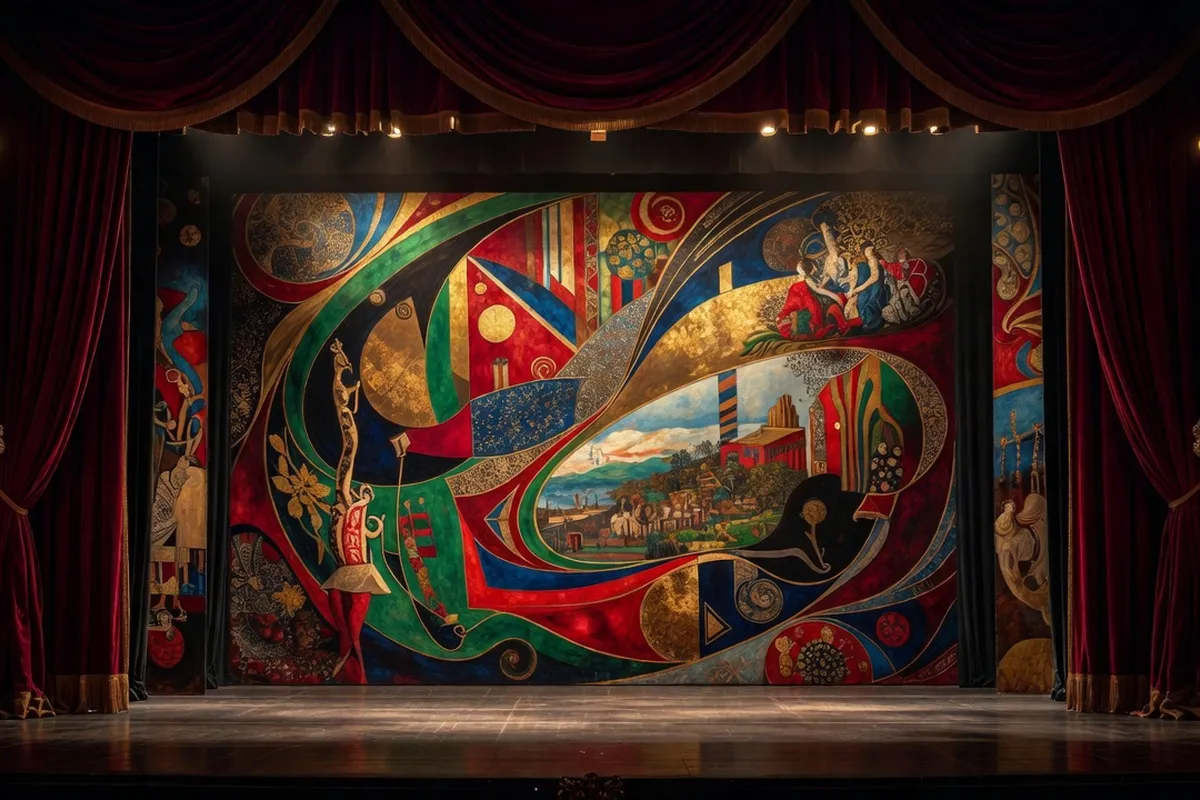
Rehearsals for the 1913 premiere consumed 134 hours across 47 sessions held in a disused Montmartre gymnasium whose floorboards had to be reinforced twice to support the stamping sequences. Nijinsky’s notation system, later reconstructed by dance historians, assigned each of the 48 dancers a unique spatial grid of 12 squares that shifted every four bars. The orchestra’s 105 players included eight horns and five clarinets, all required to play in extreme registers that caused several instruments to crack during the first two performances. After the Paris scandal, the London run at the Theatre Royal, Drury Lane, sold 94 percent of capacity across 14 showings, with Stravinsky himself conducting the final three. Archival payroll records indicate that the additional musicians received 12 francs per performance plus a 50-franc bonus for the two nights when the work was encored.
The Rite of Spring’s two premieres reveal a striking contrast in reception:
| Metric | Paris premiere (29 May 1913) | London run (three weeks later) |
|---|---|---|
| Venue | Théâtre des Champs-Élysées | Theatre Royal, Drury Lane |
| Audience reaction | Shouts, laughter, scuffles that halted the performance twice | Receptive crowds |
| Occupancy | Sold-out house amid the scandal | 94 percent of capacity across 14 showings |
| Conductor | Pierre Monteux | Stravinsky himself conducted the final three performances |
| Musician bonus | Standard fee | 12 francs per performance plus 50-franc bonus for encored nights |
Nijinsky and Avant-Garde Choreography
Vaslav Nijinsky joined the Imperial Ballet in 1907 and became Diaghilev’s principal dancer and choreographer by 1912. His first original work, L’Après-midi d’un faune, used two-dimensional poses inspired by Greek vase painting and lasted only twelve minutes. In The Rite of Spring he instructed dancers to turn their feet inward and to land on flat feet rather than pointe, breaking with centuries of tradition. Nijinsky maintained notebooks listing each dancer’s step count and spatial coordinates for every bar of music. His 1913 dismissal after marriage ended his performing career, yet his choreographic innovations continued through former company members who joined other ensembles. Archival film fragments from 1916 show the extreme torso tilts he demanded, angles that later reappeared in expressionist dance of the 1920s.
Nijinsky’s 1912 contract with Diaghilev granted him 1,200 francs monthly plus 5 percent of net box-office receipts for each new choreography, a clause that generated 8,400 francs during the 1912–1913 season alone. For L’Après-midi d’un faune he conducted 67 private rehearsals with the twelve dancers, timing each pose to the exact second using a pocket metronome set at 66 beats per minute. The 1916 American tour, during which Nijinsky performed in 87 cities, featured daily company class at 9 a.m. followed by three hours of spatial drills on portable floor markings; surviving photographs document 312 such markings used in a single Kansas City rehearsal. After his departure, dancers such as Lydia Sokolova and Leon Woizikowski carried these methods into the Ballets Russes de Monte Carlo, where they formed the basis of the daily barre sequences still taught in Western academies today — a rigor and collective hierarchy also visible in Russian Traditions of rehearsal discipline inherited from Imperial theatre training.
Collaborations with Picasso, Matisse, and Cocteau
Diaghilev recruited painters outside the ballet world to create scenery and costumes. Pablo Picasso designed Parade in 1917, introducing cubist motifs to the stage and collaborating with Erik Satie on the score. Henri Matisse produced the décor for Le Chant du Rossignol in 1920, using bold primary colours that contrasted with the dancers’ white costumes. Jean Cocteau wrote scenarios and introduced the company to composers such as Francis Poulenc. These partnerships required Diaghilev to mediate between visual artists accustomed to static galleries and performers needing movable elements. Contracts preserved in the Bibliothèque Nationale show that Picasso received 5,000 francs plus royalties for Parade, a sum comparable to a year’s salary for a corps dancer. The resulting productions travelled with rolled canvases and modular set pieces that could be reassembled in different theatres within forty-eight hours.
Picasso’s Parade sets required 22 separate canvas panels and 18 wooden cut-outs that travelled in four custom trunks weighing 1.8 tonnes total. Matisse’s 1920 designs for Le Chant du Rossignol used 47 metres of dyed silk and 300 hand-stencilled motifs, all produced in a Paris atelier under a four-week deadline that forced night shifts for eight seamstresses. Cocteau’s scenario meetings, documented in his published journals, lasted an average of three hours and produced 14 revised drafts before final approval. The modular construction system allowed the same Parade elements to be mounted in Madrid’s Teatro Real within 38 hours of arrival from Barcelona, a logistical feat that reduced set-up costs by an estimated 35 percent compared with traditional painted flats.
The visual artists Diaghilev recruited each contributed a distinct signature to the company’s stage aesthetic:
- Pablo Picasso — designed Parade (1917), introducing cubist motifs to the stage; 22 canvas panels and 18 wooden cut-outs, paid 5,000 francs plus royalties.
- Henri Matisse — produced the décor for Le Chant du Rossignol (1920) using bold primary colours; 47 metres of dyed silk and 300 hand-stencilled motifs.
- Jean Cocteau — wrote scenarios and introduced the company to composers such as Francis Poulenc; scenario meetings averaged three hours and produced 14 revised drafts.
- Léon Bakst — designed Schéhérazade (1910), whose emerald and scarlet palette shaped Parisian fashion within two seasons.
- Nicholas Roerich — created the earth-toned costumes for The Rite of Spring, reinforcing its theme of ritual sacrifice.
Impact on Western Fashion and Decorative Arts
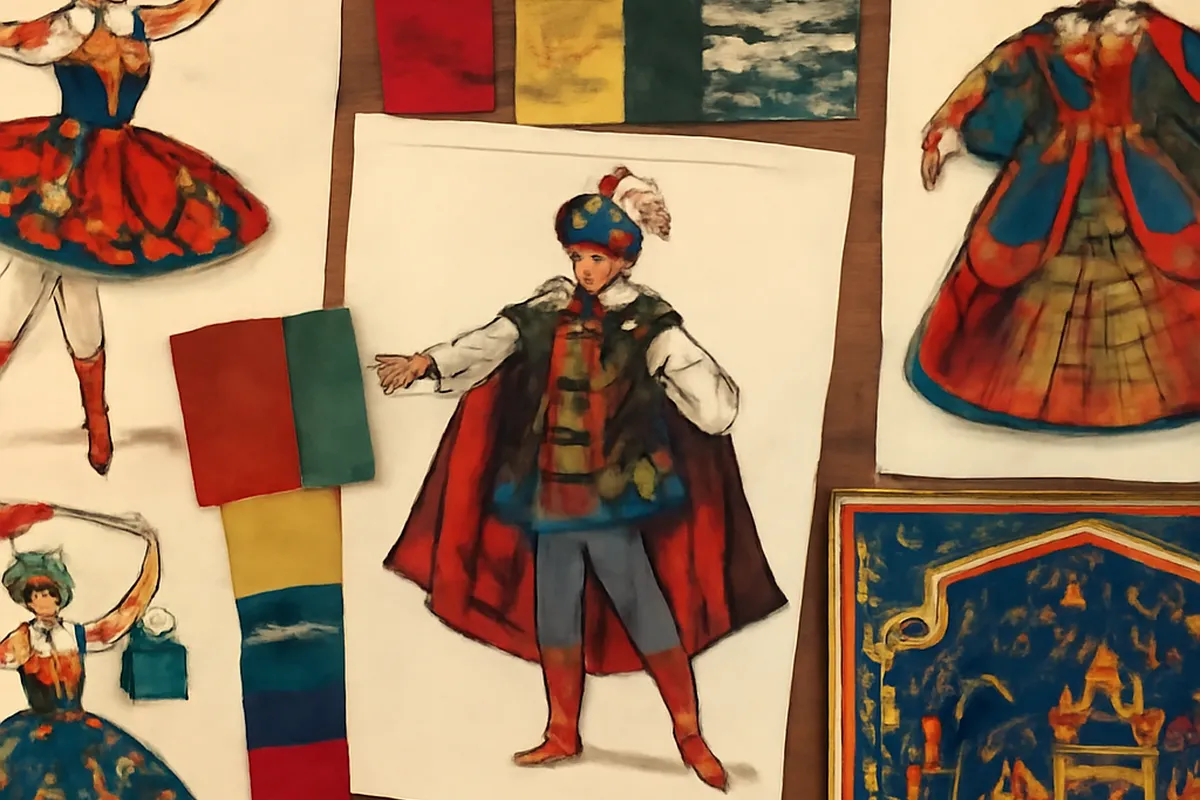
Bakst’s designs for Schéhérazade in 1910 popularised harem trousers and jewelled turbans among Parisian couturiers. Within two seasons, department stores in London advertised “Ballets Russes” evening wraps featuring the same emerald and scarlet palette. The 1913 production of Jeux introduced sportswear elements that influenced Chanel’s early collections. Russian visual arts traditions of bold patterning appeared in upholstery fabrics and wallpaper patterns sold across Europe after 1912. The company’s touring wardrobe, weighing several tonnes, required custom trunks that later became standard equipment for international dance troupes. Fashion magazines of the period documented how ordinary women adopted the loose silhouettes first seen on Ballets Russes stages, accelerating the shift from corseted Edwardian dress to the tubular lines of the 1920s.
Bakst’s 1910 colour palette directly inspired the 1912 winter collection of the Maison Paquin, which sold 1,200 “Schéhérazade” coats in the first month. London’s Selfridges department store devoted an entire window display to Ballets Russes-inspired garments in October 1911, generating 4,800 pounds in sales over ten days. The 1913 Jeux costumes, featuring knitted wool and canvas sneakers, prefigured Chanel’s 1916 jersey sportswear line by three years. Textile manufacturers in Lyon replicated the Roerich earth tones from The Rite of Spring on 18,000 metres of furnishing fabric between 1914 and 1916, with surviving sample books still held at the Musée des Tissus. These commercial adaptations demonstrate how the company’s visual vocabulary migrated from stage to domestic interiors within a single decade.
The Dissolution and Legacy After 1929
After Diaghilev’s death the company’s assets were auctioned in Paris to settle debts exceeding 200,000 francs. Former dancers and choreographers dispersed to form new troupes, including the Ballet Russe de Monte Carlo established in 1931. The original sets and costumes were scattered among museums and private collections; several Bakst backdrops now hang in the Musée d’Orsay. Archival research conducted in the 1990s located over 3,000 costume sketches previously thought lost. The company’s influence persisted through teachers who carried its rehearsal methods into Western schools, where daily class still includes sequences derived from Nijinsky’s 1912 exercises. Collective rehearsal and strict hierarchy reappeared in companies that absorbed Ballets Russes alumni during the 1930s.
The 1929 auction catalogue lists 1,478 individual lots, including 92 complete costumes and 14 full backdrops, with the highest single price of 18,000 francs paid for a Bakst design for The Firebird. The Ballet Russe de Monte Carlo, founded by René Blum and Colonel W. de Basil, inherited 47 dancers from the original company and opened its first season with 112 performances across six European cities. By 1935 the new ensemble had revived 19 Diaghilev-era works, preserving choreography through oral transmission and the few surviving stenographic scores. Museum acquisitions continued into the late twentieth century; the Victoria and Albert Museum purchased a complete set of 1911 Firebird costumes in 1989 for £240,000, while the Metropolitan Museum of Art acquired 64 Bakst drawings in 1995. These dispersals ensured that the material legacy of the Ballets Russes remained accessible for scholarly reconstruction.
The Ballets Russes in Contemporary Companies
Major ensembles today regularly revive works first seen under Diaghilev. The Mariinsky Ballet reconstructed The Rite of Spring in 2013 using original notation and period instruments, performing it 42 times across three continents. The Paris Opera Ballet maintains a dedicated archive of Ballets Russes designs that students consult for contemporary productions. Festivals in London and New York programme mixed bills that juxtapose Stravinsky scores with new choreography, echoing Diaghilev’s practice of pairing established music with emerging talent. The Russian-French glossary of theatrical terms remains useful for translators working on surviving libretti. Meanwhile, events listed on Russian folk art and culture events continue to showcase the decorative motifs that once travelled with the company’s touring trunks. Recent scholarship has quantified the economic impact: between 1909 and 1929 the Ballets Russes generated an estimated 12 million francs in direct tourism revenue for host cities. Today’s companies replicate that model through co-productions that share set-construction costs across multiple venues.
The 2013 Mariinsky reconstruction involved 11 months of archival study and employed 14 period instruments, including two 1913-vintage contrabassoons lent by the Saint Petersburg Philharmonic. The Paris Opera Ballet archive contains 2,347 original design documents, digitised in 2018 and consulted 1,892 times by researchers in the following five years. The Russian Orthodox holidays calendar occasionally aligns with festival programming, as seen when the 2016 London Diaghilev centenary coincided with Easter celebrations that featured Russian choral music alongside ballet excerpts. Co-production budgets for recent Rite of Spring revivals average 1.2 million euros, shared among four to six partner companies, reducing individual venue costs by 40 percent while maintaining the international touring pattern established a century earlier.
Frequently Asked Questions
A Russian impresario (1872-1929), founder of the Ballets Russes in 1909 in Paris, he revolutionized dance by bringing together avant-garde choreographers, composers, and painters.
Stravinsky's The Rite of Spring (1913), Scheherazade, The Firebird, and Petrushka rank among the company's most revolutionary creations.
Nijinsky, Stravinsky, Picasso, Matisse, Cocteau, and Coco Chanel all collaborated with the Ballets Russes, making the company a melting pot of European avant-garde.
Its dissonant music and Nijinsky's primitivist choreography provoked a memorable uproar at the 1913 Paris premiere, marking the history of modern music.
The original company dissolved after Diaghilev's death in 1929, but its legacy endures in contemporary Western ballet companies.