Why Learn Russian in 2026? The Case for English Speakers
Russian is not a fashionable language choice in 2026. Spanish, Mandarin, and even Japanese attract more learners in the English-speaking world. And yet, for those with the right motivations and temperament, Russian remains one of the most rewarding language investments available.
Start with the numbers: Russian is spoken by approximately 170 million people as a first language and serves as a second language or lingua franca for an additional 100+ million people across the former Soviet space — from the Baltic states to Central Asia, from Belarus to parts of eastern Ukraine. It is the third most widely used language on the internet and the dominant language of an enormous body of literature, music, philosophy, and scientific writing.
The strategic case is real. Russia’s cultural output — the literary tradition that produced Tolstoy, Dostoevsky, and Chekhov; the musical heritage of Tchaikovsky, Prokofiev, and Shostakovich; the mathematical and scientific tradition — is accessible in its full depth only in Russian. Translation captures perhaps 70% of the experience. The remaining 30% lives in the particular musicality of the language, the wordplay, the cultural references embedded in every sentence.
For the Russian Language learner, there is also the practical dimension: Russian-speaking communities exist throughout Western Europe, North America, and Australia, with significant populations in Germany, Israel, the US, Canada, and Belgium. The language opens personal relationships, professional doors (particularly in energy, space, and mathematics-adjacent fields), and access to a cultural world that remains genuinely alien and fascinating to most English speakers.
One honest caveat: Russian is classified by the US Foreign Service Institute as a Category IV language — the hardest tier for English speakers, requiring approximately 1,100 classroom hours to reach professional working proficiency. This is not a weekend project. But conversational ability is achievable much faster, and the learning process itself is genuinely interesting for people who enjoy linguistic puzzles.
Did you know? The FSI’s four-category system ranks Russian alongside Amharic, Hebrew, Thai, and Vietnamese in terms of difficulty for English speakers — well above Category I languages like Spanish or French, which require roughly 600-750 hours for the same level of proficiency.
Learning the Cyrillic Alphabet in Two Hours
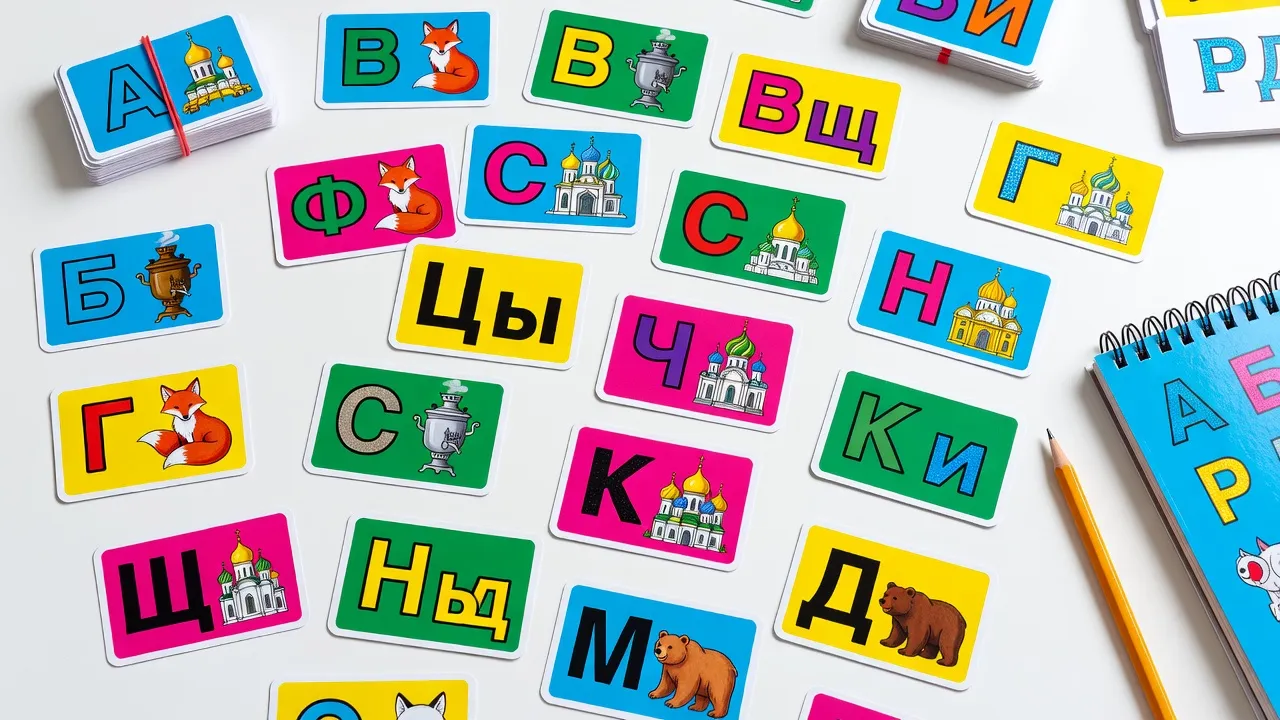
The first thing most English speakers worry about — and the least thing they actually need to worry about — is the Cyrillic alphabet. It looks intimidating on first encounter but is genuinely learnable in a single focused session of 2-4 hours. Here is how to do it efficiently.
The 33 letters of the Russian Cyrillic alphabet divide cleanly into three groups, summarized in the table below:
| Group | Description | Example letters | Study time |
|---|---|---|---|
| Group 1 — Friends | Look like Latin, sound like Latin | А (a), Е (ye), К (k), М (m), О (o), Т (t) | ~20 minutes |
| Group 2 — False Friends | Look like Latin, sound different | В (v), Н (n), Р (r), С (s), Х (kh), У (u) | ~40-60 minutes |
| Group 3 — New Letters | Entirely new shapes, no Latin equivalent | Б, Г, Д, З, И, Л, П, Ф, Ш, Щ, Ю, Я | ~60-120 minutes |
Group 1 — Friends (look like Latin, sound like Latin): А (a), Е (ye), К (k), М (m), О (o), Т (t). You already know these. Six letters down immediately.
Group 2 — False Friends (look like Latin, sound different): В (v, not B), Н (n, not H), Р (r, not P), С (s, not C), Х (kh, not X), У (u, not Y), В (v). These are the trickiest to internalize because the visual shape misleads you. The classic memory trick: imagine a Russian street sign using these letters. What looks like “PECTOPAH” to an English eye is actually pronounced “restoran” — restaurant. Training yourself to see these correctly takes about an hour of practice.
Group 3 — New Letters: The remaining 13-17 letters (depending on how you count the borderline cases) are entirely new shapes with no Latin equivalent. But they each have a single consistent sound, unlike the messy sound-spelling relationship of English. Б (b), Г (g), Д (d), З (z), И (i), Л (l), П (p), Ф (f), Ш (sh), Щ (shch), Ю (yu), Я (ya) — these can be learned with simple mnemonics and 1-2 hours of practice.
The two special letters: Ъ (the hard sign, very rare in modern Russian) and Ь (the soft sign, extremely common — it tells you to “palatalize” the preceding consonant). The soft sign is not a sound but a modifier.
The two-hour method: Take a sheet of paper. Write each Cyrillic letter, its transliteration, and an example word containing it. Divide into the three groups above. Spend 20 minutes on Group 1 (easy), 40 minutes on Group 2 (false friends), and 60 minutes on Group 3 (new letters). Test yourself by reading simple words: кот (cat), дом (house), мама (mama), привет (hi). By the end of two hours, you should be able to sound out simple Russian words slowly. Speed comes within a week of practice.
A critical recommendation: do not use transliteration. Never write Russian in Latin letters, even temporarily. Transliteration creates deeply embedded wrong habits that are very difficult to unlearn and produces systematically incorrect pronunciation. Invest the two hours in Cyrillic from day one. It is the single best investment in the Russian learning process.
Tip: If you catch yourself writing a Russian word in Latin letters “just to remember it,” stop and write it in Cyrillic instead, even slowly. The habit compounds: every transliterated shortcut now is a mispronunciation to unlearn later.
The Best Methods and Resources for English Speakers
The Russian language learning market is large, and the quality varies enormously. Here are the resources and methods that actually work for English-speaking adults.
Anki (spaced repetition flashcard software) is the foundation of any effective vocabulary learning program. Russian has a core vocabulary of about 3,000-5,000 words that covers 95%+ of everyday speech. Anki’s spaced repetition algorithm ensures you review words at precisely the intervals that maximize long-term retention. Pre-built Russian decks are available free on AnkiWeb. 20-30 minutes of Anki daily, maintained consistently for six months, will give you a solid foundation. The key is consistency: Anki done imperfectly every day beats Anki done perfectly twice a week.
Assimil’s “Russian with Ease” is the gold standard text course for European language learners (the English edition is available). The method involves daily lessons of 20-30 minutes, combining reading, audio, and graduated exercises. It is slower than digital apps but builds more durable grammatical intuition. Most people who complete the Assimil course reach a solid B1 level.
Duolingo and Babbel are useful for absolute beginners as an introduction to the script and basic vocabulary, but both plateau early. Duolingo’s Russian course is good for the first 2-3 months; beyond that, it does not build the grammatical depth needed for real communication. Use these tools as a starting point, not a destination.
Italki and Preply offer conversation sessions with native Russian tutors at rates ranging from $10 to $40 per hour. These are invaluable from the intermediate level onward (typically after 3-4 months of study). Speaking with a native speaker — even imperfectly — develops the ear and the production muscles that no app can replace. Start with tutors who specialize in teaching beginners; the experience difference is significant.
Russian Made Easy (podcast series) is specifically designed for English speakers and addresses the peculiarities of Russian that are most confusing for native English speakers: the case system, verb aspects, and pronunciation. It is excellent as a supplement to text-based study from the very beginning. For intermediate learners, “Coffee Break Russian” and “Slow Russian” are podcasts that build listening comprehension at a manageable speed.
For a comprehensive overview of linguistic resources and the history of the language, The Russian Language provides broader context. The site langue-russe.fr is an excellent French-language resource that is also useful for English speakers accessing grammatical explanations with extensive example sentences.
The resources discussed above serve different purposes at different stages of learning, as summarized here:
| Resource | Best for | Stage | Format |
|---|---|---|---|
| Anki | Vocabulary retention | All stages | Spaced-repetition app |
| Assimil “Russian with Ease” | Grammatical intuition | Beginner to B1 | Text course with audio |
| Duolingo / Babbel | Script and basic vocabulary | Absolute beginner | Mobile app |
| Italki / Preply | Speaking practice with natives | Intermediate onward | Video conversation |
| Russian Made Easy podcast | Case system, aspects, pronunciation | Beginner to intermediate | Audio podcast |
| Coffee Break Russian / Slow Russian | Listening comprehension | Intermediate | Audio podcast |
YouTube channels: “Russian Made Easy,” “Learn Russian with Alfia,” and “RussianPod101” (for beginners) provide video instruction that addresses visual learners. For intermediate-advanced students, watching Russian films and television with Russian subtitles (not translated subtitles) is among the most effective listening comprehension tools available.
The 5 Grammar Shocks: What No One Tells English Speakers
Russian grammar is genuinely challenging for native English speakers, and understanding in advance what the major challenges are helps manage expectations and focus study appropriately.
Shock 1 — Six grammatical cases: English has largely lost its case system, retaining only a few vestiges (I/me/my, who/whom). Russian uses six cases that systematically change the endings of nouns, adjectives, pronouns, and some numerals depending on their grammatical function. The nominative (subject), accusative (direct object), genitive (possession, “of”), dative (indirect object, “to/for”), instrumental (with/by means of), and prepositional (location, used with certain prepositions) cases each have multiple sets of endings depending on the noun’s gender and declension class.
This sounds overwhelming, and initially it is. The practical approach: learn the patterns for the most common nouns first, accept that you will make case errors for months or years, and prioritize communication over perfection. Native speakers are very tolerant of case errors in foreign speakers; the meaning is usually clear even when the ending is wrong.
Shock 2 — Verbal aspects (perfective and imperfective): English distinguishes past, present, and future tense. Russian adds an additional distinction: every verb has two “aspects” that indicate whether an action is completed (perfective) or ongoing/habitual (imperfective). “I was writing” uses the imperfective; “I wrote (and finished)” uses the perfective. This distinction is not optional and must be incorporated from early in your learning.
The good news: each verb pair must simply be learned as a pair. The bad news: there is no simple rule for which prefix or suffix transforms an imperfective into a perfective. This requires memorization and exposure.
Shock 3 — Three grammatical genders with adjective agreement: Russian nouns are masculine, feminine, or neuter, and all adjectives, pronouns, and short-form adjectives must agree in gender, number, and case. The gender of a noun is largely predictable from its ending (masculine nouns usually end in a consonant, feminine in -а/-я, neuter in -о/-е), but there are significant exceptions.
Shock 4 — Free word order (with meaning consequences): Russian word order is far more flexible than English. The same semantic content can be arranged in multiple orders, each with a different pragmatic or emphatic focus. “Я люблю тебя,” “Тебя я люблю,” and “Люблю тебя я” all mean “I love you,” but with different emphasis. This flexibility is liberating once understood but initially confusing.
Shock 5 — Vowel reduction: Russian unstressed vowels sound different from stressed ones. The letter О when unstressed sounds like А (schwa). The letter Е when unstressed sounds like И. This vowel reduction is automatic and cannot be omitted without sounding strangely formal. Learning where stress falls in Russian words — which is not rule-governed and must be learned word by word — is one of the most time-consuming aspects of Russian pronunciation.
A 45-Minute Daily Practice Routine That Works

The most common reason adult learners of Russian fail to progress is inconsistency rather than difficulty. A 45-minute daily practice session, maintained for six months, will bring most dedicated learners to a conversational B1 level. Here is a routine that balances the different skills:
Minutes 1-15: Anki vocabulary review. Open your Anki deck and work through whatever cards are due for review that day. Do not skip. Do not do more than what is due (this leads to future backlogs that create discouragement). Trust the algorithm.
Minutes 15-30: Grammar and text input. Work through your current lesson in Assimil, or study a specific grammar point (one case, one verb conjugation pattern, one aspect pair group) with examples. Write sentences using the new material. The act of writing by hand encodes the Cyrillic letters more effectively than typing.
Minutes 30-45: Listening. Listen to a Russian Made Easy episode, a slow-speed podcast, or (for intermediate learners) an episode of a Russian television program at normal speed. Do not watch with English subtitles. If you need subtitles, use Russian ones.
Weekly additions:
- One Italki conversation session per week, starting from month 3 onward.
- One Russian film per week, subtitled in Russian rather than English.
- Periodic reading of graded Russian texts to reinforce vocabulary in context.
Important: Consistency beats intensity. A 45-minute session done daily for six months outperforms sporadic multi-hour sessions, because spaced repetition and daily exposure are what actually consolidate vocabulary and pronunciation in long-term memory.
The connection to cultural understanding deepens as language ability grows. The untranslatable words explored in the Russian-English Glossary: 40 Essential Words — dusha, toska, mir, avos — become genuinely meaningful, not just intellectually understood, once you can encounter them in authentic Russian text. The sense of the Russian Soul that operates beneath so much Russian behavior and art becomes clearer when you begin to hear the language rather than just hearing about it.
The TORFL (Test of Russian as a Foreign Language) provides an internationally recognized benchmark for measuring progress, with levels from A1 (beginner) to C2 (near-native). Most learners aiming for practical language use target the B1 or B2 levels. Taking a practice TORFL test after six months of serious study is a useful calibration exercise.
Finally: be patient with yourself, and be persistent. Russian will not yield quickly. But the language contains worlds — in its literature, its music, its folk tradition, its scientific writing — that are genuinely inaccessible without it. Every hour of study opens a door that could not be opened otherwise. That is not a small thing.
Frequently Asked Questions
The US Foreign Service Institute classifies Russian as a Category IV language (the most difficult tier for English speakers), requiring approximately 1,100 classroom hours to reach professional working proficiency. However, conversational ability — enough to navigate daily life and have basic discussions — is achievable in 6-12 months of dedicated study. Reading can come faster; speaking takes longer.
No — the Cyrillic alphabet is genuinely learnable in 2-4 hours, often in a single focused session. Of the 33 letters, about 10 look and sound like their Latin equivalents (A, E, K, M, O, T), about 10 look like Latin letters but have different sounds (B, H, P, C, X, Y), and the remaining 13 are completely new. The third group takes slightly longer but is not difficult.
The six grammatical cases, the aspectual system (perfective vs. imperfective verbs), the three genders with their adjective agreement, free word order, and vowel reduction in unstressed syllables. Of these, the case system and the verbal aspects are the most significant challenges for English speakers, as English has neither.
Anki for vocabulary memorization is essential and highly effective. Duolingo is useful for beginners but becomes shallow at intermediate levels. Italki or Preply for conversation with native speakers is invaluable from intermediate level onward. The 'Russian Made Easy' podcast series and 'Coffee Break Russian' are excellent audio resources. For reading, graded readers (adapted Russian texts) build skills more efficiently than native texts initially.
Always learn Cyrillic first, before anything else. Transliteration (using Latin letters to represent Russian sounds) creates habits that are very difficult to unlearn and produces incorrect pronunciation. The Cyrillic alphabet takes 2-4 hours to learn and unlocks the entire written Russian world immediately. It is the single best investment of time in the Russian learning process.