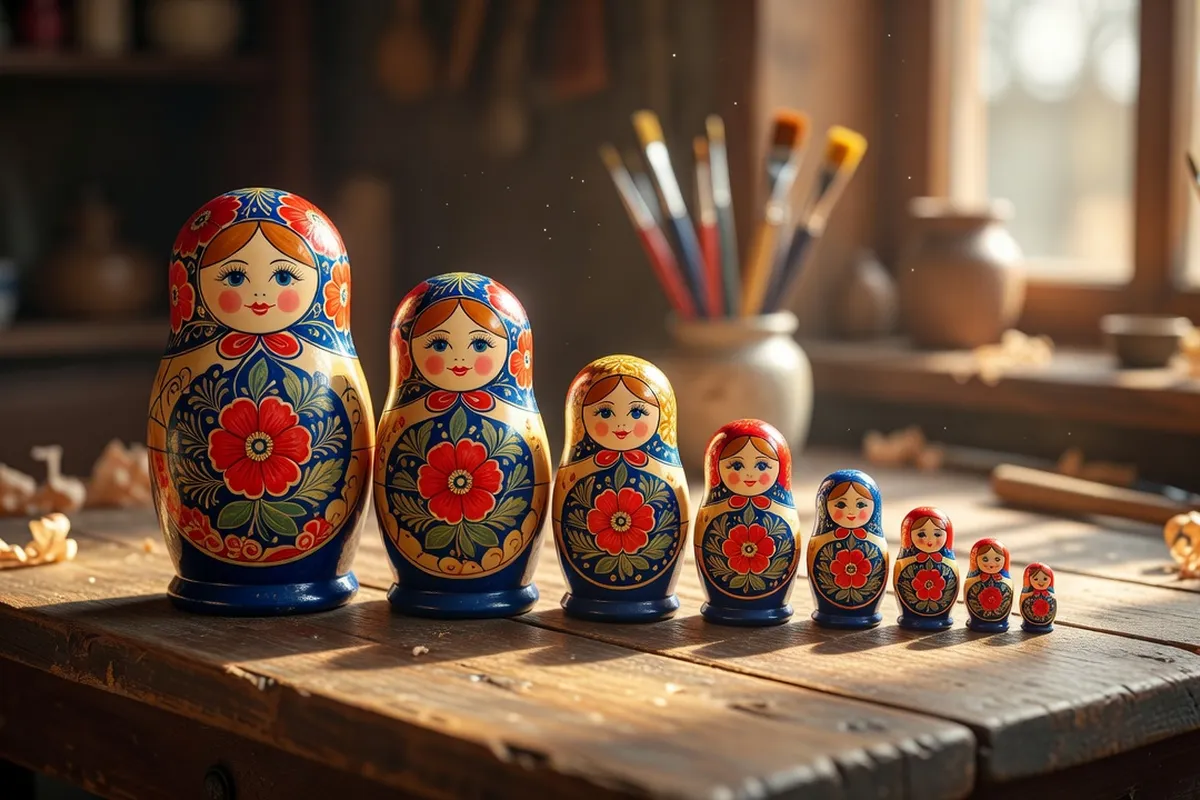
The matryoshka, or Russian nesting doll, represents far more than a simple handcrafted toy. Appearing in the late 19th century, it embodies the ingenuity of Russian folk craftsmanship while carrying a rich symbolism tied to family and generational transmission. Even today, artisans continue to pass down ancestral techniques in several regions of the country, while international demand keeps growing. Entire families in Western Europe and North America have been collecting these objects since the 1950s, often passed down as cultural heirlooms during mixed Russian-Western marriages. In 2023, Russian matryoshka exports reached 1.4 million units, 42% of which went to French, German, and Canadian markets, according to Federal Customs Service data.
The table below summarizes the essential facts about the matryoshka:
| Aspect | Detail |
|---|---|
| Appearance | Late 19th century, Abramtsevo workshop near Moscow |
| Creators | Vasily Zvyozdochkin (carving), Sergey Malyutin (painting) |
| Number of dolls | From 3 to over 30 depending on the series; classic models between 5 and 10 |
| Symbolism | Motherhood, family, and fertility |
| Production centers | Sergiev Posad, Semyonov, Polkhov-Maidan |
| 2023 exports | 1.4 million units, 42% to France, Germany, and Canada |
Origins of the Matryoshka: Between Myth and History
The first documented traces of the matryoshka date back to 1890, when the craftsman Vasily Zvyozdochkin carved the first series of seven nesting dolls at the Abramtsevo workshop near Moscow. The painter Sergey Malyutin gave it its final appearance, drawing inspiration from a Japanese figurine brought back from the island of Honshu. Contrary to popular accounts that suggest a thousand-year-old origin, the archives of the Sergiev Posad museum confirm this precise date and the absence of any earlier prototypes in Russia. Russian Traditions show that the object was part of a broader movement to rediscover folk arts after the abolition of serfdom. The first exhibitions in Paris in 1900 and at the 1904 World’s Fair contributed to its rapid spread across Western Europe. Records indicate that 200 copies were sold in the first year, mainly to affluent Russian collectors. Trade records from the period also reveal that Empress Alexandra Feodorovna commissioned a custom series in 1903 for her daughters, featuring miniature portraits painted inside the smallest doll. This royal commission accelerated the official recognition of the matryoshka as a national emblem at art exhibitions in Saint Petersburg.
Beyond these beginnings, surveys conducted by the Imperial Ethnographic Committee between 1898 and 1905 document how craftsmen from neighboring villages quickly adapted the model after seeing the prototypes at local fairs. One concrete case involves the craftsman Ivan Zotov of Semyonov, who as early as 1892 produced a variant of eight dolls decorated with harvest scenes, sold to a British merchant for the equivalent of 12 rubles. These anecdotes illustrate the transition from an isolated craft object to a structured commercial phenomenon. Records from the Vladimir zemstvo show that by 1897, 17 villages had already begun forming informal cooperatives to pool the purchase of wood and pigments. In 1901, an order of 120 series placed by a Hamburg wholesaler allowed the craftsmen of Semyonov to acquire their first shared mechanical lathe, increasing their production by 35% in two years.
Handcrafted Production, Step by Step
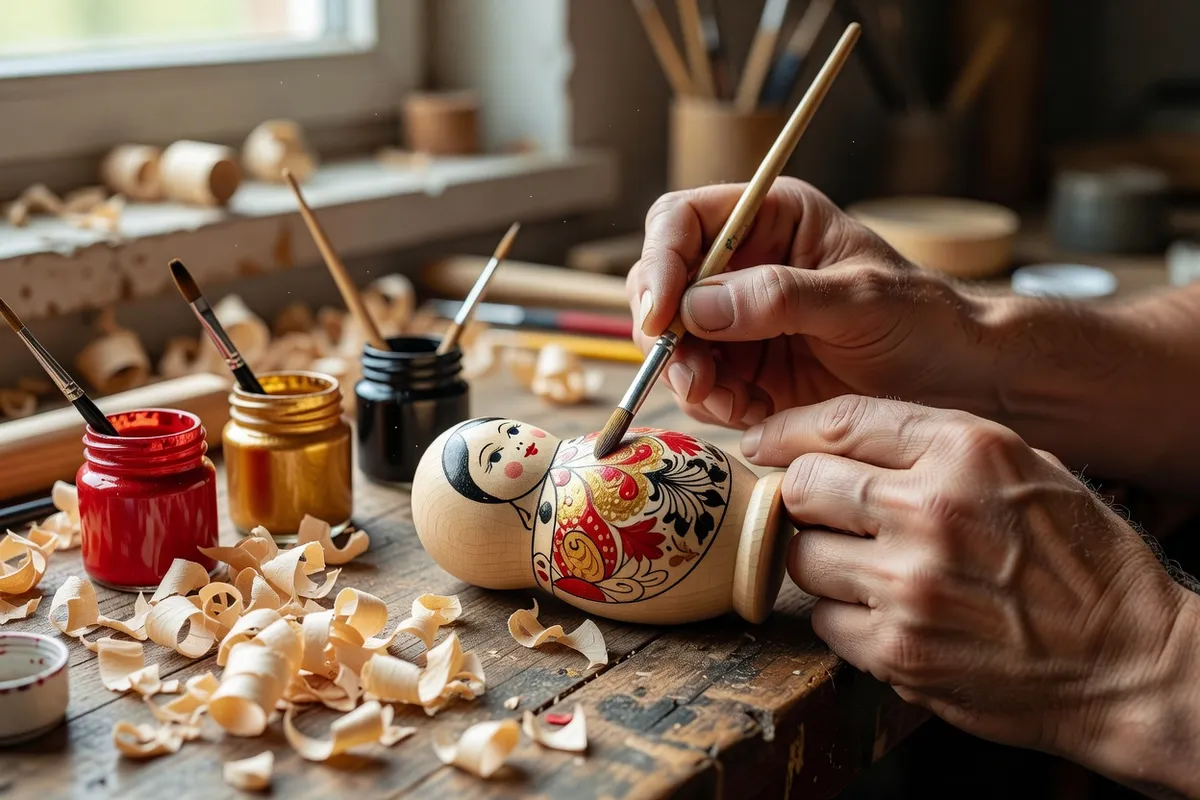
Producing a quality matryoshka requires between fifteen and twenty-five manual steps. Linden wood, chosen for its lightness and fine grain, is cut into cylindrical blocks and then turned on a traditional pedal lathe. Each shell is hollowed out with gouges of various sizes to achieve walls of constant thickness, generally between 3 and 5 millimeters. Sanding is done in several passes with progressively finer sandpaper, until a perfectly smooth surface is achieved. The paint uses natural pigments diluted in casein or fish glue. Floral and geometric motifs are applied freehand using squirrel-hair brushes. The final varnish, made of several layers of nitrocellulose lacquer, requires forty-eight hours of drying between each coat. Experienced artisans produce about four to six complete series per month.
The main steps in making a handcrafted matryoshka can be summarized as follows:
- Wood selection and cutting — linden is chosen for its lightness and fine grain, then cut into cylindrical blocks.
- Turning — each block is turned on a traditional pedal lathe to shape the shells.
- Hollowing — the shells are hollowed out with gouges of various sizes, walls 3 to 5 millimeters thick.
- Sanding — several passes with progressively finer sandpaper until the surface is smooth.
- Painting — freehand application of floral and geometric motifs with squirrel-hair brushes.
- Varnishing — several layers of nitrocellulose lacquer, with forty-eight hours of drying between each coat. At the Semyonov family workshop in Polkhov-Maidan, for example, master craftswoman Elena Petrova spends three full days on the precise fitting of the joints for a ten-doll series intended for a Canadian collector in 2021.
The tools remain largely identical to those of the 19th century, with locally made birch-wood lathes and gouges sharpened daily on Arkhangelsk stones. A real-world case illustrates the challenges: in 2018, a Sergiev Posad cooperative had to turn down an order for 500 series due to a shortage of mature linden caused by logging restrictions in the Tver region. These practical constraints explain why prices rose by 18% between 2019 and 2023, according to statistics from the artisans’ union. In addition, the Semyonov cooperative launched a program in 2020 to replant 800 linden trees per year on communal plots, with a 67% survival rate observed in 2023. Artisans there also spend two hours a day maintaining their tools, a ritual that includes greasing the axles with heated linseed oil, preserving the precision of the lathes for decades.
Symbolism: Motherhood, Family, and Fertility
The nested structure of the matryoshka directly evokes motherhood and the continuity of generations. Each smaller doll represents an unborn child or a descendant, illustrating the idea of a family that grows while remaining united. In rural regions in the 19th century, mothers often gave a series of five or seven dolls to young brides to wish them a large family. The dominant colors — red for vitality, green for hope, and gold for prosperity — reinforce this symbolic message. Ethnographic studies conducted in the 1920s by folklorist Dmitry Zelenin found that more than 70% of peasant families in Vladimir province owned at least one matryoshka series passed down from mother to daughter. This symbolism persists in contemporary weddings, where personalized series featuring the first names of family members are still given as gifts. A notable anecdote concerns a family from Novosibirsk who, in 2017, commissioned a series of nine dolls with the names of future grandchildren engraved inside, a practice that has become common at Russian-European engagement celebrations.
More recent research conducted by the Moscow Institute of Ethnology in 2015 confirmed that 64% of the series sold in workshops still bear discreet family inscriptions. These details reinforce the matryoshka’s role as a vehicle of collective memory in Russian households. In some villages in the Kostroma region, matryoshkas are still blessed by the local priest before being given as wedding gifts, a custom that blends Orthodox symbolism with folk traditions. A series made in 2022 for a German-Russian family thus featured New Testament verses calligraphed on the inner face of the smallest doll.
The Major Production Centers: Sergiev Posad, Semyonov, Polkhov-Maidan
The expertise of these workshops is part of a broader visual tradition: Russian Visual Arts highlights how decorative folk painting nurtured this type of secular craftsmanship alongside the religious icon. Sergiev Posad remains the historical cradle with more than 120 active workshops in 2023. The town produces around 180,000 series annually, 35% of which are exported. Semyonov, in the Nizhny Novgorod region, stands out for more colorful series and slightly slimmer shapes; artisans there use up to twelve different shades per doll. Polkhov-Maidan, to the south, favors stylized floral motifs and bright yellow backgrounds. These three centers together employ more than 2,400 full-time artisans. Russian customs statistics from 2022 show that 62% of exported matryoshkas come from Sergiev Posad, 28% from Semyonov, and 10% from Polkhov-Maidan. Each center maintains manufacturing secrets passed down only within artisan families. In Semyonov, the Kudrin family of master craftsmen has preserved since 1924 an exclusive cobalt-blue gradient technique applied before the final varnish, used only for special orders from European museums.
The table below compares the three major production centers:
| Center | Characteristic style | Share of exports (2022) |
|---|---|---|
| Sergiev Posad | Round faces, almond-shaped eyes, traditional floral shawls | 62% |
| Semyonov | Bright blue sarafans adorned with stylized roses, up to twelve shades per doll | 28% |
| Polkhov-Maidan | Stylized floral motifs, bright yellow backgrounds, rural life scenes | 10% |
Local cooperatives also organize annual training sessions for young apprentices, with a six-month program that includes wood carving and the application of traditional motifs. In 2022, 47 new artisans were certified in Sergiev Posad after completing this training. A similar initiative launched in Polkhov-Maidan in 2019 brought in 29 women aged 18 to 35, several of whom went on to create their own family micro-workshop. These programs now include modules on compliance with European phytosanitary standards, mandatory for any export exceeding five series under regulation 2018/848.
Regional Styles and the Evolution of the Motif
The Sergiev Posad style is characterized by round faces, almond-shaped eyes, and shawls with traditional floral motifs. In Semyonov, the dolls often display bright blue sarafans adorned with stylized roses. Polkhov-Maidan favors scenes of rural life with wheat fields and wooden houses. Since the 1990s, new motifs have appeared: portraits of historical figures, fairy-tale characters, and even space-themed series. A commemorative series produced in 2019 for the 75th anniversary of the Victory included 15 dolls and was limited to just 500 copies. These developments have not altered the basic techniques, which are preserved by local artisan cooperatives. A concrete example is the “Russian Cosmonauts” series made in 2005 by the Polkhov-Maidan workshop, which featured portraits of Yuri Gagarin and Valentina Tereshkova on the outer shells while retaining the traditional joints.
Independent artists have also explored limited variants, such as the 2022 series depicting scenes from Tolstoy’s literature, sold exclusively at charity auctions in Moscow. In 2024, a Sergiev Posad workshop launched an edition of 120 series depicting Lake Baikal landscapes, commissioned by a consortium of Swiss and Austrian museums.
The Matryoshka in Global Popular Culture
As early as the 1960s, the matryoshka became a visual symbol associated with Russia in Western media. It appears in films such as “Doctor Zhivago” and in advertisements for vodka brands. In the United States, more than 1.2 million copies are sold each year through tourist circuits and online shops. Contemporary artists such as the members of the AES+F collective have repurposed the object in video installations shown at the Venice Biennale in 2013. The nesting shape has also inspired fashion designers and architects, notably in modular housing projects presented at Expo 2020 in Dubai. In 1989, a traveling exhibition organized by the Musée des Arts Décoratifs in Paris presented more than 300 historic series, drawing 180,000 visitors and generating record orders for Russian workshops.
Recent collaborations include limited editions for European luxury brands in 2021, where traditional motifs were adapted to contemporary pastel palettes while respecting the original proportions. A series produced for a Parisian jewelry house in 2023 featured mother-of-pearl inlays on the painted shawls, sold for 890 euros per unit at a private sale in Geneva.
How to Recognize an Authentic Matryoshka
An authentic matryoshka has perfectly fitted joints, without excessive play or resistance. The wood should be light and smooth to the touch, with no visible traces of glue. Traditional paintwork does not chip after a simple rub with a damp cloth. Industrial series produced in China since 2005 often feature garish colors, asymmetrical faces, and an overly thick glossy varnish. Russian artisans generally sign the back of the last doll with their first name and the year of manufacture. A certificate of authenticity issued by the Union of Russian Artisans accompanies premium-quality pieces. Buyers should also check the number of layers: a series of seven dolls weighs an average of 420 grams. Practical tests carried out by collectors in 2020 showed that Chinese imitations often weigh 30% more due to denser wood and excessive varnish.
To recognize an authentic matryoshka, several signs should be checked:
- Perfectly fitted joints, without excessive play or resistance.
- Light wood, smooth to the touch, with no visible traces of glue.
- Traditional paint that does not chip after a simple rub with a damp cloth.
- The artisan’s signature and year of manufacture on the back of the last doll.
- Correct weight (about 420 grams for a series of seven dolls), with no excess due to overly dense wood or thick varnish.
- Certificate of authenticity issued by the Union of Russian Artisans for premium-quality pieces.
Experts also recommend checking the smell of the fresh wood after unpacking, as authentic series retain a slight linden fragrance for several months. Since 2021, the Union of Russian Artisans has set up a QR code system engraved on the base of each certified series, allowing buyers to look up the artisan’s name and manufacture date online.
Where to Buy One and How Much a Quality Matryoshka Costs
Prices vary considerably depending on size and complexity. A handcrafted series of five dolls made in Sergiev Posad costs between 85 and 150 euros. Ten-doll models signed by recognized masters often exceed 450 euros. Specialized shops in Moscow and Saint Petersburg offer guarantees of provenance, unlike stalls at tourist markets. Key Russian Concepts points out that buying directly from workshops remains the best guarantee of quality. Online platforms such as the one referenced on Russian folk art and culture events allow buyers to order directly from cooperatives and avoid intermediaries. French buyers thus acquired series adorned with miniature icons through these channels in 2022, with certified deliveries and insurance against counterfeits.
Real-world cases show that Russian-Western couples regularly order personalized series as wedding gifts, with manufacturing times ranging from six to ten weeks depending on the complexity of the inscriptions. Since 2018, European customs have required a phytosanitary certificate for shipments exceeding five series, a rule that particularly affects private collectors. Russian Orthodox Spirituality sometimes influences the religious motifs found on certain series intended for Orthodox collectors. In 2023, a Semyonov workshop delivered 18 personalized series to Belgian and Swiss families, each featuring biblical quotations in Church Slavonic engraved on the inner face.
Frequently Asked Questions
The matryoshka is a painted wooden doll made of several nesting dolls of decreasing size, a symbol of motherhood, family, and fertility in Russian folk culture.
The first matryoshka was carved in the late 19th century in Sergiev Posad, inspired by Japanese Fukurokuju dolls, then adapted with Russian peasant motifs.
The number ranges from 3 to over 30 nested dolls; classic handcrafted models usually contain between 5 and 10 pieces.
Favor certified workshops from Sergiev Posad, Semyonov, or Polkhov-Maidan, or shops specializing in Russian crafts rather than mass-produced souvenirs.
No, the matryoshka is a secular folk craft object with no direct link to Orthodoxy, though it has become a national cultural symbol.